frost on the nets at eight, green oil by midnight
Reserve the olive harvest and first milling in the Sierra de Segura, mid November to late December
Seven nights in the mountain villages of northeast Jaen, taken anywhere inside the six weeks of the picking campaign, from $4,846 per person on two sharing. Six of the days are spent under the trees with a gang bringing the fruit down, and one night is spent inside a cooperative mill while it works through until two in the morning. The Picual up here grows between 700 and 1,300 meters, so it colors late, comes off cold, and goes into the tank greener than anything picked on the plain.
Reserve a windowAn answer is written inside one business day by somebody at this end.
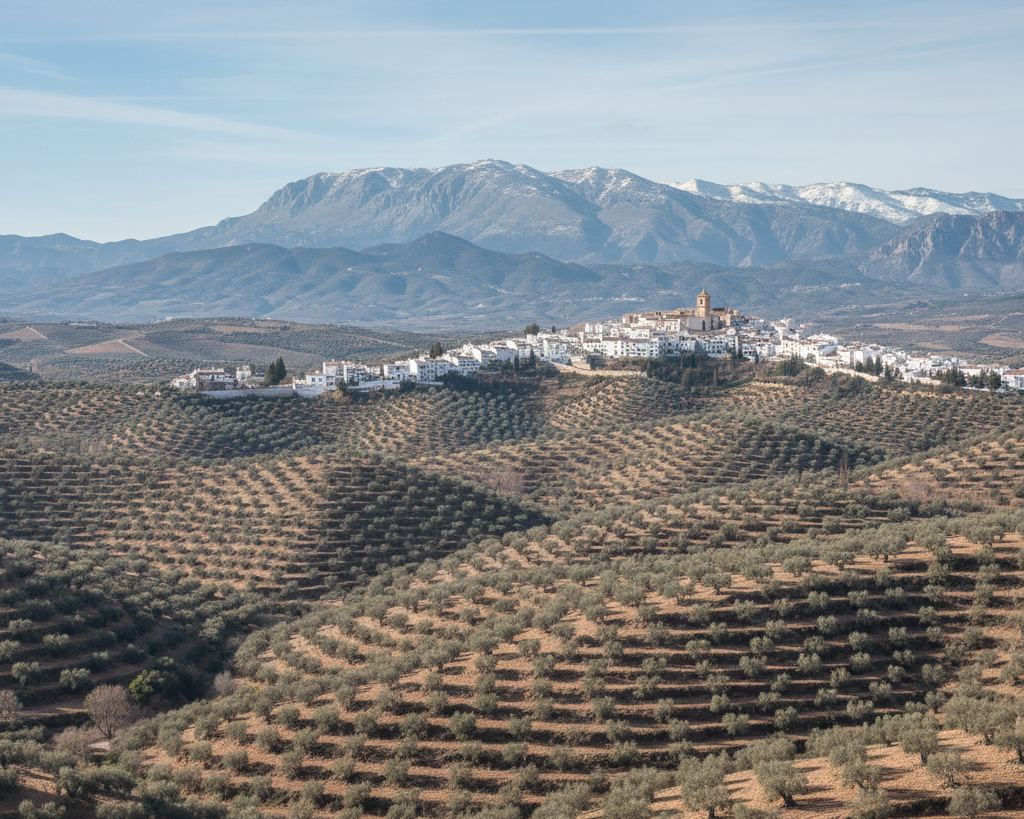
Picual comes off the trees in the Sierra de Segura between 700 and 1,300 meters, and that altitude sets the calendar for everything else on this page. Fruit on the terraces above Segura de la Sierra colors two or three weeks behind the same variety on the valley floor, so the plain can be in full campaign while the hill parcels are still being walked, squeezed between finger and thumb, and argued about in the bar. When the boards of the mountain cooperatives finally vote their mills into service, usually in the second week of November, the whole thing starts on one day and runs without a pause until the highest ground is clean.
That is the window, and it is six weeks long because the harvest is six weeks long. It is written as six weeks rather than as a date because nobody up there will commit to a date in advance.
Seven nights, based in two village houses at 1,120 meters, one with four rooms and one with three. You go out with a picking gang on six of the seven days. The vehicle leaves the square at 07:50, which in the third week of November is still dark, and the nets are down under the first tree by the time there is enough light to see what you are knocking.
Runs November 14 to December 22.
The window opens when the boards of the mountain cooperatives vote their mills into service, which happens once the fruit on the lower parcels has turned from green to the first purple, and it shuts when the ground above 1,100 meters has been stripped and the yards go quiet for Christmas.
The opening has moved by as much as twelve days either side of November 14 in the last ten years depending on how the autumn rain ran, so the rooms are held across the whole six weeks rather than against a fixed date, and the operator settles which gangs and which parcels about a week out.
Most of the daylight. The trip is programmed for the working daylight, from about 08:15 when the frost has come off the nets to the last trailer leaving the grove near 17:45 in November and 17:30 by the third week of December.
The dark at either end belongs to you, apart from the one night you are inside the mill from nine until roughly two in the morning, when the yard is at its fullest and the whole line is running.
7 nights, from $4,846 per person.
Fruit comes off these trees every year, but how much of it does is not settled: most terraces here alternate a heavy year with a light one, and a hard frost in December can stop picking on the high parcels for three or four days together. Nothing about the size of the crop or the weather in your particular week is underwritten by anyone, and if the gangs stand down you spend those days at the mill and on the terrace walls instead of on the nets.
- What this office books
- The office reserves the seven nights across two village houses, the vehicle and its driver for all seven days, the six days out with the picking gangs, the night inside the cooperative mill and the road transfer at both ends, and it reserves nothing to do with your flight, your lunches in the villages or any car you take for yourself.
- Who books it
- A person booking this wants to stand on a terrace at 1,000 meters while the fruit is knocked out of a tree, and then watch that same fruit come out of a decanter as oil before the night is over.
- Why somebody picks another window
- If you want the groves quiet, the ground warm and the light long enough to walk the terrace paths for pleasure, the flowering in the second half of May does all of that and there is not a net or a trailer anywhere in it.
- In the figure
- Seven nights across two village houses at 1,120 meters, one of four rooms and one of three, with three rooms held for this trip; breakfast at 07:15 in both houses, plus the eleven o'clock bread and oil at whichever bar is nearest the parcel; the vehicle and its driver for all seven days, seating nine; six days out with picking gangs on parcels between 700 and 1,300 meters, arranged through the families who farm them and their cooperative; one night inside the cooperative mill from 21:00 until the line eases, usually around 02:00; a tasting drawn from three deposits of the current campaign, straight off the tank rather than out of a bottle; one morning on the terraces with the man who rebuilds the dry stone walls, which is how the ground stays where it is; dinner at the houses on five of the seven evenings; the road transfer from Madrid in both directions, about three and three quarter hours each way with one stop; local taxes and the municipal charge; a paper sheet of parcel names, altitudes, road numbers and the hours the light is usable.
- Not in the figure
- Your own round trip flight from Orlando to Madrid, which you arrange yourself and which in this window has been running about $690 to $1,420; a night in Madrid at the front end if your arrival hour makes one sensible, $95 to $180; the two dinners not taken at the houses, $18 to $45 a head; lunch in the villages on the working days, $12 to $22; oil carried home from the mill store, $14 to $34 for a five liter tin; boots and work gloves if you do not bring your own, $40 to $110 in Beas de Segura; a hire car for the free afternoons, $48 to $85 a day with fuel near $6.40 a gallon equivalent; laundry at the house, $9 to $16 a load; single room supplement, $612 for the seven nights; anything bought at the cooperative store, $6 to $40.
- Who this window will not suit
- You are outdoors from a quarter past eight until the light goes on six of the seven days, in air that starts close to freezing and reaches 14 degrees at best, and there is no indoor version of this week. The ground under the trees is loose stone on dry stone terraces, the work involves lifting loaded sheets, and rain turns all of it to red mud that comes back into the van with you. One night runs to two in the morning inside a mill that is loud, hot in places, and smells of crushed stone and warm skins for the whole five hours. Anyone who wants a late breakfast, a pool, a warm afternoon and a week that asks nothing of the body should take a different window.
A starting figure for two people sharing one room. Pricing the exact window you pick runs two to four working days, because the company working those dates answers first. No air ticket is ever folded in.
A day under the trees
Frost is the first thing that happens each morning. Cold air drains off the ridges and settles in these valleys overnight, the nets come off the trailer stiff, and on most days nothing is beaten until about a quarter past eight, once the sun has been on the terrace long enough that the fruit is not brittle. Air temperature at that hour runs 1 to 4 degrees in the back half of November and sits below zero on the higher parcels in December. By two in the afternoon it is 12 to 16 in the sun and about 8 in the shade of the tree, and the shade of the tree is where you are.
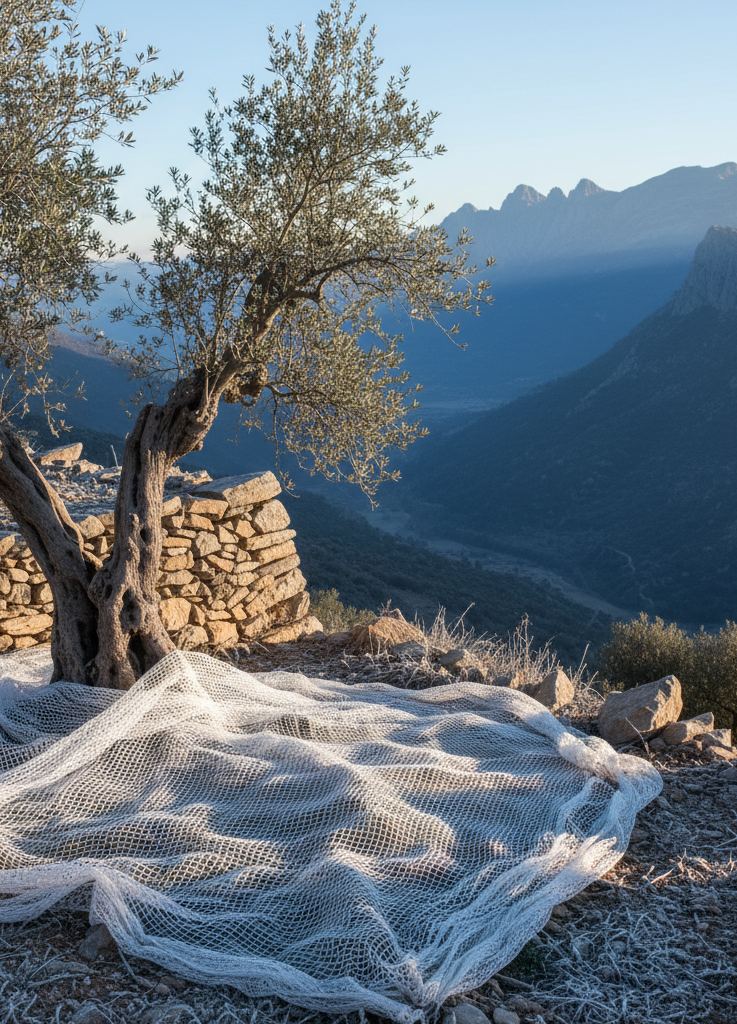
The work is nets and poles. Two people spread the mantones, the fabric sheets that go around the trunk and over the terrace edge, and the rest of the gang works the canopy from the outside in with fiberglass poles about three meters long. Where a terrace is wide enough and the slope is under something like 20 percent, a trunk shaker goes in instead, an umbrella frame that clamps the tree and vibrates for eight or ten seconds. Above the village most terraces are neither wide enough nor level enough for that machine to turn, which is why the pole is still the tool here. A tree carries 20 to 40 kilograms in a heavy year and half that on the alternate one, and every kilogram of it is lifted off the sheet by hand, tipped into the trailer, and driven down.
The break comes at eleven at whichever bar is nearest the parcel: bread, new oil, coffee, and a great deal of shouting. Then it goes on until the light goes. A pole is put in your hand on the first morning, though how much you use it is your own business. Wear boots with a hard sole. The terrace walls are dry stone, the ground under a tree is loose rubble, and after four hours you will know precisely which muscles a three meter pole works.
What happens at the mill
The trailer that leaves the grove at a quarter to six crosses the weighbridge before seven and is empty by nine, because a cooperative in campaign runs its mill through the night and every night. Fruit that sits is fruit that heats, and fruit that heats is worth less to the man who grew it. One night of your seven is spent in there from about nine until two in the morning, which is when the yard is at its fullest and every stage of the line is working at once.
What you watch is not picturesque. The fruit goes up a hopper, through a blower that lifts the leaf off it and a wash that takes the dust of the terrace, then into a hammer mill that reduces the whole olive, stone included, to a gray paste. That paste goes into a horizontal malaxer and is stirred for 35 to 45 minutes at 24 to 26 degrees, which has to stay under 27 for the oil to be described the way this cooperative describes it. Then a two phase decanter spins it at around 3,000 revolutions a minute and throws oil out of one port and a wet brown solid out of the other. About 800 kilograms of that solid comes off every tonne of fruit, and it is trucked to an extraction plant further down the valley.
The arithmetic underneath this whole window is short. In the middle of November this fruit gives up its oil grudgingly, and it takes something near 6 kilograms of olives to make a liter of it. By the end of January the same trees give a liter for about 4.5. A grower who picks in November is accepting less oil from the same crop in exchange for what is in it: free acidity around 0.1 to 0.2 percent, and total polyphenols usually between 600 and 900 milligrams per kilogram against roughly a third of that late in the season. You can taste both halves of that trade standing at the tank, where the oil coming out is green enough to color the glass and bitter enough at the back of the throat to make most people cough on the first spoonful.
The six weeks and what each of them does
- November 14 to 20
- Mills come into service, the parcels near 700 meters go first, and the yards are busy without yet being on night shifts.
- November 21 to 30
- The main run across the middle ground, gangs on most terraces, and the mill on 24 hours.
- December 1 to 10
- The high parcels above 1,100 meters, the coldest mornings of the window, and the first frost stoppages.
- December 11 to 18
- Late and shaded ground, smaller loads by trailer, and the earliest tanks of the campaign settled enough to taste properly.
- December 19 to 22
- The tail of it, one shift a day at the mill, and the villages turning toward Christmas.
- December 24 to 26
- Everything shut, nothing picked, and the trip is not run across those three days.
- Any week at all
- Rain stops picking outright, because wet fruit heats in the trailer, and two wet days together move your parcels rather than cancel your days.
The village, the road, and what is shut
Segura de la Sierra sits at 1,120 meters on a spur under a castle wall, with fewer than 200 people living in the village and about 1,900 in the municipality around it. It stands inside a natural park of 209,920 hectares, the largest protected area in the country, and the boundary runs straight through farmed olive ground, which is unusual and explains a good deal about how the terraces above the road are worked. The designation these mills bottle under covers roughly 40,000 hectares of grove across thirteen mountain municipalities, and better than nine trees in ten of that is Picual.
The road up is 14 kilometers of hairpins off the valley floor, 25 minutes in the dry and 40 when the fog sits, which it does two or three mornings in a typical six weeks. Sunrise on November 20 is 08:05 and the sun is off the terraces by 17:55; on December 20 it is 08:28 and 17:52, so the working light shortens by a little over half an hour across the window. The village has one bakery, two bars and a shop that closes at two and stays closed on Sunday afternoon. Fuel is 7 kilometers down at Orcera. Dinner in both houses is at half past eight, because that is when people eat here, and the kitchen will not move for anybody.
Getting yourself as far as Spain is your own piece of the arrangement, and no air ticket is written at this office. The road transfer from Madrid, about three and three quarter hours each way with one stop, sits inside the figure quoted above and begins once you are on the ground. Nothing else described here is ours: not a bed in either house, not the van on the hairpins, not a net, not a liter of what comes out of the decanter. Whichever company holds the days you take will bill you itself, in its own name and on its own terms, and no money is collected in Orlando at any stage of it.
Tell us which end of the six weeks suits you and how many are sharing, by telephone on +1 (407) 629-3157 or in writing to bookings@rovinghours.com. A costed answer against the dates you name arrives inside two to four working days, because three small operations up there answer the telephone in their own time and none of them keeps a rate sheet. Roving Hours Bookings LLC, which does business under the name Roving Hours, works from 1350 N. Orange Avenue, Suite 221 in Orlando, FL 32789, Orange, Florida. Anything on this page that has drifted from what you find on the ground should go to corrections@rovinghours.com and it gets checked against the operator.
Start with the weeks, not the country
This form takes requests every hour of every day, and a person answers within one business day. Nothing here commits you. No figure is charged at this end.