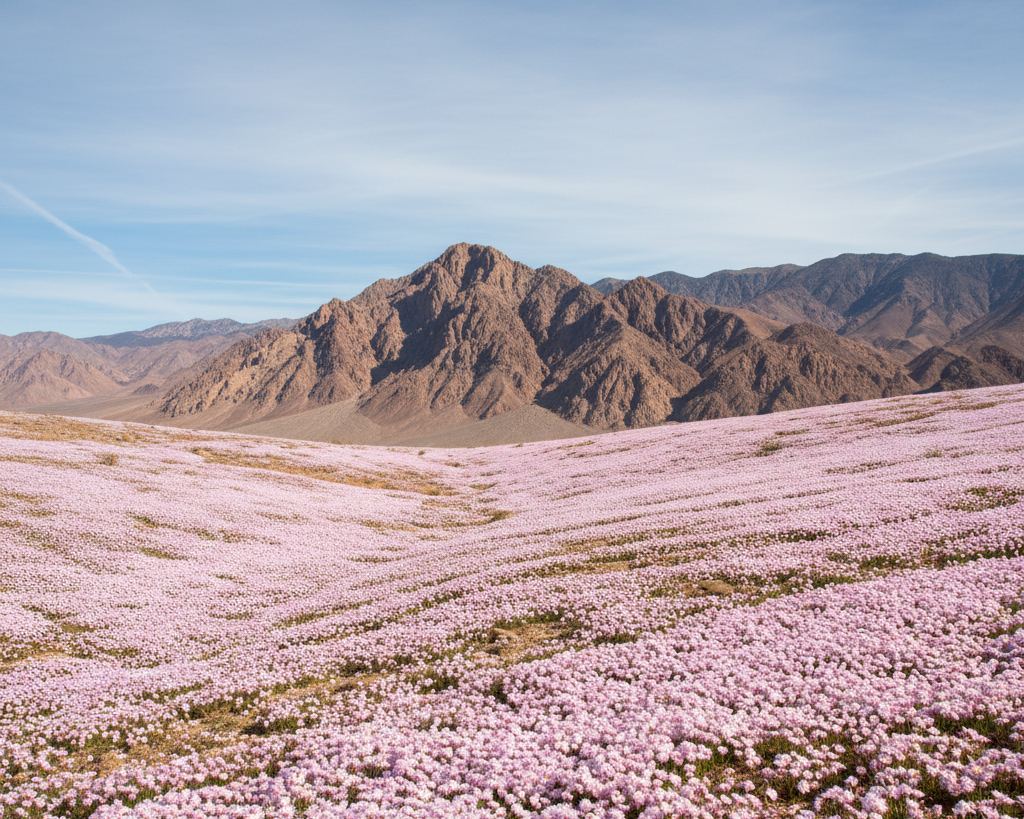
purple ground at ten in the morning, gravel again by five
Reserve a flowering desert trip in the Huasco valley, August to early October
What is held for you here is eight nights between the plain north of Vallenar and the coast at Huasco, from $4,908 per person on two sharing, inside the band that opens in the second week of August. Seed that sat through four or five dry winters comes up all at once when about fifteen millimeters of rain lands in the right eight weeks, and the flats read purple and white from the car for something under a month. You are put on that ground in the middle of it, with a driver and somebody who walked the same quebradas the last time it happened.
Reserve a windowAn answer is written inside one business day by somebody at this end.
In most years the plain north of Vallenar is stone, sand and a low gray scrub that looks finished and is not. Under the stones is seed lying dormant, some of it four or five winters deep, waiting on a specific thing: about fifteen millimeters of rain, a little over half an inch, falling inside a short stretch of May, June or July. Most years it never comes. In the years it does, the flats between the town and Domeyko come up purple and white and yellow, hold for three to six weeks between August and the start of October, and then go back to stone. That is the whole of it. The event has no fixed date, belongs to nobody, and can be sold honestly only as a probability with a calendar attached.
What you reserve here is a flowering desert trip in the Huasco valley built as eight nights placed at the middle of that band. Three nights on the plaza at Vallenar, three above the harbor at Huasco, two up the valley at Alto del Carmen, moving by high clearance pickup with a driver who lives in the province and a guide who walks these quebradas whenever the ground comes up. The figure is $4,908 a person on two sharing. The long leg is not in it, since you hold that ticket in your own name and no air travel of any kind is sold from this office.
The one useful thing that can be done about a flowering nobody controls is refusing to sell the dates until the rain has already fallen. So this window goes on sale in a given year only after the May to July totals are in and the germination is a fact on the ground. What stays uncertain after that is spread and duration, and those get settled by the four weeks between the rain and your arrival.
Runs the second week of August to the first week of October.
It opens six to ten weeks behind the last useful winter rain, once the pata de guanaco carpets are actually standing on the Route 5 flats, and it closes when the first hot northerly after the equinox pushes the afternoons past twenty seven degrees Celsius and takes the color off inside eight to twelve days.
Both edges slide two to three weeks with the timing of the rain, so rooms are held loosely across a five week spread from early August and the exact eight nights are pinned at the end of July, when the province rainfall totals for May, June and July are all in.
Most of the daylight. Field time runs about 09:30 to 18:00, because pata de guanaco does not open until the light is properly on it near 10:00 and folds itself shut again between 16:40 and 17:20, so the flowers themselves set the working part of the day.
What is left is the hour of road out before the ground is worth looking at, and after the flowers close, the coast road, the light going off the water and a late meal near 20:30 with nothing arranged after it.
8 nights, from $4,908 per person.
The office only opens this window in a year when the winter rain has already fallen and been measured, so germination is a fact on the ground before any dates are quoted, and what remains open is how far the color spreads and how long it holds. A narrow year gives patches along the roadside and full ground in two or three quebradas rather than whole basins. Weather is underwritten by nobody, here or in Chile, and in the years the plain stays gray the same eight nights run as a coast, canyon and valley trip with the same rooms, the same driver and the same figure.
- What this office books
- The office books the eight nights of rooms, the pickup and its driver, the field guide, the park entries and the two road transfers at Copiapo, and it books no air ticket of any kind, holds no rooms of its own and owns not one wheel of what carries you.
- Who books it
- A person reserving this wants to stand on ground that is bare stone in most years and find it covered, and wants to be there in the ten or twelve days when it is at its widest rather than a month behind it.
- Why somebody picks another window
- Anybody who needs the thing they came for to be sitting there on the date printed on the paper should take a window built around something fixed, a tide or a harvest or a set of hours of daylight, because no calendar on this coast can do that with a flowering.
- In the figure
- Eight nights on two sharing, three in a nine room hotel on the plaza at Vallenar, three in a guesthouse of six rooms above the harbor at Huasco and two in a farmhouse with four rooms up the valley at Alto del Carmen; all ground transport in a high clearance pickup with a driver, from the airport at Copiapo and back to it; a field guide on all seven full days who has worked this ground in every flowering year of the last decade; park entry on the coast on the days the coast is used; breakfast every morning and a packed midday meal on the six field days; the first dinner and the last; a marked map of exactly where color was standing in the week before you land, redrawn on the morning you arrive; one laundry at the halfway point; drinking water and a folding stool carried in the vehicle for each person; a printed timetable with the day by day hours and the driver's number on it.
- Not in the figure
- The long flight, which is yours to arrange and hold in your own name, Orlando down to Santiago and back with the leg north to Copiapo, roughly $960 to $1,780 for the round trip; six of the eight dinners, $14 to $32 a head in Vallenar and Huasco; anything to drink with a meal, $3 to $9 a glass; a room of your own instead of sharing, $612 across the eight nights; a second vehicle when the party runs over six, $148 a day split between you; anything bought at the stills or the olive presses up the valley, $9 to $40 a bottle; the small museum at Vallenar and the coastal lookout gate, $2 to $6 each; extra nights at either end, $118 to $164 a room; tips for the driver and the guide, which are entirely your own call; anything you add on the spot, billed to you by the company running the trip on its own paper.
- Who this window will not suit
- This is six days looking hard at low plants in flat light and hard wind, often on your knees on gravel, and if that has worn thin by the second afternoon it will be a long week. The driving is real: 130 to 190 miles a day between the town, the coast and the quebradas, a good part of it on washboard gravel, with the midday meal eaten standing beside the truck. There is no shade on the plain, the coastal wind gets up around 15:00 and does not sit down until dark, and the nights inland are cold enough that the farmhouse rooms are heated with a stove you feed yourself. And the flowering can come narrow, or come and go early, so a traveler who cannot hold in mind a version of this trip that ends with gray ground and a good coast should reserve something else.
A starting figure for two people sharing one room. Pricing the exact window you pick runs two to four working days, because the company working those dates answers first. No air ticket is ever folded in.
What the rain has to do, and by when
The trigger is not annual rainfall, which here is a number so small it barely means anything, but a single wet spell heavy enough to soak the top few centimeters and keep them wet for several days. Fifteen millimeters in one storm will usually do it. Ten millimeters spread over three separate afternoons usually will not, because the surface dries between them and the seed reads the whole thing as noise. This is why two years with the same total on paper can produce a covered plain and a bare one.
After the soaking, germination and then flowering follow on a fairly reliable clock: six weeks at the fast end, ten at the slow, depending on how cold the nights stay through July. A late June storm therefore puts the first color out in the second week of August. A storm in the middle of July pushes everything to the first days of September and holds the far edge of the window into October. The office watches which of those two shapes the year has taken before fixing anything.
The closing edge is heat, not drought. Once the sun is high enough after the September equinox and the first dry northerly runs down the valley, afternoons climb past twenty seven degrees Celsius, the plants set seed, and the color goes flat and then pale inside a week and a half. It happens faster on the open flats than in the quebradas, where shade holds things a few days longer, which is why the last week of the window is spent off the main road.
The hours the flowers keep
Pata de guanaco, the magenta one that makes the carpets, is the plant this whole schedule is built around, and it does not stay open. The flowers lift as the light strengthens, roughly 10:00 on a clear morning and closer to 10:40 when the coastal fog has pushed inland overnight. They hold through the middle of the day. Then somewhere between 16:40 and 17:20, well before sunset, they fold shut, and a field that read solid purple at two in the afternoon reads gray green at half past five. Nobody photographs it after that and there is nothing to be gained by standing in it.
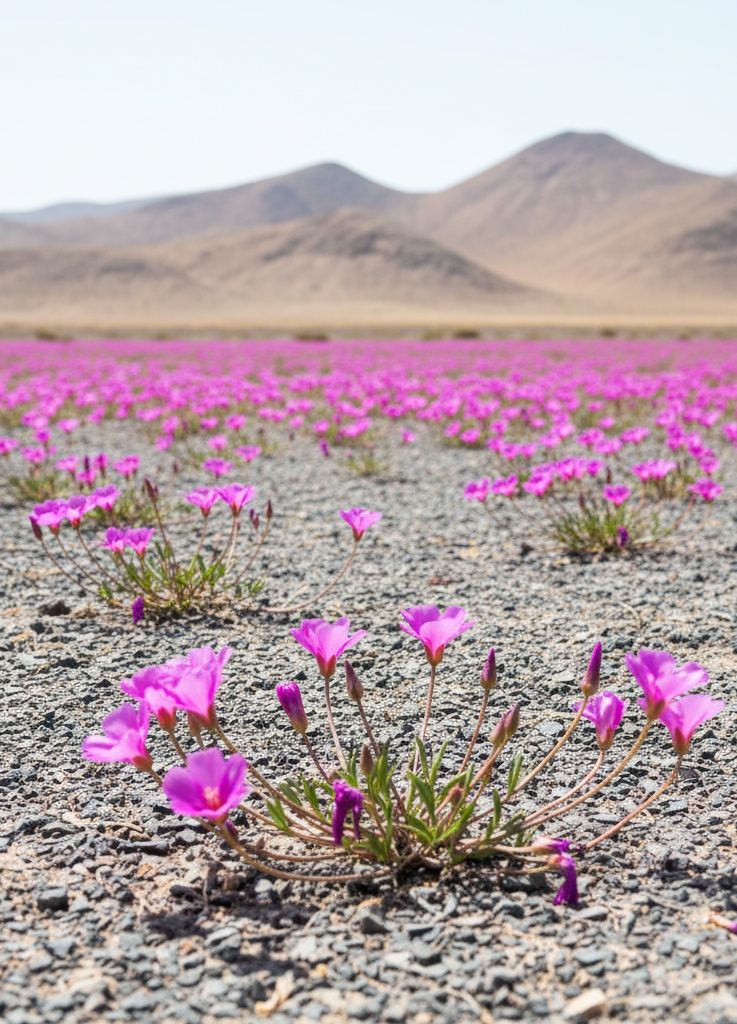
So the working block is 09:30 to about 18:00, which is three quarters of the useful day and the reason the hours mark on this window is set where it is. The half hour before ten is spent driving out, because the ground worth reaching is between twenty and fifty miles from wherever you slept. The end of the afternoon has a second use: the low light after the flowers close is when the guanacos come down toward the coastal flats, and the run back from Carrizal Bajo is timed for that rather than for speed.
- Week of August 10
- first color on the flats north of town, patchy, mostly white and pale yellow
- Week of August 17
- pata de guanaco opening properly, the ground reading purple from a moving car
- Week of August 24
- the coastal strip behind Huasco comes up, garra de leon in it if the year is strong
- Week of August 31
- usually the widest ground of the whole season and the week the office aims for
- Week of September 7
- clocks forward, light until 19:30, color holding well inland
- Week of September 14
- flats beginning to thin, quebradas still full, work shifts off the highway
- Week of September 21
- seed setting, ground going pale from the open plain inward
- Week of September 28
- last week that repays the journey, and in a hot year it is already finished
Three grounds, not one
The plain is the reason for the trip but it is not the whole of the eight nights, partly because six straight days of the same flat gravel would be a hard sell and partly because the flowering behaves differently at each level. Route 5 north of Vallenar is the wide version: long shallow ground where a good year covers everything you can see and a poor one leaves color only in the low lines where water ran. It is easy walking, it is exposed, and it is where the ninety mile days happen.
Behind the coast north of Huasco the picture changes. Fog comes in overnight, sits until about eleven, and adds moisture that the plain never gets, so the coastal strip can carry flower in a year when the interior is thin. That strip is also the only place garra de leon grows, low orange clumps on gravel slopes, and it is the plant most likely to be missing when the winter has been poor. The coast days start an hour later than the inland ones for the fog and finish on the beach at Carrizal Bajo, where the swell comes in hard and the wind is up every afternoon by three.
Up the Huasco valley at Alto del Carmen there is no flowering at all, and it is included precisely because of that. Irrigated grape terraces, stone walls, stills working through the season, a river with actual water in it, and a night sky at 2,600 feet with no town in the way. Two nights there at the end reframes the six that came before it, and it puts you within reach of Copiapo for the road transfer out.
Reserving dates that are not fixed yet
The way this is handled is that a provisional band gets held rather than a fixed set of nights. You say which five week spread in August and September you can travel in; rooms in all three places are put on hold across it; and at the end of July, when the rainfall record for the winter is complete, the eight nights are set inside your band and confirmed to you in writing. Naming your spread and getting it costed on paper takes two to four working days at this end.
Every roof and every vehicle described on this page is somebody else's property, and the company that actually runs the trip in Atacama invoices you directly for it. No money moves through Roving Hours. There is no card taken here, no deposit collected here and no checkout on this site, and if any page appears to suggest otherwise, write to corrections@rovinghours.com and it will be corrected.
Roving Hours is the name Roving Hours Bookings LLC works under, from 1350 N. Orange Avenue, Suite 221 in Orlando, Orange County, Florida, and post reaches that address as Orlando, FL 32789. Booking requests come in through the form below, by bookings@rovinghours.com or by telephone on +1 (407) 629-3157, and the first thing you will be asked is which winter you are aiming at, because in a dry one there is nothing here to hold.
Start with the weeks, not the country
This form takes requests every hour of every day, and a person answers within one business day. Nothing here commits you. No figure is charged at this end.