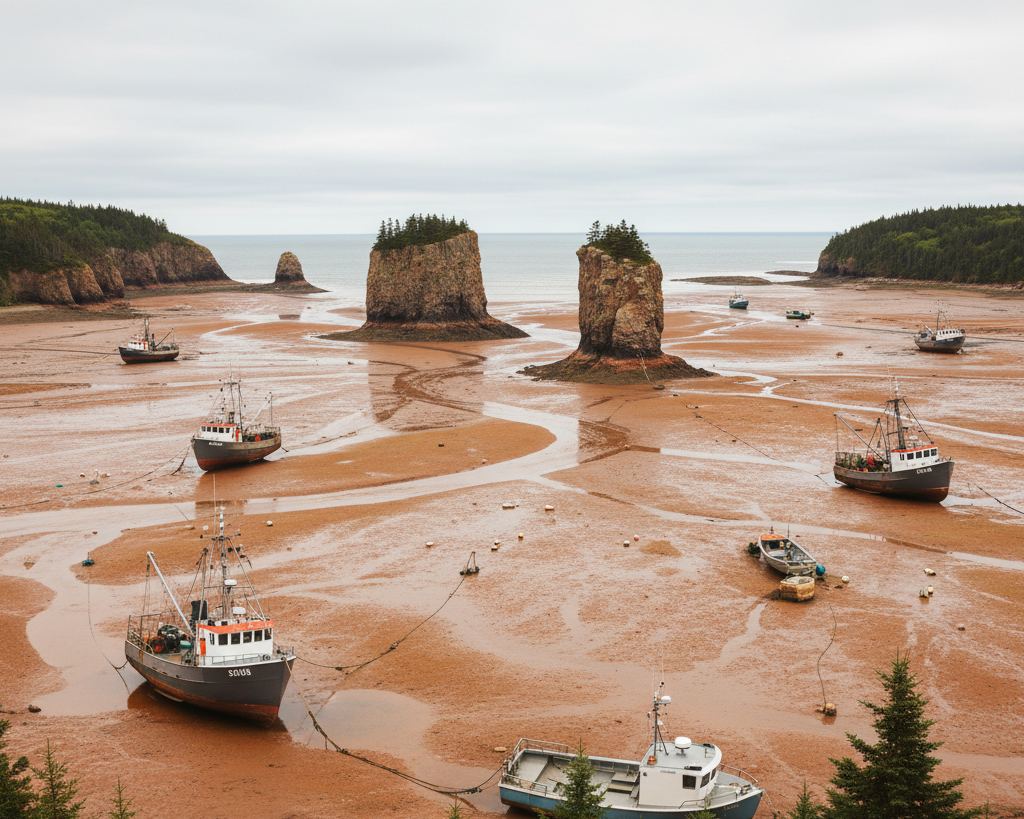
red mud underfoot at nine, forty feet of water there by three
Reserve a Bay of Fundy tide week in Nova Scotia on the big September and October tides
Seven nights on the Minas Basin shore of Nova Scotia with a driver, a vehicle and a guide, arranged around one named set of perigean spring tides falling between September 5 and October 24, from $3,815 per person on two sharing. The bay fills and empties twice a day the whole year, but on four or five sets of dates in those two months it does it through a vertical range close to forty seven feet, and every hour on the itinerary is measured off the low water of those particular days.
Reserve a windowAn answer is written inside one business day by somebody at this end.
The Bay of Fundy is a funnel about 170 miles long that narrows and shallows nearly the whole way in, and the water the Gulf of Maine pushes into it has nowhere left to go but up the shore. People who reserve a Bay of Fundy tide week in Nova Scotia are buying seven nights set against one particular run of dates in September or October when that rise reaches its yearly limit, close to forty seven feet at the head of the Minas Basin, and every arrangement on the itinerary is timed off the low water of those days instead of off a breakfast table.
The height is a matter of timing rather than of size. The bay sloshes end to end on a natural period of something near thirteen hours, and the ocean tide arrives at the mouth every twelve hours and twenty five minutes, close enough that each new flood shoves a body of water that is already moving the same way. The last forty miles finish the job: the bay splits in two, the northern arm shallows into a basin of red mud flats, and a range of about ten feet out at the mouth arrives at the head as forty seven.
Spring tides come twice a lunar month, at new and at full moon, when the sun and the moon pull along one line. A perigean spring tide is what happens when that alignment also lands within a day or so of the moon's nearest point in its orbit, some 31,000 miles closer in than its furthest. Four or five times a year the two coincide, and in September and October the sun sits over the equator as well, so the autumn sets carry the highest high waters and the lowest low waters of the twelve months. Those sets, and not the month, are what this page is selling.
Runs September 5 to October 24.
The window opens with the first September set in which a new or full moon falls within about a day of the moon's closest approach in its orbit, and it shuts in the last week of October when the ocean floor park at the head of the basin closes for the season and the river boats come out of the water.
The moon keeps no calendar, so the big sets land on different dates every year and can sit as much as a fortnight from where they sat last year; the office works out the four or five candidate sets for the year you are asking about and prices your seven nights against one of them instead of against a fixed departure date.
A morning or an evening. The programmed part of each day is a block of roughly three and a half hours around one low water, because that is the only span in which the floor at the head of the basin, the beach under the fossil cliffs and the boulder flats west of Parrsboro can be walked on at all.
The rest of the day belongs to you and it slides: low water comes about fifty minutes later each day, so a week that starts with a block at eight in the morning ends with one at two in the afternoon, and the free half of the day moves the opposite way behind it.
7 nights, from $3,815 per person.
The tide is the one part of this trip that is worked out years ahead, and the office sends the times and the predicted heights for each of your seven days along with the quote. What sits on top of that table is weather, and a deep low or three days of hard southwest wind can put a foot on a predicted height or take one off, which is enough to turn the front on the river from something chest high into a brown ripple you would walk past; nobody underwrites the sea, and the figure covers the nights and the arrangements rather than the water.
The seven nights split four and three. Four go at the head of the basin, inside half an hour of the floor walks and of the river, and three go on the north shore near Parrsboro, which puts the fossil cliffs and the boulder flats in reach without a two hour drive at six in the morning. The two shores uncover at slightly different times and expose entirely different ground, which is the reason for moving rather than sitting in one place all week.
- What this office books
- The office books the seven nights, the driver and vehicle, the guide, the three ocean floor walks, the beach tour under the fossil cliffs and your places on two bore departures; it books no airfare of any kind, and the river passage on those inflatable boats is held and billed by the company that runs them under its own licence.
- Who books it
- Somebody booking this wants to stand on ground that will be under thirty or forty feet of cold salt water before supper, and then to be up on the bank watching the same ground go.
- Why somebody picks another window
- If you want warmth and long evenings on that shore, the last week of June and the first of July give you light until nine and water you can wade in without flinching, but the tides in those weeks are ordinary ones and the floor uncovered at low water is a good deal smaller.
- In the figure
- Seven nights in small inns and one farmhouse, two sharing, four at the head of the basin and three on the north shore; breakfast every morning, set to the tide rather than to the clock; a driver and a vehicle for all seven days, about 480 miles of it, with the boots and the wet gear travelling in the back; a guide who has worked this shore for several seasons and goes through the next day's table with the group each evening; three guided walks on the uncovered floor, one of them timed to the lowest water of your set; the beach tour under the fossil cliffs at Joggins, run at low water and at no other time; places held for you on two bore departures on the river, with the dry suit, boots and helmet inside the hire; one afternoon on the boulder flats west of Parrsboro with a hammer, a chisel and a bag; every road transfer between the inns and the shore; and a printed sheet for your seven days giving the low water time, the predicted height and the minute the vehicle leaves.
- Not in the figure
- The flight, which is your own arrangement, Orlando to Halifax and normally one stop, about $410 to $880 round trip in these weeks; the fares on the bore boats, billed by the firm that works the river, about $70 to $135 a person a departure; entry to the ocean floor park and to the fossil cliff site, $8 to $17 a person a visit; lunches and suppers, $22 to $70 a person a day and more where lobster is on the table; chest waders if you want to work the flats yourself, $15 to $30 a day; a rain shell and rubber boots if you do not own them, $45 to $160; a single room supplement, $690 for the seven nights; a hire car for the two free afternoons if you would rather not wait on the group vehicle, $65 to $120 a day; and gratuities, which are not looked for on this shore and are not inside the figure.
- Who this window will not suit
- This week is arranged around mud, and you will be in it up to the ankle for three of the seven days. The programmed block moves fifty minutes later every morning, so there is no settled breakfast time and no settled anything, and people who want the same shape to each day find that wearing by the fourth. Two of the mornings start in the dark at the far end of the window, the water on the river is around 55F under the suit, and the wind at the head of the basin comes off open flats with nothing standing in it. Anyone who expects the sea to perform on the hour should also stay away, because the table gives a time and a height and the weather has its own opinion about both.
A starting figure for two people sharing one room. Pricing the exact window you pick runs two to four working days, because the company working those dates answers first. No air ticket is ever folded in.
What forty seven feet does to a shoreline
At the head of the basin the low water of a big set walks the sea out about a mile and a half from the summer high water mark, and what it leaves is not a beach. It is a floor: ribbed red mud, then flats of sandstone scoured flat, then a scatter of stacks fifteen to forty feet high standing on their own pedestals with the last tide's weed hanging on them at eye level. You walk out on ground that has been salt water for nine hours and will be salt water again in five.
The turn is the part people underestimate. Coming back in, the water is slow for the first hour, then quickens; through the middle of the flood it climbs near eight vertical feet an hour at the head, which works out at roughly an inch and a half a minute against a post, and the guides take the group up the stair an hour and a half after low water because the channel at the foot of the cliff is filling by then. From the top you watch the ground you were standing on go under in about the time it takes to drink a coffee.
Something on the order of fourteen billion tonnes moves through the Minas Channel on each flood, between two headlands about three miles apart. Off the end of Cape Split the current runs to around eight knots over an uneven bottom, and from the path four hundred feet above it, it makes a sound like a long freight train that never quite passes.
The block that moves fifty minutes every day
The moon takes 24 hours and 50 minutes to come back to the same meridian, and the tide follows the moon, not the sun. So low water is fifty minutes later tomorrow than it was today, and an hour and forty later the day after that. Over seven nights the programmed block walks forward by close to six hours. A week that opens with a vehicle leaving at 08:10 finishes with one leaving at 13:20, and the half of the day that is yours slides backward the same distance, from an afternoon at the start of the week to a long morning by the end.
Nothing can be done about that, so the office prices the week as a moving thing. The guide sits down with the group after supper with the next day's numbers, and the morning departure is fixed then. The one date chosen first, before any room is held anywhere, is the day of the lowest water in your set, because that is the day the third walk goes to the furthest ground.
- 06:52
- Sunrise over Cobequid Bay, and the basin is already half drained.
- 07:30
- Breakfast at the inn, boots by the door, the day's numbers on the table.
- 08:10
- The vehicle goes. Twenty five minutes of red road to the head.
- 08:40
- Down the stair onto the floor, with two hours of it in front of you.
- 09:12
- Low water. The furthest out anybody gets on this set of dates.
- 10:45
- Up the stair. The channel under the cliff has water moving in it again.
- 12:00
- The programmed block is finished and the afternoon is yours.
- 15:25
- High water at the same spot, about forty six feet above the morning.
- 19:07
- Sunset, and tomorrow all of it happens fifty minutes later.
What else the low water opens
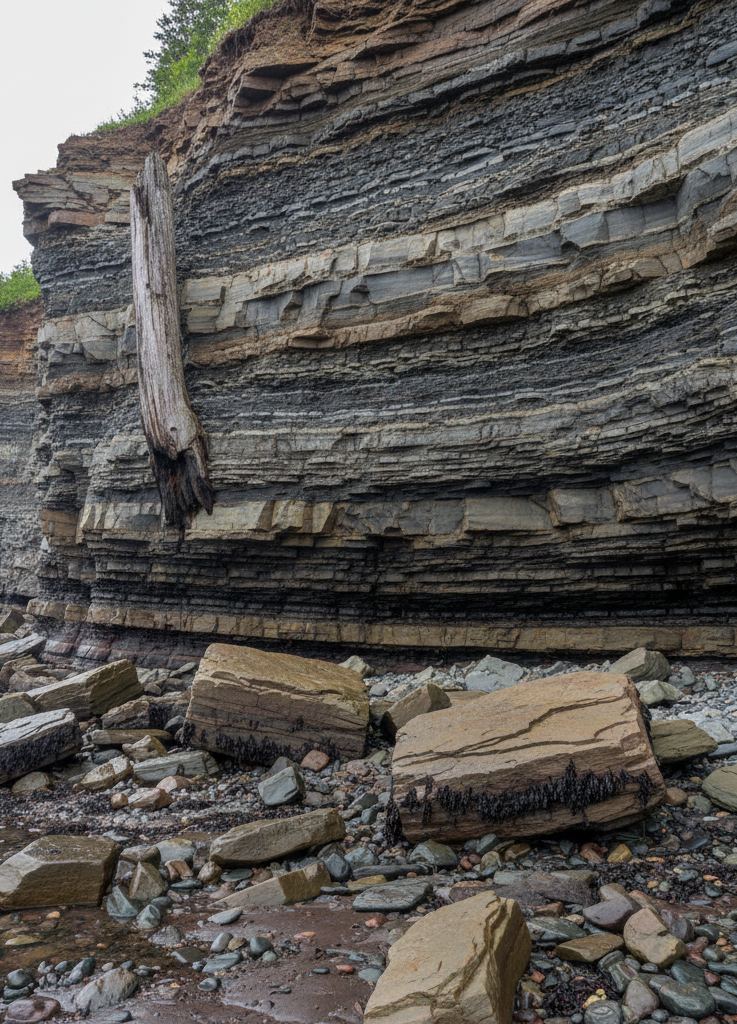
Nine miles of cliff at Joggins stand in the same tide, and they are Carboniferous, laid down about 310 million years ago as a coastal swamp with tree trunks still upright in it. The tide takes a little more off the face every twelve hours, which is why the beach under it is worth walking and why it can only be walked within about two hours of low water. On the flats west of Parrsboro the same tide uncovers basalt boulder fields carrying zeolites and amethyst in the old gas cavities, and the local rule is that you may take what is loose on the beach and nothing out of the cliff.
The river is the third thing. When the flood reaches the mouth of a shallow river with a wide funnel at its head, it goes up it as a single front rather than as a rise, and on this coast that front arrives about an hour after low water at the mouth and runs upstream at eight to ten miles an hour. On the big sets it can come in at chest height with standing waves behind it that keep breaking for twenty minutes; on a small tide, or with the wrong wind, it is a foot of brown water and a line of gulls. The boats are inflatables with outboards and they turn and ride the standing waves for an hour or so after the front has gone by, and the company that runs the river holds and bills that passage on its own paper.
If your dates fall between the sets
A week landing on the neap tides in the middle of a lunar month is a different week in the same place. The range at the head drops to something near twenty eight feet, the floor still uncovers but the far ground stays under, the stacks keep their feet wet, and the front on the river is a ripple. That is a quiet seven nights on a red shore and it is not this trip, and the office will say so rather than sell you the dates.
Come in the first half of November and the calendar has closed on you: the park at the head is shut, the boats are up on their trailers, and the inns on the north shore have gone down to weekends. Come in July and you get warmth, light until nine, and ordinary tides.
If nothing on your side fixes the dates, ask for the September set. The equinox sun adds its share, the ground is still dry enough to walk without sinking past the ankle, and there are two more hours of daylight to spend after the block is over than there will be in the third week of October.
Send the dates you can travel and a written figure comes back inside two to four working days, worked against your set and against the rooms actually free on it. Not one of the things named on this page belongs to Roving Hours Bookings LLC, which does business under the name Roving Hours from 1350 N. Orange Avenue, Suite 221 in Orlando, Orange, Florida 32789: the inns, the vehicle, the boats and the guided ground are all held with operators in Nova Scotia, and whichever company works your dates is the one that writes the invoice and sends it straight to you. Nothing with wings is included and the journey out stays yours to arrange. Questions on +1 (407) 629-3157 or in writing to bookings@rovinghours.com, and anything factually wrong above to corrections@rovinghours.com.
Start with the weeks, not the country
This form takes requests every hour of every day, and a person answers within one business day. Nothing here commits you. No figure is charged at this end.