cold granite, warm must, and a crew on the terraces by seven
Reserve the Douro vintage above Pinhão, mid September to mid October
Seven nights on a working farm on the terraces east of Pinhão, held inside the four weeks the fruit comes down, from $4,970 per person on two sharing. You are booked for the days a crew of thirty cuts a slope no machine can stand on, and for the evenings the granite tank is filled with what they carried off it. Three of the seven nights run past midnight if you want them to.
Reserve a windowAn answer is written inside one business day by somebody at this end.
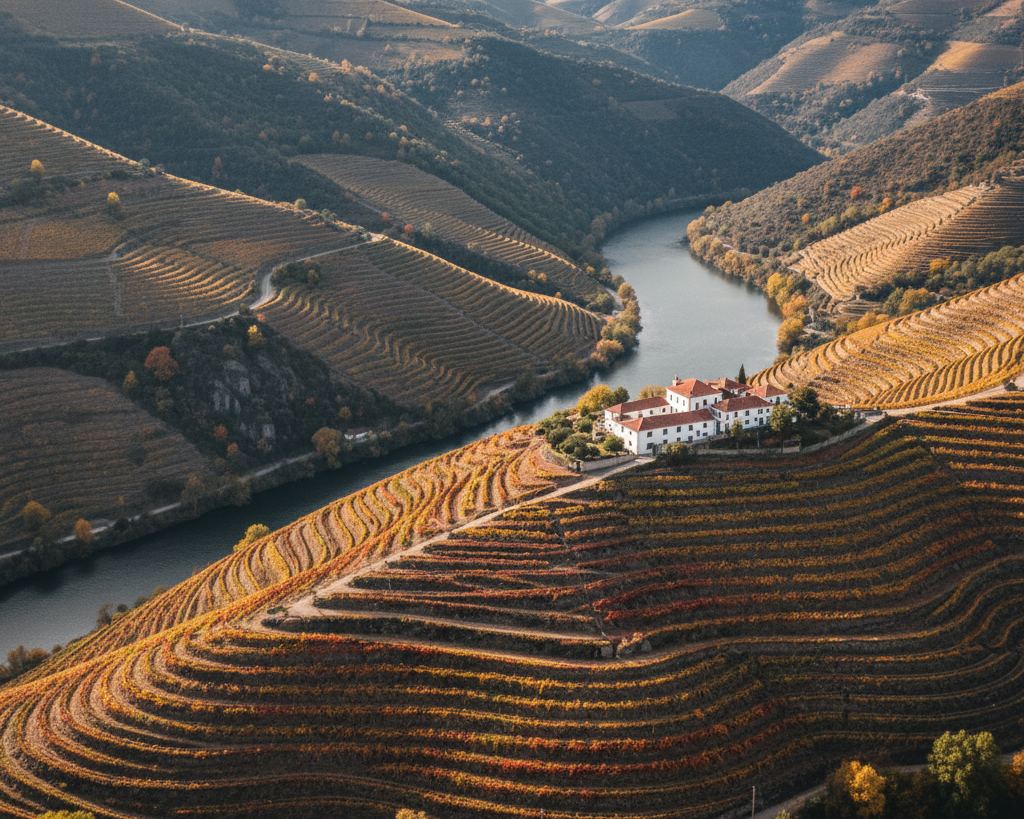
Nothing on these hillsides can be picked by a machine and nothing ever has been. The terraces east of Pinhão sit on faces running to 60 percent, the walls are dry stone and in places a meter and a half apart, and the only way fruit leaves them is in a crate carried by somebody who climbed up there at seven in the morning. That is the entire reason this window exists, and the reason it is four weeks wide instead of a season. For roughly a month the valley does the one thing it cannot do at any other point in the year, and then it stops. You are booked to be inside that month, on the slope in the daylight and beside the granite after dark.
Seven nights at a working farm on the north bank, forty minutes upstream of Pinhão by road, with two of its nine rooms held. The vehicle leaves the yard at 07:05 and seats nine. On four of the seven mornings you cut alongside the crew, which in this valley runs somewhere between twenty five and forty people and is assembled the same way it has been for generations, largely out of the same villages and largely the same families. You are handed gloves and a pair of secateurs at the shed and given a row. Nobody expects you to hold the pace, and the foreman will lift you out of a line you are slowing down.
Which blocks get cut on which day is not settled when you book and cannot be. That decision runs off sugar readings taken at first light and off the annual allowance issued for each property in the summer, which sets how much must may be fortified that year and therefore what is worth cutting and in what order. The hot upstream ground ripens first, the cooler ground down toward Régua last, and a forecast with rain in it will pull a whole week forward inside two days. The man running these days farms up here himself and takes the cutting order by telephone. That arrangement is what Roving Hours Bookings LLC reserves on your behalf, and it is why the dates on this page are written as a month rather than a week.
Runs September 14 to October 15.
The window opens when sugar readings on the early blocks come in and the year's fortification allowance has been issued for each property, and it shuts when the last crate is off the terraces and the granite has been scrubbed out, after which there is nothing on the hillside to pick until the following autumn.
Cutting has begun as early as September 8 after a hot dry August and as late as September 24 after a wet one, so the office holds your rooms across the whole four weeks rather than against a single date, and the operator names your picking days about five days ahead.
Most of the daylight. The trip is programmed for the daylight, roughly 07:15 until the light comes off the face of the block, which on September 25 means the sun is gone from the terraces before 19:00 and by October 12 before 18:30, because that is when the crew is cutting and when the fruit is being weighed in at the yard.
The rest of the day is the dark at either end of it, and on three of the seven evenings the lagar is filled at about 20:30 and worked for four hours, which is yours to take or skip and which nobody who takes it finishes before one in the morning.
7 nights, from $4,970 per person.
The cutting happens every year and something is coming in somewhere across these four weeks, so the failure case is not an empty month but a wrong week: two days of steady September rain will stop a crew outright, push the order back and leave you at a kitchen table instead of on a slope. Whether the lagar you are standing beside gets filled on your particular night depends on how much fruit came off that afternoon, and neither the weather nor the yield is underwritten by anybody.
- What this office books
- The office reserves the two rooms at the farm, the vehicle and its driver for all seven days, your place in the cutting crew on four mornings, the three lagar evenings, the ninety minute river movement through the lock and the road transfer at both ends, and it reserves nothing to do with your flight, your meals in the villages or any car you decide to hire for yourself.
- Who books it
- A person booking this wants to be on a terrace wall at nine in the morning with secateurs in their hand and then standing shin deep in the same fruit at half past eight that night.
- Why somebody picks another window
- If you want the valley quiet, the river flat and the terraces standing whole without forty people and eight tonnes of fruit moving through them, the back half of August gives you that and you will not touch a grape.
- In the figure
- Seven nights at a working farm on the terraces east of Pinhão, two of its nine rooms held for this trip; breakfast at 06:45 in the yard, bread, cheese, ham and coffee taken standing up; the vehicle and its driver for all seven days, seating nine; four mornings cutting alongside the crew, with gloves and secateurs issued at the shed; the weigh in and the sugar reading each afternoon at the receiving hopper, and the chalk board where both go up; three evenings at the granite lagar, from the fill at about 20:30 through the two hour disciplined phase and whatever follows it; one morning walking the schist with the man who rebuilds the dry stone, including a wall taken down to its footing; a tasting of four fortified lots drawn at different ages, poured in the farm office; a ninety minute movement on the water through the lock at Bagaúste, which the company operating that boat holds under its own license and invoices under its own name; dinner at the house on five of the seven evenings; the road transfer from the coast airport in both directions, about two hours each way; every local charge and the municipal tourist levy; a printed sheet of block names, elevations, cutting order and the hour the light leaves each face.
- Not in the figure
- Your own round trip flight from Orlando to northern Portugal, which you buy yourself and which across late September and October has been running about $860 to $1,560; the two dinners not taken at the house, $22 to $55 a head in the village; wine bought at the farm gate, $14 to $180 a bottle; a car for the free afternoons, $58 to $95 a day with fuel around $6.90 a gallon equivalent; the valley railway between Régua and Pinhão if you ride it rather than take the van, $3 to $6 each way; a second time on the water if you want one, $45 to $120; laundry at the house, $12 to $20 a load; boots and long trousers, which you bring or buy in Régua for $40 to $110; the single room supplement, $889 across the seven nights; anything carried home out of the tasting, $18 to $140 an item.
- Who this window will not suit
- You are on your feet from 07:15 on ground that pitches at up to 60 percent, and you carry crates up stone stairs built into a wall with nothing to hold. The lagar is cold granite to begin with and the must in it is sticky, warm, full of skins and stalks, and anybody who does not want the legs of strangers against their own for two hours should say so when they book rather than at 20:40. Two days of rain in the third week of September stops the cutting and there is no substitute program that puts you back on a terrace. Anyone wanting a late breakfast, a pool and a town they can walk to should take a different month.
A starting figure for two people sharing one room. Pricing the exact window you pick runs two to four working days, because the company working those dates answers first. No air ticket is ever folded in.
The day, 07:15 to the chalk board
The van is on a track above the block by quarter past seven and the crew is already working. Cutting is done bent, from underneath the bunch, and what comes off goes into 20 kilogram crates rather than the tall wicker baskets in the old photographs, because 65 kilograms carried on one shoulder crushes whatever is at the bottom of it. Crates go to the head of the row by hand, then down to the track, and on the steepest blocks that last part is done by a small winch running on a rail bolted into the slope.
By half past eleven an open terrace in the third week of September is at 28 to 32 degrees and the crew comes off. Lunch is soup, bread, sardines or pork and a jug of last year's table wine, eaten in whatever shade a wall is throwing. Work restarts near two and runs until the light leaves the face, which on a north facing block happens well before the sun actually sets.
The last hour of the day belongs to the receiving hopper. Fruit is weighed in row by row, a reading is taken off each load, and both numbers go up on a board in chalk against the name of the block they came from. Ten minutes in front of that board tells you more about how the year has gone than the whole morning on the slope does.
The granite after dark
A lagar is a shallow open tank cut from granite, waist high on the outside, and it is filled to somewhere between 55 and 65 centimeters of fruit. The one you will be standing in takes about nine tonnes. Filling starts around eight in the evening once the day's crates are in, and the first thing anybody notices is that the stone underfoot is cold, near 18 degrees, while the fruit that spent the afternoon in the sun is not.
The work has two halves and they are not remotely the same. The first is done in ranks, arms across the shoulders of the people either side, crossing the tank at roughly one step a second while somebody calls the direction from the wall. It lasts two hours and it is closer to marching than to dancing. Talk dries up after the first twenty minutes. The purpose is mechanical: a human foot breaks skins without cracking the seeds inside them, and two hours of that pulls color and tannin out of the fruit in a way that no pump reproduces.
The second half is loose. The ranks break, an accordion generally appears, people move however they like and it carries on for as long as it carries on. Around that point the must begins to warm on its own as fermentation starts, up through the low twenties, and the tank stops feeling cold. Somewhere in the following two days a measured quantity of grape spirit goes in to stop the ferment with sugar still in it, which is the step the whole valley is organized around.
You will be sticky to the hip and your legs will hold a stain for two days. There is a hose and a cold tap in the yard and that is the entire washing arrangement.
- September 8 to 13
- Only in a hot dry year, and only the upstream ground; most yards are still washing out tanks.
- September 14 to 20
- First real cutting, small volumes, granite filled perhaps every second evening.
- September 21 to 27
- The main run in an ordinary year, thirty people on a block, tanks worked six nights out of seven.
- September 28 to October 4
- Volume peaks and so does the noise, with spirit going into lots in the same building you are standing in.
- October 5 to 11
- The cooler downstream ground and the last of the table wine blocks; days back to 19 to 23 degrees.
- October 12 to 15
- Tail end, one or two crews left in the valley, and the first color coming into the leaf.
- October 16 onward
- Empty terraces, scrubbed granite, and six weeks of red and yellow hillside with nothing left to cut.
- Any week at all
- Two days of steady rain stops the cutting, because fruit that has taken water will not make the reading.
What is holding the hillside up
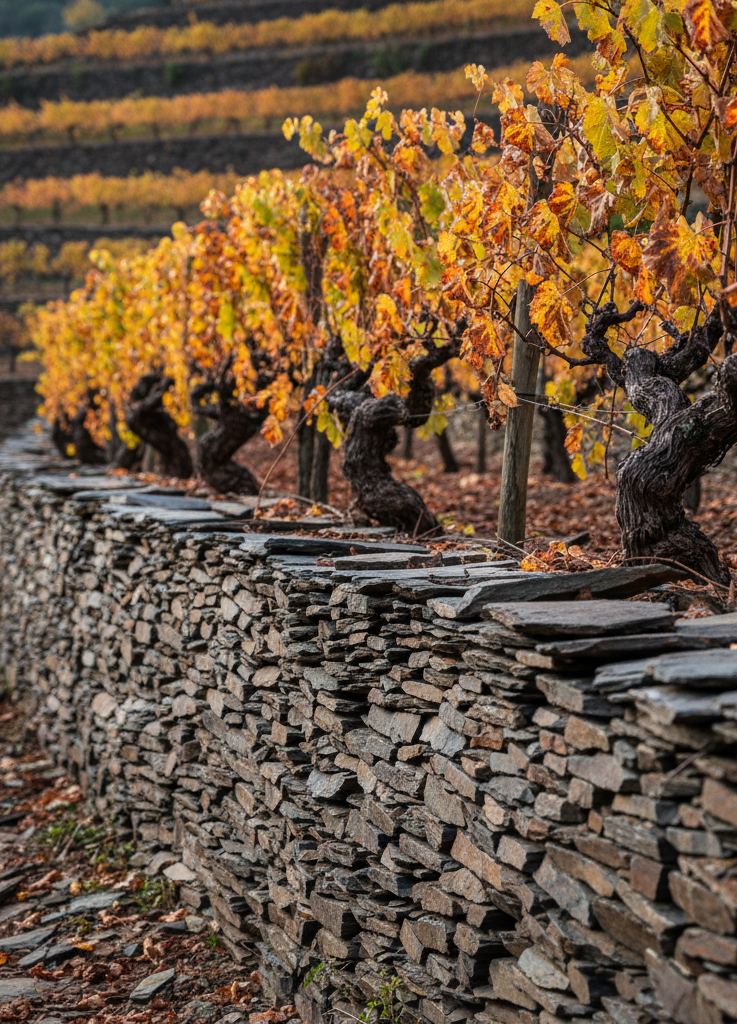
The planted ground here was not arranged by anybody with a view in mind. It is a quarter of a million dry stone walls holding soil that would otherwise be in the river, stacked over two and a half centuries on rock that happens to split the right way. Schist breaks vertically, so a root gets down eight to ten meters and finds water in a place that takes 400 to 700 millimeters of rain a year and none of it in the four months before you arrive. Where the old wall system was replaced in the 1970s by shelves cut with a bulldozer you can see the join from the far bank, because the two forms carry different row spacing and take the six o'clock light at different angles.
One afternoon of the seven you go down onto the water. That movement runs about ninety minutes and passes through the lock at Bagaúste, which lifts a boat somewhere near 35 meters inside a concrete chamber and takes about twenty minutes over it. The company operating that boat holds the passage under its own license and invoices it under its own name. The farm owns no boat and neither does this agency.
The other free afternoons are yours and nothing is arranged inside them. Village shops close from 12:30 to 14:30 and largely stay shut on Sunday. The valley railway runs along the floor below the farm, with a station twenty minutes from the gate if you would rather ride than be driven.
Holding seven nights inside the four weeks
You choose the nights you want and Roving Hours works backward from them. Costing one specific set of dates takes two to four working days at this end, because the room rate moves with which week you take and because your picking days have to go in front of the operator before any figure comes out. The number on this page is a real floor for two sharing a room, not an opening position.
Not one bed, van, granite tank or boat named anywhere above belongs to Roving Hours Bookings LLC. The farm and the company running the cutting days invoice you directly, under their own names and on their own paper, and they settle with you in their own way; nothing is collected at this end at any stage. Your flight into northern Portugal is yours to buy and no ticket of any description is sold by this agency.
Send the weeks you are looking at, the number of people and whether you want the lagar evenings. Roving Hours Bookings LLC answers from Orlando, Orange, Florida, and the office is at 1350 N. Orange Avenue, Suite 221, Orlando, FL 32789. Reach it on +1 (407) 629-3157 or write to bookings@rovinghours.com; a figure here that has gone out of date goes to corrections@rovinghours.com and gets checked against the operating company.
Start with the weeks, not the country
This form takes requests every hour of every day, and a person answers within one business day. Nothing here commits you. No figure is charged at this end.