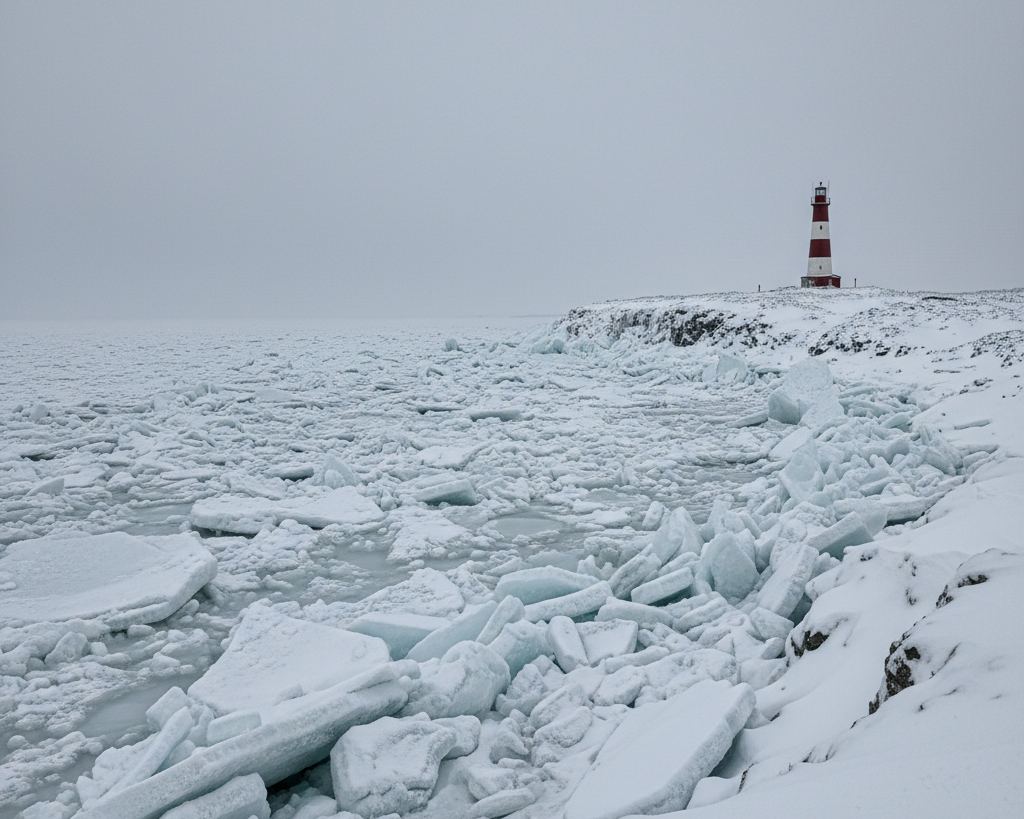
floes grinding under the bow at first light, fifteen degrees on deck
Reserve a drift ice trip in Hokkaido for the late January to mid March window
Eight nights on the Okhotsk coast of Hokkaido, four of them at Abashiri and four across the peninsula at Rausu, with a driver, a guide and four programmed mornings on the ice, from $4,505 per person on two sharing between January 25 and March 15. The dates are the product here: the field arrives from the north, holds the coast for a few weeks and then goes, and everything on the itinerary sits inside that.
Reserve a windowAn answer is written inside one business day by somebody at this end.
The Sea of Okhotsk freezes from the north end downward, and what shows up off Hokkaido in the last week of January is the leading edge of that. People who reserve a drift ice trip in Hokkaido are buying eight nights set against the short run of weeks when the field lies near enough to the shore to be walked on, pushed through, or watched from a beach at seven in the morning. Everything else on the itinerary is arranged behind that one fact.
The ice is not made here. It forms at the shallow top of the sea, where the Amur empties enough runoff to keep the surface layer half fresh so that it freezes earlier and at a warmer temperature than open ocean would, and it comes down the eastern side of Sakhalin on a current that takes about two months over the journey. What arrives is not a sheet. It is a field of separate plates, most of them a foot to a yard thick, some of them as wide as a parking lot, and they work against each other constantly. You hear a field before you can pick out any single piece in it.
This is the furthest south that the sea freezes anywhere in the northern half of the world. Abashiri, where the first four nights are spent, sits at roughly the latitude of Toronto. That mismatch is the whole oddity of the coast and it is also why the window gets counted in weeks rather than months.
Runs January 25 to March 15.
Ice made at the shallow top of the sea comes down on the current and is normally in sight of the Abashiri shore by the third week of January, and by the middle of March the same current and a warming sea have taken it off the beach for good.
First sighting has landed anywhere between January 9 and February 6 over the last few decades, so the office holds your ground arrangements against your own dates and reorders the days if the field is late, rather than shifting the whole trip.
A morning or an evening. The programmed part of the day runs from about 05:15 to 11:30, because the ice departures, the eagle mornings on the strait and the walk on the floes all happen in the first hours of light.
Afternoons are unprogrammed: the light goes flat by two, it is dark before five, and most people spend the middle of the day on a bath, a long lunch and sleep.
8 nights, from $4,505 per person.
In a normal winter the ice lies against the Abashiri shore for something between three and six weeks, and the vessels out of Abashiri and Monbetsu find workable plates on most mornings inside this window; in a thin year they run over open grey water and there is nothing on it. Nobody underwrites the ice, this office least of all, and the figure covers the nights and the arrangements rather than the weather.
The eight nights split four and four. Four go on the Okhotsk side, within reach of both the Abashiri and the Monbetsu harbors, and four go on the eastern side at Rausu, on the strait behind the Shiretoko Peninsula. The two coasts can have entirely different ice on the same morning, which is the reason for the split and the reason this is not sold as one base with long day runs out of it.
- What this office books
- The office books the eight nights, the driver and vehicle, the guide, the walk on the floes and your places on the four boat mornings; it books no airfare, and the passage on the icebreaking vessels is held and billed by the companies that operate them under their own passenger licences.
- Who books it
- Somebody booking this wants to stand on a beach where the sea has stopped behaving like water, and to see the birds that come to Hokkaido only because the field does.
- Why somebody picks another window
- If you want long days outdoors rather than short ones, the last week of March gives you close to two more hours of light and an empty coast, but the field will very likely have gone by then.
- In the figure
- Eight nights in small family run lodgings, two sharing, four on the Okhotsk side and four on the strait side; breakfast every morning, set out early because the outings are early; a driver and a vehicle on winter tires for all eight days, including the run around the base of the peninsula; a guide who has worked this coast in winter for several seasons; places held for you on two morning departures of the icebreaking vessels; places held for you on two eagle mornings out of the fishing harbor at Rausu; one guided walk on the floes with the dry suit, boots and gloves in the hire; one afternoon on a frozen lagoon with a hut, a hole and tackle; every road transfer between lodgings and harbors; and a day by day sheet giving the time each outing leaves and what replaces it if the field is offshore.
- Not in the figure
- The flight, which is your own arrangement, Orlando to Tokyo and on to the airport at Memanbetsu, about $1,150 to $2,300 round trip in the ice weeks; the fares on the icebreaking vessels and the eagle boat, billed by the firms that run them, about $32 to $95 a person each morning; lunches and dinners, $18 to $55 a person a day and more where crab is on the table; the slow coastal train leg if you would rather ride it one day than go with the driver, $9 to $28; boot spikes, a face cover and heavy mittens if you do not own them, $40 to $130; hot spring entry where a lodging has no bath of its own, $6 to $14; a single room supplement, $560 for the eight nights; anything bought on the harbor front at Monbetsu, where dried scallop and crab run $12 to $70; and gratuities, which are not looked for on this coast and are not inside the figure.
- Who this window will not suit
- This is a cold trip taken mostly in the dark. You will be up at four thirty on five of the eight mornings, standing still for two hours in wind that has come across ice with nothing in the way, and back indoors by lunchtime with the rest of the day empty in front of you. Anyone who cannot sit through a blank morning should not book it: a warm week can leave the beach open and there will be nothing on the water to look at, and no part of the price comes back for that. It is also wrong for anyone who wants the day filled, because the afternoons are yours and there is very little in them.
A starting figure for two people sharing one room. Pricing the exact window you pick runs two to four working days, because the company working those dates answers first. No air ticket is ever folded in.
What the field does in a given week
The coast keeps three dates every winter, and the local record of them is long. The first is the day ice is seen from land, which on the Abashiri shore averages the third week of January. The second is the day it touches the beach, normally in the first days of February, occasionally two weeks after that. The third is the day a working vessel can get out through it again, which usually falls between March 10 and March 20. Those three dates are the frame this window sits in, and the office puts your nights inside them rather than across the edges.
Within the window the field moves daily, and it moves on the wind rather than on the calendar. A steady south or southeast blow takes the outer edge eight or ten miles offshore overnight, so a beach packed solid on Tuesday is open water on Wednesday. A north wind brings it back, sometimes inside twelve hours, and it returns with a sound on the shingle you can hear a quarter mile inland. That behavior is why the itinerary holds two ice mornings instead of one, why the nights are split between two coasts, and why the guide reads the wind at breakfast and tells you which harbor you are going to.
The mornings this is built on
The programmed part of the day runs from about 05:15 to 11:30, and that is not a matter of taste. The first departure of the day goes close to first light because the field is stiff after a cold night and the plates hold their edges; by mid afternoon the same plates have been worked over by the swell and by three earlier runs. The vessel at Monbetsu turns a pair of augers on its bow and chews a channel through them. The one at Abashiri rides up onto the ice and breaks it downward under its own weight. Two harbors, two methods, two quite different mornings on the same field.
The walk on the floes at Utoro is a morning thing as well, and the company running it will not put anyone onto the ice when the field is loose or has started to shift offshore. On those days it becomes a walk under the cliffs instead and no hire fee is taken. In the second week of February the sun comes up over the Okhotsk at about 06:29 and is gone by 16:47. The usable light is the first ninety minutes: low, orange, and crossing the ice sideways. By two in the afternoon it has gone flat, and it stays flat until it goes altogether.
- 04:40
- up, tea in the room, nothing else open
- 05:15
- the vehicle goes, twenty minutes of black road
- 05:55
- harbor, boots on, the operator reads the wind
- 06:29
- sunrise across the plates, the hour the trip is for
- 07:40
- alongside again, hands on the engine housing
- 08:30
- breakfast, and the guide settles the afternoon
- 11:30
- the programmed part of the day is finished
- 14:00
- the light goes flat and stays that way
- 16:47
- dark
The birds that come south with the ice
The sea eagles arrive with the field and leave with it. On the strait side at Rausu several hundred of them winter within a few miles of the fishing harbor, standing on the plates in the early light with the white shoulder showing at half a mile. White tailed eagles are there in similar numbers and are usually the ones that come closest. Their peak falls in the second and third weeks of February, which is also when the ice on that side is at its heaviest, and the two are one event rather than two: the birds are there because the fleet works the ice edge and because the field gives them somewhere to stand.
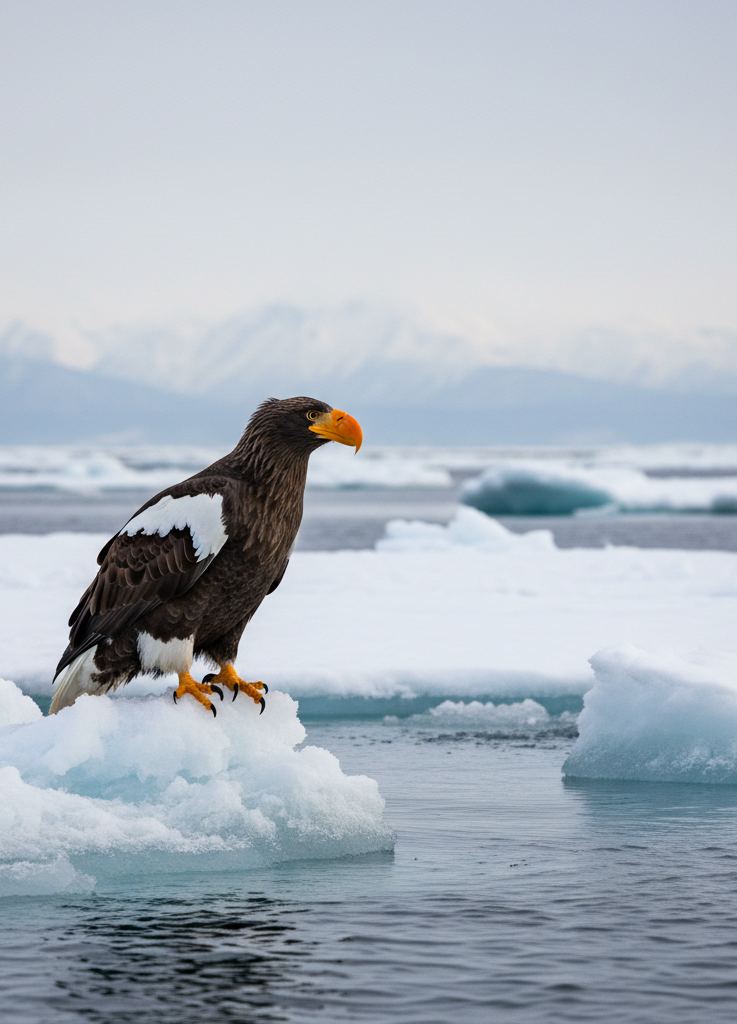
None of that is underwritten by anybody. Two mornings on the strait in a normal February will put birds in front of you. A warm week with the field pushed offshore will put you on flat grey water with a few gulls on it. It is worth saying to yourself before you book that the eight nights and the arrangements that get you onto a beach at five in the morning are the thing being reserved, and that the ice and the eagles are the reason for the dates rather than an item on a list.
Two weeks early, two weeks late
Arrive in the second week of January and you get a cold, dark, quiet coast with no ice on it. The average first sighting is still a week or more away, the vessels at both harbors are running over open water as ordinary excursion boats, and the walk at Utoro has not opened for the season. That is a real week in a real place, but it is not this trip and the office will say so plainly rather than sell you the dates.
Arrive in the last week of March and the position reverses. Sunrise has moved back to about 05:35 and sunset out to 17:28, so there are nearly two more hours of daylight, the mornings stop being brutal, the lodgings are quiet and the roads are clear. The field, though, has usually gone north or melted out by then and the eagles have gone with it. If the long light matters to you more than the ice does, take the later dates deliberately and with the loss understood.
The two weeks the office would choose for you, if nothing on your side fixed the dates, are the ones straddling the middle of February. That is when the three things this trip stands on, the field against the beach, the eagles on the strait and the walk at Utoro, most often overlap. Ask for those and expect to be told what else is in the water that year, because the field is different every winter and the last several have been thinner than the ones before them.
Send the dates you can travel and a costed answer comes back inside two to four working days, worked against your dates and not against an average. Nothing that carries you or puts a roof over you on this trip belongs to Roving Hours Bookings LLC, which does business under the name Roving Hours and works from 1350 N. Orange Avenue, Suite 221 in Orlando, Orange, Florida 32789: the nights, the vehicle, the four boat mornings and the walk are all held with firms in Hokkaido, and the invoice is written by the operator there on terms that company sets, and goes straight to you. Getting yourself to Japan is your own affair and no airfare passes through here. Questions by telephone on +1 (407) 629-3157 or by mail to bookings@rovinghours.com, and corrections to anything factual on this page to corrections@rovinghours.com.
Start with the weeks, not the country
This form takes requests every hour of every day, and a person answers within one business day. Nothing here commits you. No figure is charged at this end.