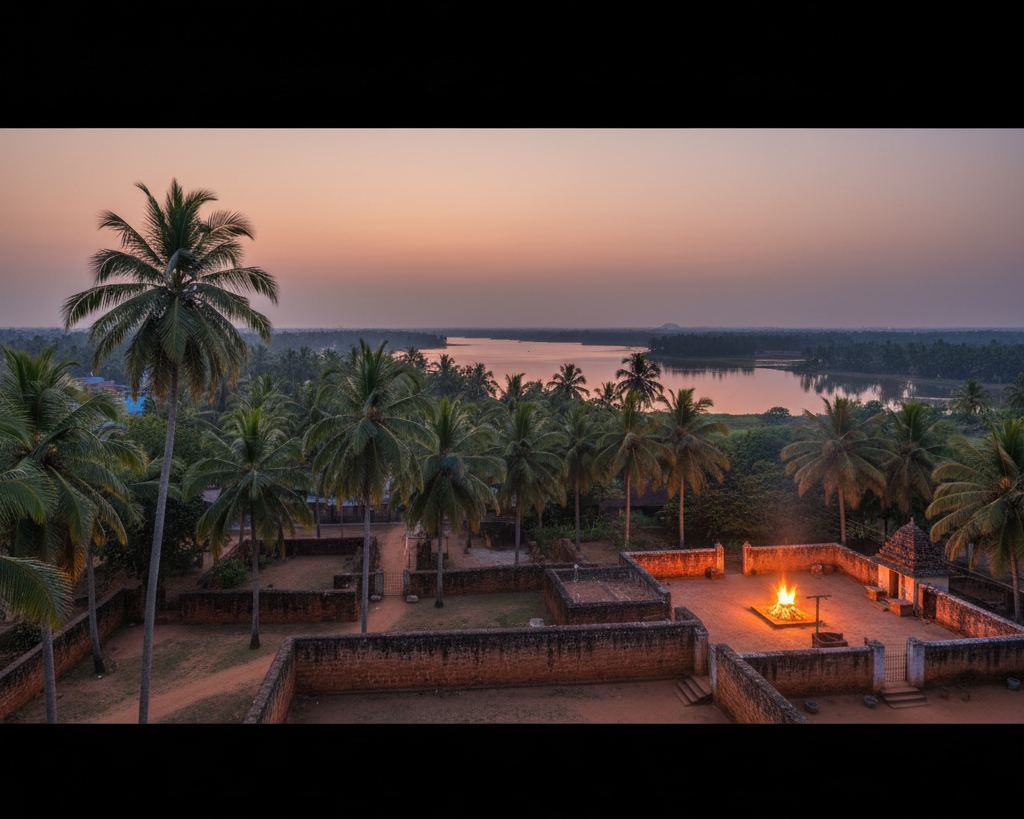
rice paste on a face at midnight, drums against a low wall
Reserve a northern Kerala theyyam season trip, December to late March
Eleven nights in the two districts at the top of Kerala, six of them set against shrines that are holding a festival on your dates, from $5,116 per person with two of you sharing a room. Between December and the end of March a man from one of the performing communities is painted for hours in a thatched shed, dressed in split coconut leaf and beaten metal and raised into a headdress, and from the moment he is handed the mirror the people in the yard address him as the deity until the paint comes off after sunrise.
Reserve a windowAn answer is written inside one business day by somebody at this end.
You can reserve a northern Kerala theyyam season trip with Roving Hours for any stretch of the dry months between the first week of December and the last week of March, which is when the shrines in the two districts at the top of the state hold their festival nights. Eleven nights, six of them set against shrines that are genuinely working on your dates, from $5,116 per person with two of you sharing a room. The nights are what you are buying. The days are what you do while you get over them.
A theyyam is not a performance with seats and there is nowhere to sit. It happens in the yard of a kavu, a walled patch of trees nobody has been permitted to fell, or in the courtyard of a house that has carried the obligation down the family. A man from one of the performing communities is painted for hours, dressed in split coconut leaf, cloth and beaten metal, and raised into a headdress that on some figures stands six metres above him. When the headdress is fitted he is handed a small mirror, and from the moment he looks into it the people in the yard stop using his name and start asking him questions.
All of that sits between dusk and the middle of the following morning, and hardly any of it happens in daylight. That is the whole reason this window falls where it does and the hours are marked the way they are below.
Runs early December to the last week of March.
It opens once the second rains have finished and the paddy is off the ground, which is what frees both the shrine families and the performing families to hold a festival at all, and it shuts as the heat builds toward the middle of April, after which the shrines still working are few and a long way apart.
Every shrine fixes its nights by the Malayalam calendar and by its own reckoning, so a festival that fell on January 12 one year lands on January 28 the next, and a number of shrines hold theirs once in three years, or twelve, or on a gap nobody outside the family can forecast, which is why we set your eleven nights against what is actually falling in the weeks you can travel rather than against a fixed route.
Before dawn until after dark. The programmed hours run from about seven in the evening to nine or ten the following morning, with the dressing through the middle of the night, the smaller figures from around half past one, and the tall headdress walked out at or just after first light.
The rest of the day is sleep from mid morning until three or four in the afternoon behind shutters with a fan going, and then a free late afternoon for the backwater, the tea shop and the run to wherever the next night is.
11 nights, from $5,116 per person.
These nights are human obligation rather than weather, so the festivals themselves run: a shrine that has announced its dates holds them. What is not settled in advance is which figures appear on your night, whether the tall one is up at half past five or half past seven, and whether a death in the family that holds the shrine moves the whole thing by a fortnight, and none of that is underwritten by us or by anyone else.
- What this office books
- This office books the eleven nights of rooms, the car and driver, the interpreter who stays with you through every night, the meals taken outside the shrines and the arrangement with the company that works these festivals; it books no flight of any kind, and it takes no money from you at any stage.
- Who books it
- A person reserving this wants to be standing on swept earth at four in the morning while the coals are being raked level, rather than watching a daytime version of the same thing arranged for visitors.
- Why somebody picks another window
- If you would rather sleep at night, take the district in tolerable heat and walk the coast with no headdress anywhere in it, come for a week in November and accept that you will be a month early for nearly every festival.
- In the figure
- Eleven nights of rooms on two sharing, six of them in a tiled family house of four rooms behind a coconut garden and the rest in small guesthouses on the road; every meal taken outside the shrines, from dinner on the first night to breakfast on the last; a car and driver for eleven days and for every one of the nights, which is the hard part to hold, because the driver works from seven in the evening to ten the next morning; an interpreter from the district who stays with you the whole night, translates what the deity says to the households who come forward, and tells you where to stand; the arrangement made in advance with each shrine committee, including permission to attend and, where the committee gives it, permission to photograph; six programmed nights at shrines holding a festival on your dates, chosen against the calendar once your weeks are fixed; one afternoon at a performing family's house while a headdress is rebuilt and the ornaments are fitted; an offering made in your name at each shrine you attend, in the ordinary amount a local household gives; drinking water and flasks of tea through the nights, and a folding stool each, since you will be on laterite for eight hours at a stretch; your room held through the middle of the day, so the bed you slept in is still yours when you come back at ten in the morning.
- Not in the figure
- Your flight, which nothing here includes and which stays your own arrangement from the first leg to the last: Orlando to the south of India and home again, by way of one hub or two, has run $1,180 to $2,050 depending on routing and how far ahead you set it; getting to and from Orlando, plus a room by that airport the night before if you want one, $110 to $220; the backwater crossing when a night's shrine sits on the far bank, which the company running these nights holds under its own licence and bills on its own invoice, $6 to $14 a person each way; anything you put in the shrine collection box beyond the offering already made in your name, $2 to $20 a night and entirely your own decision; tips for the driver and the interpreter together, $18 to $30 per traveller per day, which is above the usual rate here and is about the hours; a second interpreter so that two of you can be at different shrines on one night, $70 to $110 a night; drinks and anything eaten outside the arranged meals, $2 to $9 each; laundry, which you will want more often than you expect in March, $5 to $12 a bag; an air conditioned room in place of a fan room at the family house, $16 to $28 a night and subject to one being free; a car and driver for a free afternoon on the ridges inland, $45 to $80.
- Who this window will not suit
- Do not reserve this if you need to sleep at night, because six of the eleven nights are spent awake from seven in the evening until nine or ten the next morning, and the sleep is taken in the heat of the day. The ground at a kavu is laterite and swept earth, there is no seating beyond what you carry in, the lavatory is a tap and a squat pan behind the shed, and by March the yard holds the day's heat well past midnight. If a crowd pressed against you in the dark, drums at close range for hours on end, and burning coconut husk throwing sparks across an open yard are things you would rather not be among, this is the wrong window and probably the wrong trip. And you can sit through a whole night for one figure that comes out at eight in the morning after eleven hours of waiting, and if that would feel like a night wasted, take a trip where the thing you came for is scheduled to the quarter hour.
A starting figure for two people sharing one room. Pricing the exact window you pick runs two to four working days, because the company working those dates answers first. No air ticket is ever folded in.
What the night does, from the first song to the paint coming off
The evening opens with the thottam. The performer comes out in a red waistcloth and a small headpiece, no paint on his face and no metal on him, and sings the story of the deity to two chenda drums and a pair of cymbals. It is a long recitation, thirty to ninety minutes depending on which figure it belongs to, and it is the part most visitors miss, because it starts at about half past seven while they are still eating.
Then he goes into the shed at the back and stays there. The face is written on with the trimmed rib of a coconut leaf, in rice paste, turmeric and a red mixed from lime and turmeric, with the man flat on his back and the painter kneeling over him. Two to six hours, depending on the figure. You can stand in the doorway and watch the whole of it and nobody minds, and it is the quiet part of the night: one bare bulb, three men working, the drums outside taking a rest.
The smaller figures come out from around half past one. Each runs forty minutes to two hours; the deity circles the yard, dances to the drums, and stops. If the night has fire in it, and a fair number of the figures here do, a heap of coconut husk lit at sunset has burned down to coals by three or four in the morning, and the figure goes into it and out of it while men with palm ribs rake the bed level again between passes. The crowd stands eight to ten metres off and the sparks carry that far.
The tall figure is held for the light. On a December night it comes out of the shed at about a quarter past six with the sky already grey, and the headdress is walked forward by two men with their hands under the frame while the performer takes the weight on a shoulder strap. From about seven the deity stands at the platform and speaks to people one household at a time, in an older form of the language that your interpreter will have to work at, and puts turmeric powder into their hands. Then the headdress comes off, the paint comes off with coconut oil, and everybody eats rice in the yard.
The shape of one night, and where the hours actually go
What follows is a normal night at a shrine of middling size. Bigger festivals run two or three nights back to back and every timing stretches. Read it as the pattern rather than a timetable, because the shrine sets its own order and tells nobody in advance.
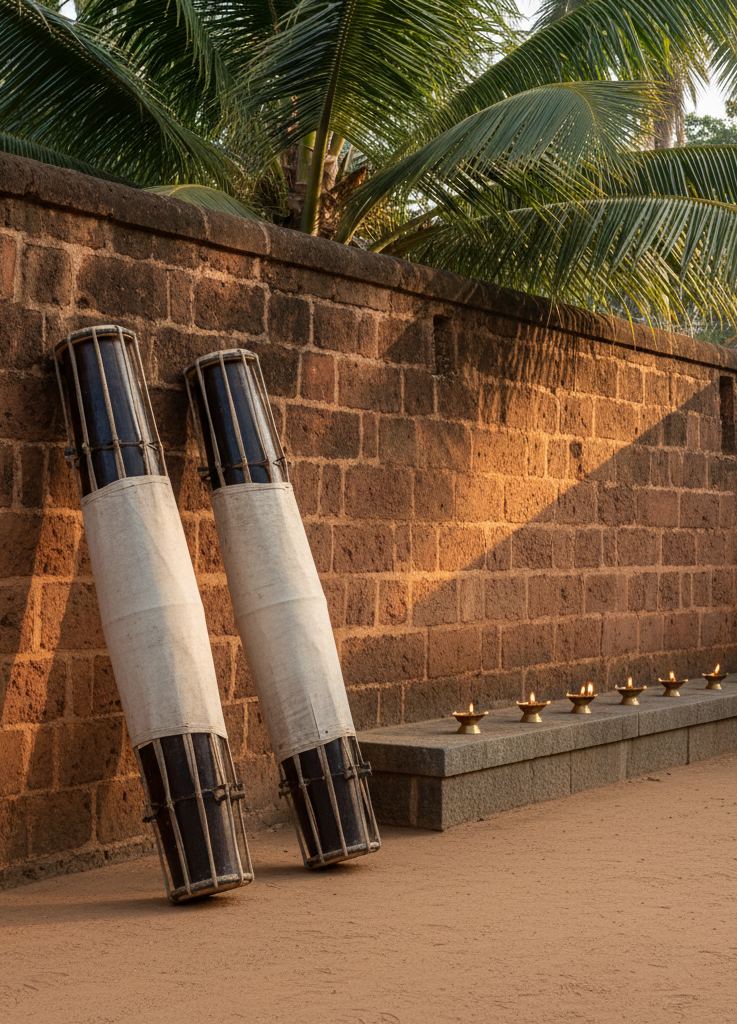
- late afternoon
- the yard swept, oil lamps set along the low wall, the husk heap lit if the night has fire in it
- 19:30
- the thottam, sung in half dress with no paint, to two drums and a pair of cymbals
- 21:00 to 01:00
- the face written on in the shed, flat on his back, four hours for the elaborate figures
- 01:30
- the first small figures out, forty minutes each, the yard still half empty
- 03:00 to 05:00
- the fire passes if there are any, the coal bed raked level between them
- 05:45 to 06:30
- the tall headdress raised inside the shed and walked out into the first light
- 07:00 to 08:30
- the deity at the platform, turmeric into people's hands, one household at a time
- by 09:30
- paint off with coconut oil, rice served in the yard, the drums packed away
Two rivers, two districts, and the driving at three in the morning
The country that carries these nights is a strip roughly 120 kilometres long between the Valapattanam river in the south and the Chandragiri in the north, with the sea down one side and the first ridges of the hills about forty kilometres inland. It is settled thickly the whole way: coconut land, cashew, tile roofs, and a shrine every few kilometres, several hundred of which hold something in these four months. Almost none of it is signposted for a visitor, and almost none of it begins at the hour you were told.
That is what the car is for. Your driver keeps the same hours you do, seven in the evening until nine or ten the next morning, and the runs between shrines are twenty minutes to an hour and a half on roads two lanes wide with a bus coming the other way. Where a night's shrine sits on the far side of the backwater, the crossing belongs to the company that runs these nights, which holds it under its own licence and bills for it on its own invoice; it is not something this agency sells you.
Heat decides the second half of the window. December and January nights sit at 21 to 23 degrees and the afternoons at 31 to 33, which is comfortable enough to sleep through with a fan and the shutters closed. By the second half of March the afternoons reach 34 to 36, the nights hold at 24, the yard keeps the day's heat past midnight, and the paint takes noticeably longer to dry, which pushes the dressing later and the tall figure closer to seven. If you are choosing between December and March on nothing else, take December.
Which nights you get, and how the calendar is assembled
No shrine here works to the Gregorian year. Each one fixes its festival by the Malayalam calendar and by its own reckoning, so the same shrine moves a fortnight or more against your diary from one year to the next. Some hold a festival every year. Some hold one every third year, or every twelfth, and some on an interval nobody outside the family will state. There is no single list of all of it anywhere, and the way the calendar actually gets assembled is the interpreter telephoning shrine committees through November and writing down what he is told.
So this runs the opposite way round from an ordinary itinerary. You give us the weeks you can travel, we come back with what falls inside them, and we say which six nights we would set against your eleven. Getting that written down with a figure attached takes two to four working days, and the wait is real work rather than a queue: the four rooms at the family house have to be held as one block, the driver and the interpreter have to be held for the same stretch, and each of the six nights has to be confirmed with a different shrine committee before any of the rest means anything.
Not one item on the included list belongs to Roving Hours. The rooms behind the coconut garden are somebody's house, the car has another name on its paperwork, and the shrine is the property and the burden of the family that has always held it. Once your dates are fixed, the company that runs the nights invoices you directly, on its own terms, and what you pay goes to it and never passes through this agency. Nothing is taken here at any point, and there is nothing on this page to settle.
The long leg is yours. No air ticket is sold from this agency, and your eleven nights begin once you are on the ground in the district and end on the morning you leave for the airport.
Roving Hours Bookings LLC, which operates under the name Roving Hours, works from 1350 N. Orange Avenue, Suite 221 in Orlando, FL 32789, in Orange County, Florida. Telephone +1 (407) 629-3157, or put your weeks in writing to bookings@rovinghours.com and we will cost them. If a figure on this page does not match what you were told on the telephone, send it to corrections@rovinghours.com and we will settle which of the two is right.
Start with the weeks, not the country
This form takes requests every hour of every day, and a person answers within one business day. Nothing here commits you. No figure is charged at this end.