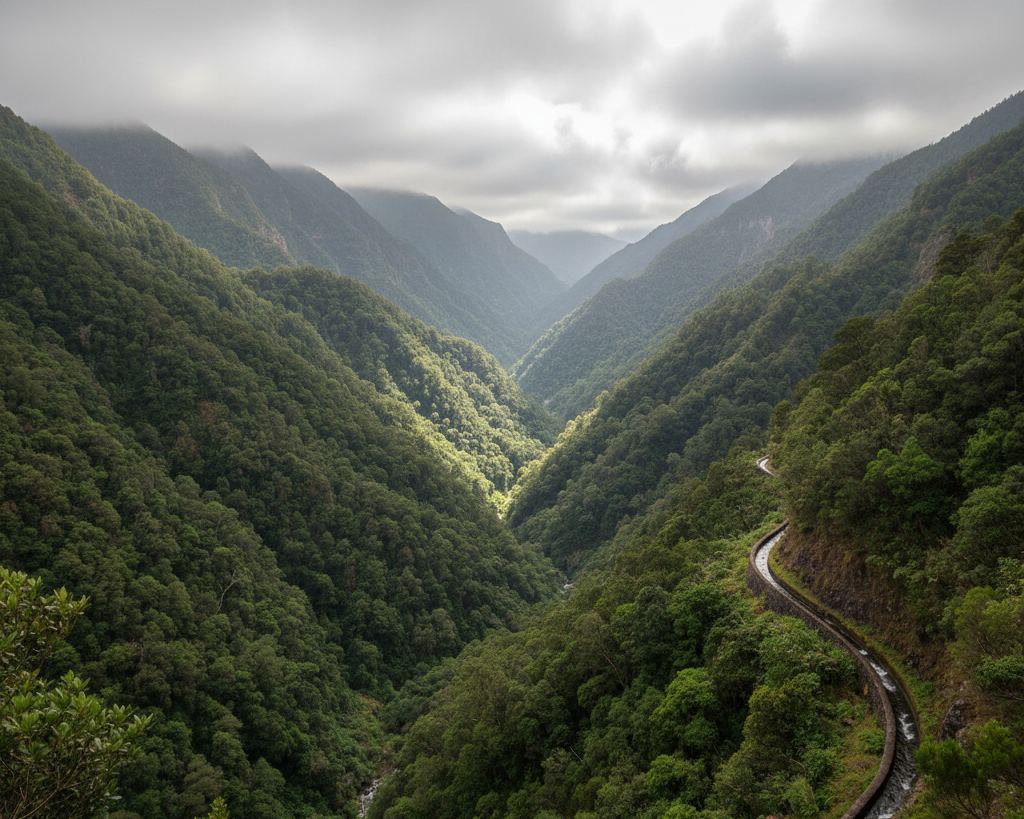
wet basalt underfoot, laurel in flower, cloud sitting above the channel
Reserve a Madeira levada walking trip in April and the first week of May
Eight nights on Madeira with eight walking days along the island's irrigation channels, inside the window that runs from the first of April to the second week of May, from $4,112 per person on two sharing. You are there for the weeks when the laurel is in flower and the cloud base has lifted high enough that the mid altitude paths run in clear air underneath it instead of inside it. One of the eight mornings is spent on the high ridge with the cloud below you rather than around you.
Reserve a windowAn answer is written inside one business day by somebody at this end.
A levada is an irrigation channel with a maintenance path running along beside it. Water is taken off the wet north side of the island and walked around the contours to the dry south side at a fall of about one meter in every thousand, which is a gradient you cannot see and can feel in your calves after four hours. Somebody has to walk each channel to pull the leaf litter out of it and work the gates, and that footpath is the reason it is possible to get into the middle of a laurel forest at 900 meters on level ground. Eight nights here are built around eight of those walks.
April is the month in which three separate things line up. The routes the forest service shut over the winter for rockfall clearance come back into use across the first fortnight. The laurel comes into flower, small cream clusters sitting in the leaf axils that you smell twenty paces before you see, with the vinhático and the tall island geraniums out on the bank underneath. And the cloud, which through February and March sits down at 500 or 600 meters and puts you inside it for the whole walk, has usually risen to somewhere between 1,100 and 1,400 meters, so the mid altitude channels run in clear air with a ceiling above them and you can see across the valley you have been cut into.
You are based twice. Five nights in a seven room guesthouse above the south coast at about 600 meters, then three on the north coast where the rain actually falls. The vehicle leaves the yard at 07:45 and seats nine. The guide is the operator's own, an islander who walks these channels in winter too and knows which stretch has render down this year and which tunnel is running knee deep.
Runs April 1 to May 8.
The window opens when the channel paths that the forest service shut over the winter for rockfall clearance come back into use and the laurel comes into flower, and it shuts in the second week of May when the flower has set into fruit and the settled summer cloud starts sitting down on the north side routes through the middle of the day.
Reopening dates move by two or three weeks depending on how wet the winter ran, and the capital's flower festival moves with Easter and can fall anywhere from late March to early May, so the office holds your rooms across the whole five weeks rather than against a fixed date and the operator fixes the walking order about a week out.
Most of the daylight. Walking is held inside the working daylight, from about 07:45 at the vehicle until somewhere between 16:30 and 18:00 back at the house, which on April 20 takes nine of the thirteen hours between sunrise at 07:32 and sunset at 20:40.
The rest of the day is the drive back down, dinner at 19:30 and two hours of light after it that most people spend on a terrace with their boots off, the single exception being the 06:00 departure on the ridge day.
8 nights, from $4,112 per person.
The flower is close to dependable: the laurel is in bloom somewhere on the island across the whole of this window in most years, and the failure case is that the low ground is two weeks past its best rather than that you see nothing. The cloud is not dependable and nobody underwrites it, so the ridge gives a clear top on roughly two April mornings in three, about one week in five is wet enough that two or three walks are swapped for lower or drier routes, and the forest service can shut a named path for rockfall on the morning with no date given for reopening it.
- What this office books
- The office reserves the two rooms held at each of the two guesthouses, the vehicle and its driver across all eight walking days, the guide who walks with you, the regional charge on each official route and the road transfers at either end; it reserves nothing connected to your flight, to your lunches on the free day, or to a car you take out on your own account.
- Who books it
- A person booking this wants to walk a shelf eighty centimeters wide cut into a cliff face with running water beside their boot, in the five weeks when the forest above it is in flower and the air under the cloud is clear enough to see out.
- Why somebody picks another window
- If what you want is the endemic orchids standing on the shaded banks and the tall blue spikes out along every coast road, the last ten days of May and the first of June do that better, and what you give up for it is a lower ceiling on the north side and fuller paths.
- In the figure
- Eight nights in two guesthouses, five in a seven room house above the south coast at about 600 meters and three in a six room house on the north coast, with two rooms held at each; breakfast at 07:00 at both, with flatbread pressed on a hot basalt slab; the vehicle and its driver for all eight walking days, seating nine; the operator's own guide on every walking day, an islander who walks these channels through the winter as well; the regional charge on each official route walked, currently three euros a person a route; a head torch each for the unlit tunnels, with a spare carried in the vehicle; eight packed lunches made at the house, bread, tuna, banana and a piece of honey cake; dinner at the house on six of the eight evenings; one afternoon on the treeless eastern peninsula, put in as the deliberate opposite of the forest; the road transfer from the island airport in both directions, about 35 minutes to the first house and an hour to the second; local tourist charges and taxes; a printed sheet giving each route its length, its fall, its tunnel lengths, its unfenced sections and the two wet weather alternates held in reserve.
- Not in the figure
- Your own round trip flight from Orlando to the island, which you arrange yourself and which in April has been running about $940 to $1,780 with one or two changes in Europe; the two dinners not taken at the house, about $18 to $45 a head with wine; lunch and coffee on the free day, $12 to $30; a car for the free day, about $45 to $80 a day in April with fuel near $7.20 a gallon equivalent; parking in the capital, $2 to $4 an hour; boots, a waterproof shell and poles if you do not already own them, $60 to $220 bought on the island; the cable car out of the old town on the free day, about $20 up and down; cane spirit with honey and lemon and whatever follows it, $4 to $8 a glass; honey cake, wine off the north coast terraces and embroidery to carry home, $9 to $60 an item; single room supplement, $1,125 for the eight nights; laundry at the second house, $12 a load.
- Who this window will not suit
- Four of the eight days put you on a shelf between 50 and 80 centimeters wide with a channel of running water on one side and an unfenced fall of 100 to 200 meters on the other, and there is no version of this week that avoids all four. Three routes go through unlit tunnels, the longest about 150 meters, with water over your boots and a roof low enough in places that you walk it stooped. The basalt on the north side is wet at every hour of every day, the walking runs eight to ten hours with 400 to 900 meters of climb in it, and one morning starts at 06:00 in the dark at four degrees. Anyone who wants a pool, a lie in and sand should book a different page: the shore here is basalt and shingle, and the one sand beach on the south coast was brought in by ship.
A starting figure for two people sharing one room. Pricing the exact window you pick runs two to four working days, because the company working those dates answers first. No air ticket is ever folded in.
What a day on a channel is
The channel is usually 40 to 60 centimeters across and about as deep, rendered smooth inside, with the water moving at close to walking pace beside your right boot for most of the morning. The path is 50 to 80 centimeters wide. On the newer stretches there is a cable or a length of rail on the open side. On the older ones there is nothing at all, and on the high contour above the western valleys the ground goes away below the path for 100 to 200 meters with the crowns of trees at eye level. You walk in single file and nobody overtakes anybody.
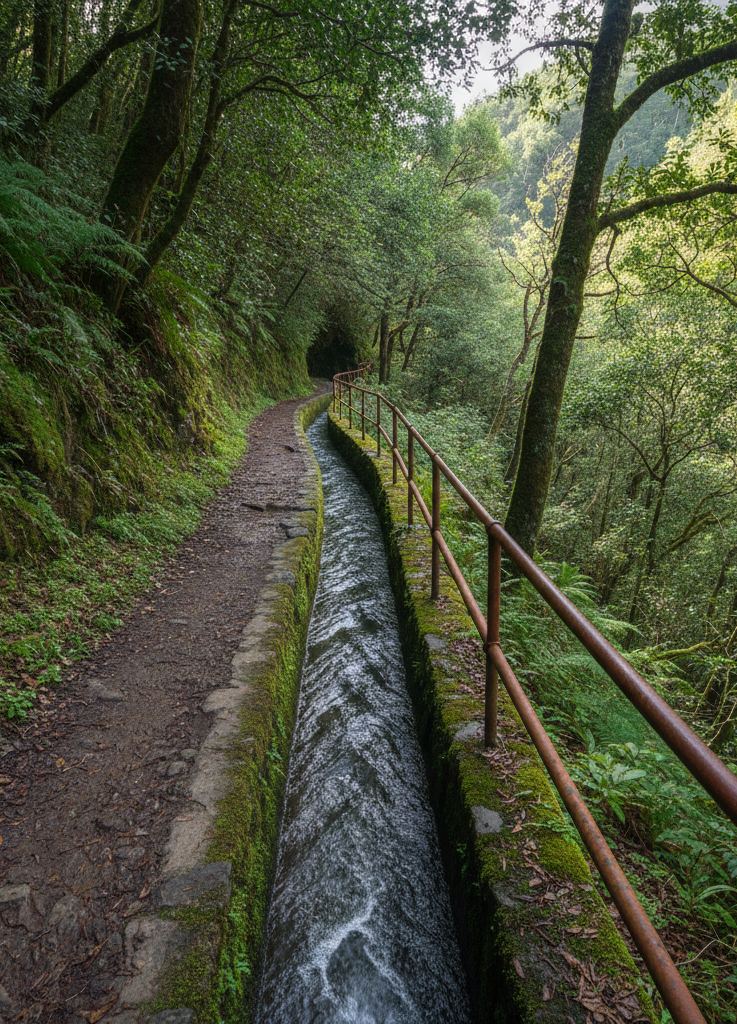
Three of the eight routes pass through tunnels driven straight through a spur where the channel could not be carried around it. They are unlit, about two meters high and dropping to something near 1.7 in places, and you walk them in water. The longest here runs about 150 meters and takes four minutes. Torches go out at the vehicle with a spare in the back, because a tunnel is the one place on the island where a telephone screen is not enough light to put your feet down by.
Water is still shared out here in units of time. A holding above a channel has a right written as so many minutes at a named gate on a named weekday, and the man who works those gates walks his section every week of the year. If you meet him he is carrying a mattock, and he has come straight up the slope you spent forty minutes contouring around.
Above the cloud line and under it
One day of the eight starts at 06:00 in the dark. The vehicle climbs to the ridge station at 1,818 meters, where April at that hour sits between 4 and 8 degrees before the wind is counted, and the walk goes out along the spine toward Pico Ruivo at 1,862. It is cut into the flank of the ridge with steps and three short tunnels, about 550 meters of climb across seven kilometers out and back. The sun comes up at 07:32 on April 20 and you want to be on the ridge first.
What you are up there for is the cloud lying below you instead of around you. When the inversion holds, the deck sits at 1,100 to 1,400 meters and the four high tops stand out of a white floor while everything under them is buried. Across April that works on something like two mornings in three. When it fails you are climbing a stone staircase inside fog at four degrees with fifteen meters of visibility, which is a wholly different morning and not a worse one if you brought the right shell. Nobody underwrites cloud, and this page will not pretend a mountain can be ordered in advance.
Ice on the ridge is possible into the first week of April and the route shuts when there is any. So does wind over about 60 kilometers an hour on the tops, and that call is made and posted by the forest service rather than by your guide. When the ridge is shut the day moves to the plateau at 1,300 to 1,500 meters, which is treeless, boggy, full of loose cattle and completely unlike everything else in the week.
The last three nights are on the north coast, in a village of about 700 people with the water coming off the hill directly behind the houses. Above those houses is the forest the island's world heritage listing was written for in 1999: roughly 15,000 hectares of laurel, a fifth of the land area, left from a forest type that covered much of southern Europe before the ice came south. Trees of 30 meters and more stand in the wet valleys, and the floor under them is a mat of moss and fern that holds water for weeks after the rain stops, which is the reason the channels still run in August.
The five weeks and what each of them does
Flower and walking conditions both move up the island as the month goes on, and they do not move at the same speed. What follows is what these weeks usually do, and usually is carrying weight in that sentence.
- April 1 to 7
- Most routes back in use after winter clearance, laurel out on the lower banks, cloud still dropping to 800 meters on two days in five.
- April 8 to 14
- The channels between 700 and 1,000 meters come into their best air, and the north coast paths are still thin of people.
- April 15 to 21
- Flower at its fullest through the forest, ridge clear on roughly two mornings in three, sunrise 07:32 and sunset 20:40.
- April 22 to 30
- The capital fills for the flower festival in most years, the coast roads go blue with the tall spiked endemic, walking unaffected either way.
- May 1 to 8
- Laurel setting fruit, the first orchids standing on shaded banks at 900 meters, 23 degrees in the capital by mid afternoon.
- After May 10
- Flower finished, cloud settling back down onto the north side routes through the middle of the day, and the paths carry more feet.
- Any week at all
- Wind over about 60 kilometers an hour shuts the high ridge, and a wet spell can close a named channel path for rockfall the same morning.
Getting onto the island
The airport sits on the south coast about 20 kilometers east of the capital, with the far end of its runway carried out over the sea on concrete columns, and the transfer from it is included in both directions: about 35 minutes to the first house and an hour to the second. Reaching the country is your own arrangement and no airfare is handled at this office. Nothing on this trip crosses water, and the passage over to the smaller island to the northeast forms no part of it.
Solar noon falls at 14:06 by the clock on April 20, because the island keeps mainland summer time from seventeen degrees west, so the sun peaks in the middle of the afternoon and there is light on the terrace until nearly nine. Dinner at the north coast house is at 19:30, usually beef threaded onto a stick of bay laurel and cooked over wood, with flatbread pressed on a hot basalt slab and a glass of cane spirit stirred with honey and lemon on a wooden stick. Village shops shut between about 13:00 and 15:00, so anything wanted in the evening is bought before one.
Roving Hours owns nothing on this page that carries or shelters anybody. The two guesthouses, the vehicle, the guide and every meter of walked channel belong to the company that runs this window on the island, and that company writes your bill on its own paper under terms it sets. Send the stretch of the five weeks you are aiming at and how many of you are walking to bookings@rovinghours.com, or call +1 (407) 629-3157 and say which end of the window suits. A costed answer against your dates comes back inside two to four working days, since the rooms and the vehicle have to be held against a walking order the operator does not fix until about a week out. Roving Hours Bookings LLC, which operates under the name Roving Hours, works out of 1350 N. Orange Avenue, Suite 221, Orlando, FL 32789, in Orange County, Florida, and anything on this page that reads wrong against what you find on the ground should go to corrections@rovinghours.com.
Start with the weeks, not the country
This form takes requests every hour of every day, and a person answers within one business day. Nothing here commits you. No figure is charged at this end.