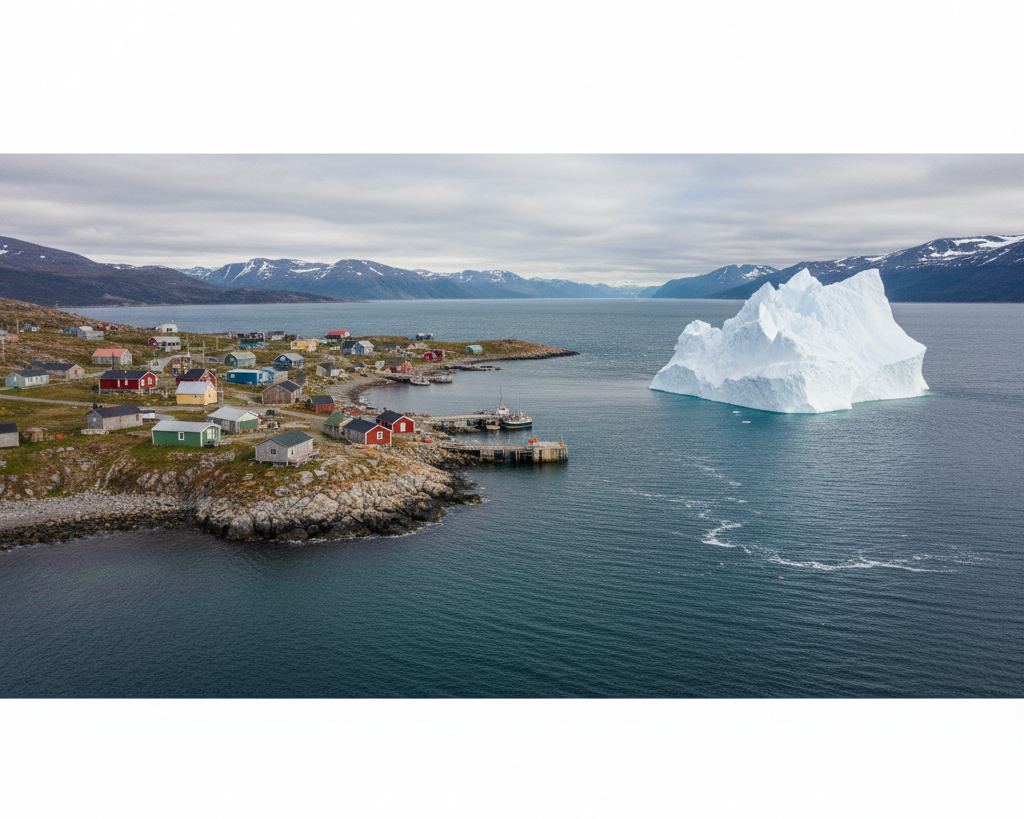
fizzing ice a quarter mile off, water at two degrees
Reserve an iceberg trip in Newfoundland for the late May to late June window
Seven nights on Notre Dame Bay with a driver, a guide, two bases and three programmed boat mornings, from $3,877 per person on two sharing, between May 24 and June 28. The dates carry the whole thing: ice made on the Greenland sheet and carried down the Labrador coast grounds in this bay for about five weeks, and the itinerary is built to sit inside them.
Reserve a windowAn answer is written inside one business day by somebody at this end.
The ice that grounds in Notre Dame Bay at the end of May is old in a way that is hard to hold in the head. It fell as snow on the Greenland sheet somewhere between eight and fifteen thousand years ago, was pressed until the air in it went to bubbles under load, then moved seaward a few feet a day for longer than a human life before coming off a glacier front on that island's west coast. People who reserve an iceberg trip in Newfoundland are buying seven nights set inside the few weeks when the end of that journey is aground in water shallow enough to sit and watch from a rock.
The route is long and it is not direct. Bergs calved on the west Greenland coast go north first, up into Baffin Bay, cross to the Canadian side and only then turn south, carried down the Labrador coast on a cold current running at well under a knot for most of its length. Two to three years is an ordinary crossing. Something that grounds off Twillingate this June left the glacier front while you were somewhere else entirely, and about nine tenths of it has been below the surface the whole way.
Notre Dame Bay is one of the places they stop. It opens due north, which is the direction the ice arrives from, and behind that opening it is a tangle of islands, tickles and shoals with the bottom at forty to eighty metres in runs where the current would otherwise take a berg straight on past. Anything with a keel deeper than the bottom touches, swings on it and stays. That is why these weeks are sold as one bay rather than a length of coast.
Runs May 24 to June 28.
The window opens when the last winter pack has gone out of the inner bay and the small boats can leave their moorings again, normally in the third week of May, and it shuts at the end of June, when surface water near six degrees has cut the waterline notch deep enough that a grounded berg comes apart over days instead of weeks.
The bay has been clear of pack by the first week of May in a light year and still plugged with it at the end of that month in a heavy one, so your dates are costed against the season actually in front of you and the running order of the seven days is fixed once that week's ice charts are out.
Most of the daylight. The programmed part of the day runs from about 08:00 to 18:30, with the boats in the morning while the bay is still flat, the headlands at midday, and a second run or a shore walk in the late afternoon.
What is left is a very long bright evening, still full daylight at nine and not properly dark until after ten, and nothing at all is arranged in it.
7 nights, from $3,877 per person.
In an ordinary season there is ice of some size aground somewhere in Notre Dame Bay for the whole of these five weeks, and the guide moves you between the two ends of the bay according to where it actually is; in a thin season the count of bergs crossing the lane at forty eight north falls under two dozen, and the bay can go a week holding nothing larger than a growler. No one can promise ice and this office will not: the figure holds the nights, the vehicle, the guide and the seats, and none of that is conditional on what floats in.
The seven nights split four and three. Four go at Twillingate, at the far end of the causeway road out from Boyd's Cove, where the boats work and where the headland at Crow Head puts you 320 feet above the water with the whole northern approach in front of you. Three go at the western end of the bay near Triton, on an arm that holds ice into late June in some years and holds none at all in others. The two ends can be carrying completely different ice on the same afternoon, which is the reason for two bases instead of one.
- What this office books
- The office reserves the seven nights, the vehicle and driver for all seven days, the guide and your seats on three boat mornings; it arranges nothing that flies, and the boat passage itself is held under the operator's own licence and billed by that operator.
- Who books it
- Somebody booking this wants to stand within a few hundred metres of a piece of the Greenland ice sheet while it is aground and still working, in the short run of weeks when it is close enough in to be watched from a rock.
- Why somebody picks another window
- If whales matter more to you than ice, the middle two weeks of July put capelin on the beaches and humpbacks in the bay, but by then most of what grounded here has broken up.
- In the figure
- Seven nights, two sharing, in owner run houses of three to six rooms, four at Twillingate and three at the western end of the bay near Triton; breakfast every morning, put out early on boat days; a vehicle and a driver for all seven days, including the run in from the airport at Gander and back, about 60 miles each way; a guide who has worked this bay through several ice seasons and who has the day's ice charts read before you are up; seats held for you on three morning boat departures, two from the Twillingate side and one from the western arm; an afternoon at the headland light at Crow Head with the walk out along the cliff top; a shore day on foot along the tickles when wind keeps the boats in, with the ice looked at from land instead; every road transfer between the two bases, the wharves and the headlands; the use of a spotting scope and binoculars kept in the vehicle; and a written running order for the week, sent before you go, showing when each boat morning leaves and what stands in its place when it does not.
- Not in the figure
- Airfare, which you arrange yourself, Orlando to Gander with a Canadian connection, about $780 to $1,690 round trip across these weeks; the boat fares, billed to you by the firms that run the boats, about $58 to $85 a person on each of the three mornings; lunches and dinners, $22 to $70 a person a day; the vehicle ferry to the islands on the eastern side of the bay if you spend a free afternoon that way, $12 to $34 a person with a car, held and billed by the ferry operator; a waterproof shell and a warm mid layer if you do not own them, $90 to $260; rubber boots that come above the ankle, $40 to $95; entry to the small local museums and the light station, $6 to $18 each; a single occupancy supplement of $505 across the seven nights; anything bought along the harbour road; and tips, which are left entirely to you and sit outside the figure.
- Who this window will not suit
- This is a cold, wet, grey week and it will not read as summer to anyone leaving Orlando in June. Water beside the boat is at freezing point, the wind comes off it with nothing in the way, and fog can take a berg out of sight for two hours at a time from three hundred metres. Do not book it if you need the thing to be there: a warm, quiet season leaves this bay holding a few growlers and some flat grey water, and nothing about that comes back off the figure. It is also wrong for anyone who wants the evenings filled, because the sun is up until nine and the office arranges none of it.
A starting figure for two people sharing one room. Pricing the exact window you pick runs two to four working days, because the company working those dates answers first. No air ticket is ever folded in.
What is aground out there, and how big it gets
The size classes are not descriptive language, they are the working terms on the radio. A growler stands under a metre out of the water and runs less than five metres long. A bergy bit is one to four metres up and five to fifteen long. A small berg is five to fifteen metres above the surface, a medium one sixteen to forty five, and anything more than seventy five metres up counts as very large and is uncommon this far south by June. What usually grounds in these tickles is the small and medium end, which still puts a wall of ice the height of a five storey building in front of the boat with eight or nine times that much hanging under it.
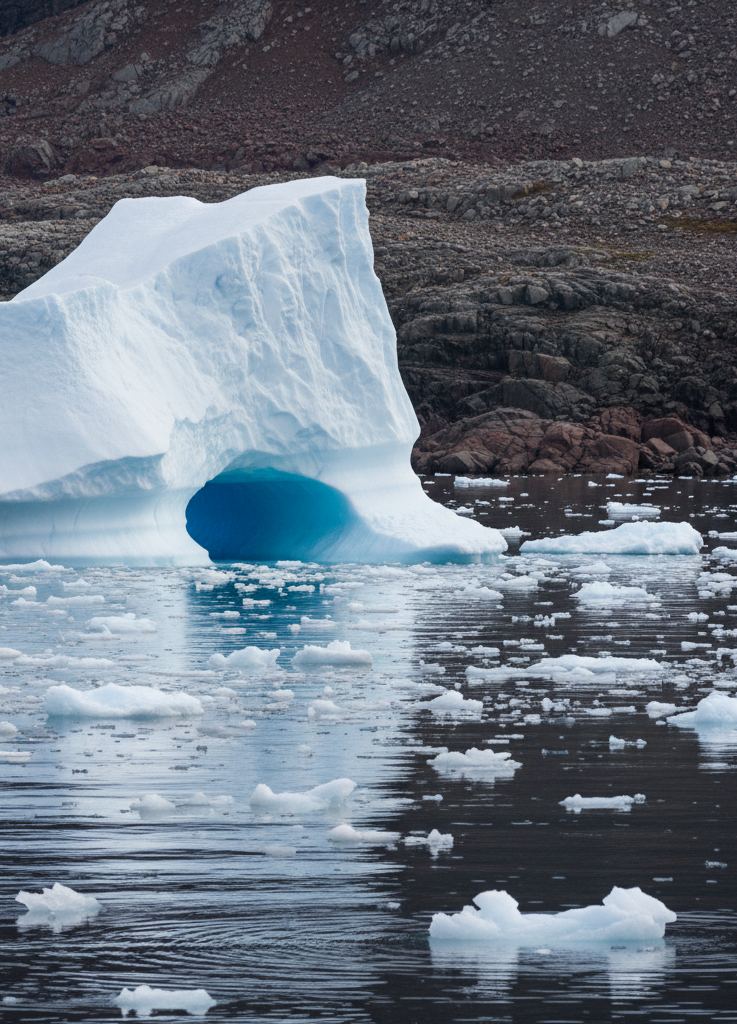
Colour tells you what the ice has been through. White is air, snow that kept its bubbles. A blue vein is meltwater that ran into a crack up on the sheet, refroze under pressure with the air pushed out, and came down inside the berg as a clear seam. A brown or black band low down is rock flour the glacier scraped off its bed. A smooth scoured face with a notch cut round it at the wrong height means the thing has already rolled once and is showing you what used to be its keel.
Sound carries further than anything else here. On a flat morning a berg is audible from a quarter mile as a continuous fizz, which is ten thousand year old air coming out of the melting surface, and every so often a crack with no warning in front of it.
The five weeks and what changes across them
The window opens on ice going out, not on ice coming in. Winter pack comes down the same current ahead of the bergs and can fill this bay solid; while it is in, the small boats stay on their moorings and the wharves are unusable. In an ordinary year the last of it leaves the inner bay in the third week of May, and that is where these dates start. They finish at the end of June for the opposite reason: by then the top metre of water is up around six degrees, the melt notch at the waterline is deep, and a grounded berg comes apart over a few days rather than a few weeks.
Late May gives the biggest ice and the most of it, with the coldest air, the cleanest light and a real chance of pack still lying in the northern tickles. The first week of June is normally the steadiest of the five: the bergs are settled where they grounded and the fog has not reached its worst. The second and third weeks trade some ice for warmth and for whales, because the first humpbacks usually come into the bay behind the capelin. The last week is a melting week, with fewer bergs, faster change, and the likeliest week for watching an arch drop or a berg turn over from the boat.
The hours this window is programmed for
Three of four means most of the daylight, and in these weeks there is a great deal of daylight. At Twillingate on May 25 the sun comes up at 05:12 and goes down at 20:59. By June 21 it is up at 05:00 and down at 21:20, and it is not properly dark until an hour after that. Sixteen hours is more day than the trip has any use for, so the programmed part runs from about 08:00 to 18:30 and the rest is left to you.
Inside that, the shape of the day is set by wind rather than by ice. The bay is flat at breakfast more often than not and the wind gets up through the middle of the day, so the boats go in the morning. Midday goes to the headlands, because a berg seen from 320 feet up is a different object than the same berg from the water, and the keel shows from the cliff top as a green shelf a hundred metres long. Late afternoon is the second run if the wind dropped back, or a walk along the shore of a tickle if it did not. Nothing is programmed before dawn or after dark, because there is very little of either and the ice does nothing at two in the morning that it does not do at four in the afternoon.
- 05:00
- light already up, and nobody is asking you to be
- 07:30
- breakfast, the guide already through the morning ice chart
- 08:15
- down to the wharf, the boats go before the wind does
- 11:00
- alongside again, hands cold, the swell starting to build
- 12:30
- lunch out of a cooler in the lee of the light at Crow Head
- 14:00
- cliff top, 320 feet up, the keel green under the water
- 16:30
- second run if the wind fell away, shore of the tickle if not
- 18:30
- the arranged part of the day ends here and the evening is yours
- 21:20
- sunset, with another hour of light after it
Fog, wind, and the mornings the boats stay in
Fog is the standing condition of this coast in June and it comes from the same current that brings the ice: cold water sitting under warmer air. It arrives in banks half a mile wide with clear sky either side, and Twillingate averages close to ten foggy days in the month. A boat morning is not cancelled for fog alone, but it changes what the morning is: a berg visible from the wharf at seven can be gone at eight and back at nine.
The boats also stay in for swell and for wind much above twenty five knots, which in a normal June is a handful of mornings. Operators work back from a grounded berg by at least its own length, and further when it is shedding, because melt is uneven and it turns over when the balance goes. On the mornings the boats do not run, the guide takes you to the headlands and along the shores of the tickles, where in most years something is aground close enough in to be looked at from land.
This office owns no boat, no vehicle and no bed. It holds the seven nights, the driver, the guide and your seats, and the invoice for the boat mornings is written by the firm in the bay that actually takes you out, on terms that firm sets. Getting yourself onto the island is your own arrangement and nothing that flies is handled here.
Send the dates you are considering and a costed answer comes back inside two to four working days; the houses out here have three and four rooms and reply one at a time. Roving Hours is the name Roving Hours Bookings LLC works under, at 1350 N. Orange Avenue, Suite 221, Orlando, FL 32789, in Orange County, Florida. Written questions go to bookings@rovinghours.com, changes to dates already held go to corrections@rovinghours.com, and the office line is +1 (407) 629-3157.
Start with the weeks, not the country
This form takes requests every hour of every day, and a person answers within one business day. Nothing here commits you. No figure is charged at this end.