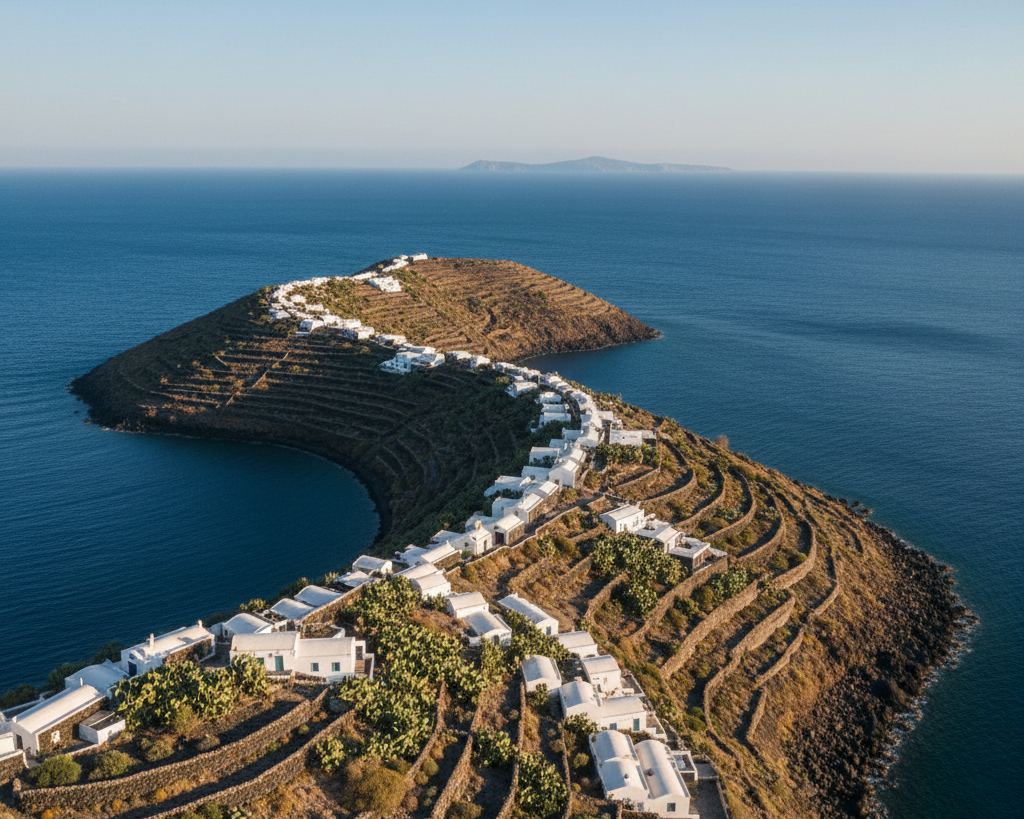
salt in the cuts and the buds off the wall by nine
Reserve a caper harvest trip on Pantelleria, June to the second week of July
Eight nights in a two room stone house above the western terraces, four picking mornings on alternate days and three sessions at the salting store, inside a window that runs from June 1 to July 12, from $4,753 per person on two sharing. The buds have to be off the bush before the sun is properly on them, so the work starts at ten past four and is finished by half past nine. You go home with a kilo of your own crop, under salt you drew the brine off yourself.
Reserve a windowAn answer is written inside one business day by somebody at this end.
You can reserve a caper harvest trip on Pantelleria for any eight nights inside the window, and what you are reserving is four working mornings rather than a look at a field. The island lies about 60 miles southwest of Sicily and 43 miles off the African coast, and the bud that pays for most of what grows here has to be off the bush before the sun is properly on it. So the alarm goes at ten past four. By half past nine the picking is over, the tubs are weighed, and the whole rest of the day belongs to you.
The plant is low and spiny and comes straight out of the dry stone walls and the black terrace faces, because in this wind there is nothing else for it to come out of. What gets picked is the closed flower bud, hard and about the size of a pea. Heat opens it, and an open one is a flower, worth looking at for a day and worth nothing in the tub, which is why pickers are on the terraces in the dark and off them before the field air goes past 28 degrees. One block of bushes comes round every eight or nine days in June, so the farm halves its ground and walks one half on one morning and the other half on the next. You go out on the alternate mornings, four of your eight.
The other half of this is salt. What you take off the wall at five o'clock goes into a tub at ten under roughly forty percent of its own weight in coarse sea salt. The brine that comes out is drawn off, the tub is salted a second time after eight or nine days and a third time ten days after that. Nothing is cooked and nothing goes near vinegar, and nothing leaves the store under thirty days. You do three of those sessions and, on the last morning, you put a tub through the sieve set and sort it by diameter, from the ones under seven millimeters up to the ones over thirteen.
Runs June 1 to July 12.
The first flush of buds is heavy enough to walk the terraces in the last days of May, and by the second week of July the plants have turned most of what they have to fruit while the morning heat now reaches the fields before a picker can finish a row.
The opening slides about ten days either side of June 1 with the spring, so the office holds a provisional week for you and the farm settles it in the second half of April, once somebody has walked the terraces and counted what is on them.
A morning or an evening. The programmed hours are 04:40 to 09:30 on the terraces, followed by an hour and a half at the salting store on the same mornings.
Everything after that is yours, and it is mostly heat: the island shuts between one and five, and the sun stays on the western rocks until about half past eight.
8 nights, from $4,753 per person.
A caper harvest is a crop and no one underwrites a crop: the bushes work in flushes of eight or nine days, and a sirocco week or a cold wet April can leave a block thin enough that a morning runs two hours instead of four. You will pick on all four mornings and the salting and grading happen whatever the field gives, but if a flush falls badly the farm moves you to a second block on the east side rather than promise you a heavy row.
- What this office books
- The office reserves the house, the four field mornings, the three salt sessions, the grading and every ground move between them, and it reserves no air, holds no money, takes none, and owns nothing that carries or shelters a traveler.
- Who books it
- Somebody books this to do the work at the hour the work is actually done, and to come home with a kilo they took off the wall themselves rather than a photograph of a field.
- Why somebody picks another window
- If you want the sea at 26 degrees, a long swim before dinner and nobody waking you in the dark, take a September window instead, when the vines are in and the caper year is finished.
- In the figure
- Eight nights in a two room dammuso with its own cistern and terrace, two sharing; four picking mornings on the terraces, taken on alternate days, with gloves, tub and a picker's apron; a fifth morning added at no change if a flush lands inside your dates; breakfast eaten sitting on a wall at about seven, bread, tomato and the farm's oil; three sessions at the salting store, weighing in, layering, turning and drawing off brine; the grading through the sieve set on your last morning, from under seven millimeters up to over thirteen; three lunches at the farmhouse on picking days; one evening in the cellar of the family who work the hollows, with the sweet wine of the island poured by them; a walk to the steam vents on Montagna Grande with the farm's man, leaving at six; every ground move on the island between house, fields and store; one kilo of last year's cured crop, packed for the journey; a day by day running order for the eight days from the company on the ground.
- Not in the figure
- Round trip air from Orlando into western Sicily, $760 to $1,620 depending on when you buy and how many connections you take, since reaching the country is your own arrangement and airfare is not handled here; the last leg out across the water from the Sicilian port, which the operating company holds under its own license and bills you for directly, $54 to $132 each way; a small hire car, which this island needs, $34 to $62 a day; fuel, about $7.60 a gallon equivalent; lunches on the four days that are not picking days, $9 to $24; dinners on the evenings nothing is arranged, $22 to $48; parking above the crater lake, $3 to $6; capers of your own bought at the store beyond the kilo included, $14 to $32 a kilo; anything you hand the pickers and the store hands at the end, $40 to $90 across the week; laundry at the house, $12 to $20 a load; single room supplement, $986 for the eight nights.
- Who this window will not suit
- The alarm goes at 04:10 on four of the eight mornings and nothing about this trip works if you sleep through them. You spend four hours bent into a spiny bush, and by the second day the salt at the store finds every cut on your hands. There is no sand on this island, the rock you get into the water over is sharp lava, and everything shuts from one until five whether you are bored or not. It is also a crop, so some mornings a row fills your tub and some mornings you are picking two hundred grams an hour, and nobody can say in advance which of those you booked.
A starting figure for two people sharing one room. Pricing the exact window you pick runs two to four working days, because the company working those dates answers first. No air ticket is ever folded in.
What opens the window and what shuts it
Two things close it, and they arrive together. By the second week of July the bushes have put most of what they have into fruit, and the crop after that is cucunci, the caper berry on its long stalk, which is a different job worked at a different hour. At the same time the heat is now on the terraces early enough that a picker cannot get through a row before the buds start opening in front of him. Before June, the other way, there is simply not enough on the bush to be worth walking.
None of that answers to a calendar. A cold wet April pushes the first serious pick into the second week of June; a dry warm one has tubs filling by May 26. The farm looks at the terraces in the second half of April and says which week it wants you, and if the whole thing moves it moves by about ten days, with your house and your ground transport moving with it.
Coming a fortnight early means standing in a field with very little on it and three sessions of salt work on somebody else's crop. Coming a fortnight late is worse, because the bushes are then in flower, and a caper field in flower is white and violet and completely useless to pick.
The mornings, from the alarm to the weigh in
You are up at 04:10 and on the terrace by twenty to five with a head torch, a canvas apron with a pouch across the front, and a tub weighed empty in front of a witness. The bud is taken with the fingers and never cut. The ones going soft at the tip are left, because they will be open by nine and are already lost. The bushes run knee to waist high and they are spiny, and the small cuts you collect on the first morning are exactly what the salt finds at ten.
A practiced picker takes eight to twelve kilos in the four hours. Your first morning will be closer to two kilos, and your fourth closer to five. The hard morning is the second one, not the first.
Breakfast happens where you are standing, at about seven, sitting on a wall: bread with tomato rubbed into it, the farm's oil, coffee out of a flask. First light in mid June is 05:22 and the sun clears the eastern rim at 05:53, and for a quarter of an hour before that the terraces go from gray to the color of rust and nobody picks anything.
- 04:10
- up, coffee taken standing in the kitchen, no talking
- 04:40
- on the terrace, torches on, tubs weighed empty
- 05:53
- sun off the eastern rim, torches into pockets
- 07:00
- bread and tomato on the wall, twenty minutes
- 09:30
- tubs weighed in, the day's picking closed
- 10:15
- at the store, layering salt and drawing brine off the tub from two days ago
- 13:00
- the island shuts and so do you
- 20:31
- the sun leaves the western rocks, dinner after that
Rock, steam and a lake with no outlet
There is a crater lake in the north with hot springs feeding its northern edge at 35 to 50 degrees and gray mud at the shallow end that people plaster on and let bake off. There are the steam vents on the flank of Montagna Grande, which stands at 836 meters, running at close to 100 degrees. On the southeast coast, at the harbor where hot water comes up between the rocks at the shoreline, you can sit in about 45 degrees with the open sea a meter away. Everything else is rock: the sea off it reads 21 to 23 degrees in June and about 25 by the second week of July, and you get in over sharp lava or not at all.
The dammuso you sleep in has two rooms, a terrace, walls near a meter thick and a dome on top. There is no fresh water on this island, no river and no spring, so the dome exists to run rain into a cistern under the floor and the cistern is the reason the house is where it is. On the drive between the house and the fields the vines are worth slowing down for. Each one sits in a hollow dug a foot into the ground with a single head pruned bush in it, out of the wind, and here and there a lemon tree stands inside a circular dry stone wall four meters high, built for one tree.
Getting out to the island
Reaching the country is your own arrangement and airfare is not handled here; from Orlando you are looking at western Sicily with one or two connections. The last leg is across the water from the Sicilian port, and the company that operates the ground here holds that passage under its own license and bills you for it directly. The night boat leaves late and lands a little after six in the morning, which puts you at the house in time to sleep before the first field morning. If you would rather cover that leg some other way, that is your own arrangement too and it is not booked from this office.
Roving Hours is the name used by Roving Hours Bookings LLC, a small independent booking office at 1350 N. Orange Avenue, Suite 221, Orlando FL 32789, Orange County, Florida. It reserves the house, the four mornings, the salt sessions and every move you make on the island, and it owns nothing that carries or shelters a traveler. No money passes through it in either direction: your bill is written by the farm company on the ground, on the terms that company sets, and it comes to you.
Send the dates you can actually travel, say whether one of you would rather sleep through the picking mornings, and say whether you want the fifth morning if a flush falls inside your stay. A priced answer against those dates comes back to you within two to four working days, because the week has to be checked against a harvest nobody has scheduled yet. Written questions go to bookings@rovinghours.com, and the number is +1 (407) 629-3157. If anything on this page does not match what you find on the terraces, write to corrections@rovinghours.com and it gets corrected.
Start with the weeks, not the country
This form takes requests every hour of every day, and a person answers within one business day. Nothing here commits you. No figure is charged at this end.