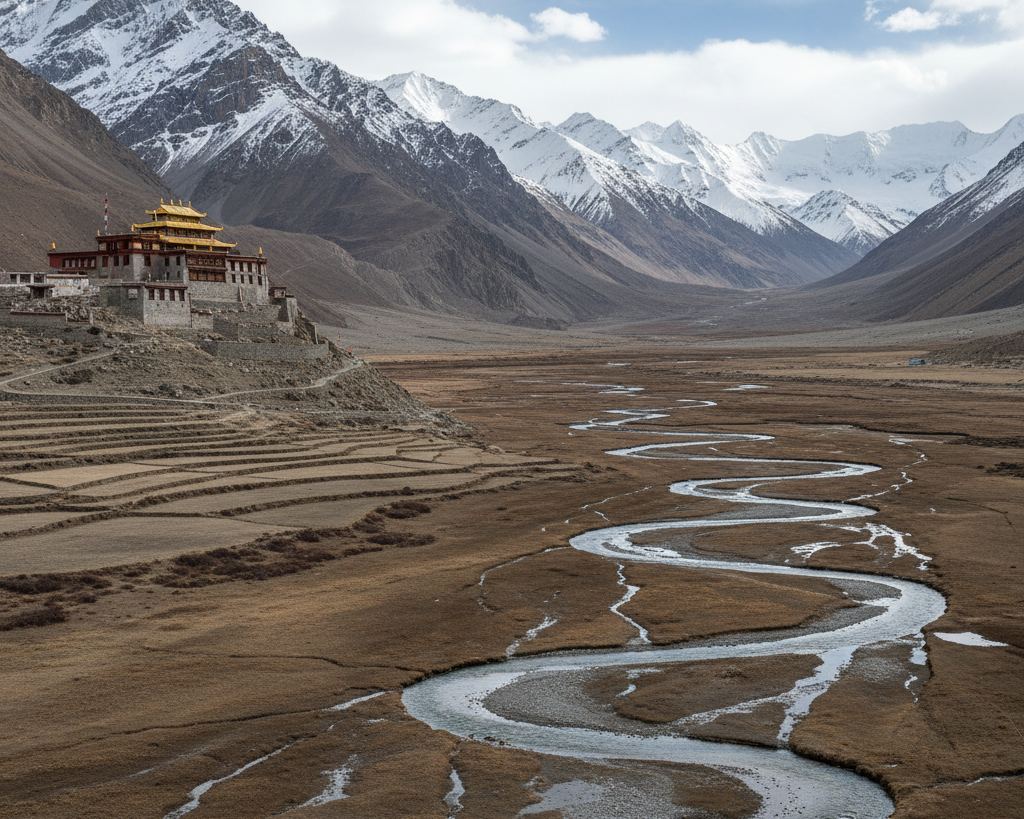
frost on the marsh grass and the first calls at half light
Reserve a Phobjikha valley crane trip, November to mid February
Nine nights in Bhutan, five of them in the valley itself, held on any week you pick between the first days of November and the third week of February, from $5,674 per person with two of you sharing a room. The black necked cranes come over the mountains from the plateau in late autumn, stand the nights in the shallow water of the marsh and feed the days in the potato fields, and go north again when the cold breaks.
Reserve a windowAn answer is written inside one business day by somebody at this end.
The flock comes over the mountains in the last week of October and the first ten days of November, in twos and threes to begin with and then in lines of twenty or thirty, and it drops onto the marsh that runs down the middle of the Phobjikha valley at about 2,900 metres. You can reserve a Phobjikha valley crane trip with Roving Hours for any week from that arrival until the birds lift north again in the second half of February. Nine nights, five of them in the valley itself, from $5,674 per person with two of you sharing a room.
The dates are the whole of it. Outside the window the valley is a wide quiet bowl of potato ground with a stream in the bottom and cattle on the marsh, and it is a pleasant place with nothing in it that you came for. Inside the window there are several hundred large grey birds standing in the shallows at night, and at first light they go out over your head in ones and pairs, calling, low enough that you hear the wings.
Five mornings are programmed and nothing else in the day is. That is on purpose. The birds keep a short schedule and they keep it at both ends of the light, so the trip is built around the early end of it and leaves the middle of the day open.
Runs early November to the third week of February.
It opens when the last of the flock has crossed the mountains from the plateau, usually inside the ten days either side of November 1, and it shuts when the birds start going back north through the second half of February.
Arrival and departure shift by about a week either way from winter to winter with the cold on the plateau, so we set your nine nights on the dates you can actually travel and tell you plainly what the birds were doing in the same week the winter before.
A morning or an evening. The programmed hours are the first three and a half of the day, roughly 06:15 to 09:40 in November and 06:40 to 10:00 in January, when the flock leaves the roost and flies out to feed.
The rest of the day is unprogrammed: the ridge trail down to the temple on the valley floor, the weaving houses in the village, a hot stone bath if you order one in the morning, and the birds coming back onto the marsh between about five and twenty to six, which you can watch from the ridge without a vehicle.
9 nights, from $5,674 per person.
The flock has come back to this one valley every winter on record, and in a normal week between mid November and early February there are birds on the marsh most mornings, but they spread over several kilometres of field once the light is up, and a morning that produces two distant birds and a great deal of frost is an ordinary morning rather than a failure. Nothing wild is underwritten, by us or by anyone else, so if the roost is empty on your dates the trip still ran and the figure stands.
- What this office books
- This office books the nine nights of rooms, the meals, the vehicle and driver, the licensed Bhutanese guide, the per night government levy and the five programmed mornings with the company that works the valley; it books nothing that flies, and it takes no money from you at any stage.
- Who books it
- A person reserving this wants the whole flock down and settled rather than the first few arrivals, and wants to be standing on the marsh in the half hour when the birds are calling and lifting off it.
- Why somebody picks another window
- If you would rather have long light, open passes and the same valley green under grazing cattle, take it in late May and accept that there will not be a crane in it.
- In the figure
- Nine nights of rooms on two sharing, five in a valley farmhouse with a wood stove and four in guesthouses on the road at either end; every meal from dinner on the first night to breakfast on the last; the government levy of USD 100 per person per night, held for all nine nights before anything else is priced; a vehicle and driver for nine days, including both passes and the thirteen kilometres of branch road into the valley; a licensed Bhutanese guide throughout, who knows where the flock fed the previous morning; five programmed mornings on the valley floor from first light to about 09:40; entry to the observation building above the marsh, where the winter count is kept; one spotting scope shared between six travellers, on a tripod at the roost edge; the 4.5 kilometre ridge walk down to the valley floor with the vehicle waiting at the bottom; hot water bottles, blankets and a stove lit at dusk in rooms that have no central heating.
- Not in the figure
- Your flight, which nothing here includes and which stays your own arrangement from start to finish: Orlando to the country and back, by way of one Asian hub or two, has run $1,750 to $2,900 depending on routing and season; getting to and from Orlando itself, plus a room by that airport the night before if you want one, $120 to $190; a private vehicle on your free afternoons, $60 to $95 a day; tips for the guide and driver together, which run $15 to $25 per traveller per day; drinks beyond the tea and water that come with meals, $3 to $9 each; the hot stone bath in the village, $18 to $30 a person and worth ordering at breakfast; hire of a down jacket, gloves and boots at the start rather than carrying your own, $40 to $70 for the trip; laundry at the valley farmhouse, $8 to $20 a bag; anything bought from the weaving houses, $25 for a wool bag up to several hundred for a woven length; a second scope kept for your own use rather than shared, $45 a day.
- Who this window will not suit
- Do not reserve this if you are unwilling to stand still in the cold, because the programmed hours are spent not moving, on an open valley floor, at first light, in January often at minus 6 with the air sliding down off the pass. The rooms have one stove and no insulation, the pipes freeze on some nights, and the shower can be lukewarm at its best. The valley sits near 3,000 metres and the road in crosses two passes above 3,300, which a good many people feel as a headache and a bad first night's sleep. And there will be mornings when the roost is empty because the flock went out early to a field you cannot walk to, and the whole of that morning is then a frozen marsh, a flask of tea and the sound of something a kilometre away.
A starting figure for two people sharing one room. Pricing the exact window you pick runs two to four working days, because the company working those dates answers first. No air ticket is ever folded in.
What the birds do between the marsh and the fields
They are black necked cranes, standing about a metre and a third, grey with a black head and neck and a red patch of bare skin on the crown, and the birds hatched the previous summer come in brown and stay close to their two parents all winter. They roost through the night standing in a few centimetres of water, which is why the wet middle of the valley matters more than all the rest of it, and they are off the water within twenty minutes of the light arriving.
The feeding is done in the harvested fields on both sides of the stream. They take the rhizomes of dwarf bamboo out of the ground, along with whatever the autumn potato lift missed, and they work a field over for two or three days before moving to the next one. This is why the farms on the north side do not turn the soil until the last bird has gone in February, and why the guide asks the previous evening where the flock was working, so that the vehicle stops at the right lay by before six in the morning.
The winter count in this valley has run in the three to six hundred range in recent years. It is kept by a conservation body that has a building above the marsh with a fixed scope in the window, and the daily figure goes on a board inside. We are not the ones counting anything; the number is theirs and you can read it there.
Two things happen at the ends of the window that do not happen in the middle. In the first days after arrival the flock circles the head of the valley in a wide unhurried spiral before it settles, and the villages watch for it. Then, from the last days of January, pairs start leaping at each other in the middle of the day, wings half open, a metre and a half straight up off the ground, which is the sign that the season is turning and that the going north is a few weeks off.
The window, week by week
The shape below is what a normal winter looks like. Read it as tendency and not as a timetable, because it is the plateau weather that decides, and the plateau does not tell anyone in advance.
- late October
- first arrivals, usually under thirty birds, the marsh still green
- first week of November
- most of the flock down, frost on the shaded side of the valley by dawn
- November 11
- the village dance day in the monastery courtyard, one crowded morning in a quiet season
- late November
- the roost at its most concentrated, birds close in, ice at the margins
- December
- the coldest mornings and the shortest working light, 06:47 to 17:06
- January
- the flock splits over the fields north of the stream, longer drives to reach it
- early February
- leaping and calling in the middle of the day, pairs separating out from the group
- mid February
- departures in groups, almost always before ten in the morning
- late February
- the marsh empty, the fields being turned, the season shut
The road in, and the two passes above it
The valley is not on the way to anywhere, and that is the reason it stayed as it is. From the airport the driving day runs east through the capital and over the first pass at 3,100 metres, then down about 1,900 metres of switchbacks into the warm river country, and we break the journey there for a night rather than doing it in one go. The second day climbs to the pass at 3,420 metres and turns off onto the branch road, thirteen kilometres over a shoulder at about 3,360 metres and down into the valley. Reckon on eight hours of actual driving from the airport, split across two days, and the same coming back.
In midwinter the branch road takes ice in the shaded corners overnight and the driver will not start down it before the sun is on it, which usually means the return journey begins around half past eight rather than at seven. That is a normal winter arrangement here and we build the last day around it rather than against it.
Cold, dark, and the rest of the day
The rooms in the valley are farmhouse rooms with a wood stove in the corner, lit at dusk and out by eleven, and no heating beyond that. Nights in January run to minus 9. Water in the pipes freezes some mornings and comes back an hour after the sun does. You want a proper down layer, a hat you can pull over your ears, gloves you can work a scope with, and boots that will take an hour of standing in frozen mud without your feet going.
The daylight is short and the ridges make it shorter. On paper the third week of December gives you 06:47 to 17:06; in the valley the light does not get down onto the marsh until about 07:40, and it is off the floor again before half past four, which is the reason the middle of the day is the warm part and the ends are not.
What fills the afternoons is up to you. There is the ridge trail, 4.5 kilometres and about 200 metres of descent through blue pine to a temple on the valley floor, an hour and a half at a walk, with the vehicle meeting you at the bottom. There are the weaving houses, where the work is done on backstrap looms and the yak hair bags take a week each. There is the hot stone bath, which has to be ordered in the morning because the river stones go in the fire for four hours first. And there is the return of the flock, which starts around ten to five and is finished before six, and which you can watch from the ridge above the farmhouse without getting into a vehicle at all.
Ask us for a written figure and give us the week you want. Two to four working days is what it takes to come back with one, and that is not us going slow: the valley rooms are farmhouses of four or six beds, the vehicle and the guide have to be held for the same nine days, and the government levy is counted per person per night before a single other line is added, so the number has to be built rather than looked up.
Whichever company works the valley on your dates is the one that bills you, under its own paperwork and its own conditions, and it says when it wants paying. We take nothing at any stage, we hold no card, and there is nothing on this website to pay. Nor does anything on the included list belong to us: not a room, not a stove, not the vehicle over the pass, and certainly not a bird on the marsh. Everything above is put together at 1350 N. Orange Avenue, Suite 221 in Orlando, FL, and that is all that happens there. Reach us on +1 (407) 629-3157 or in writing at bookings@rovinghours.com, and if you would rather the whole thing came back to you in one written piece, say so and it will.
And nothing with wings is in the figure. Getting yourself to the country and home again is your own arrangement from one end to the other; the nine nights start when you are on the ground and finish when you leave for the airport.
Start with the weeks, not the country
This form takes requests every hour of every day, and a person answers within one business day. Nothing here commits you. No figure is charged at this end.