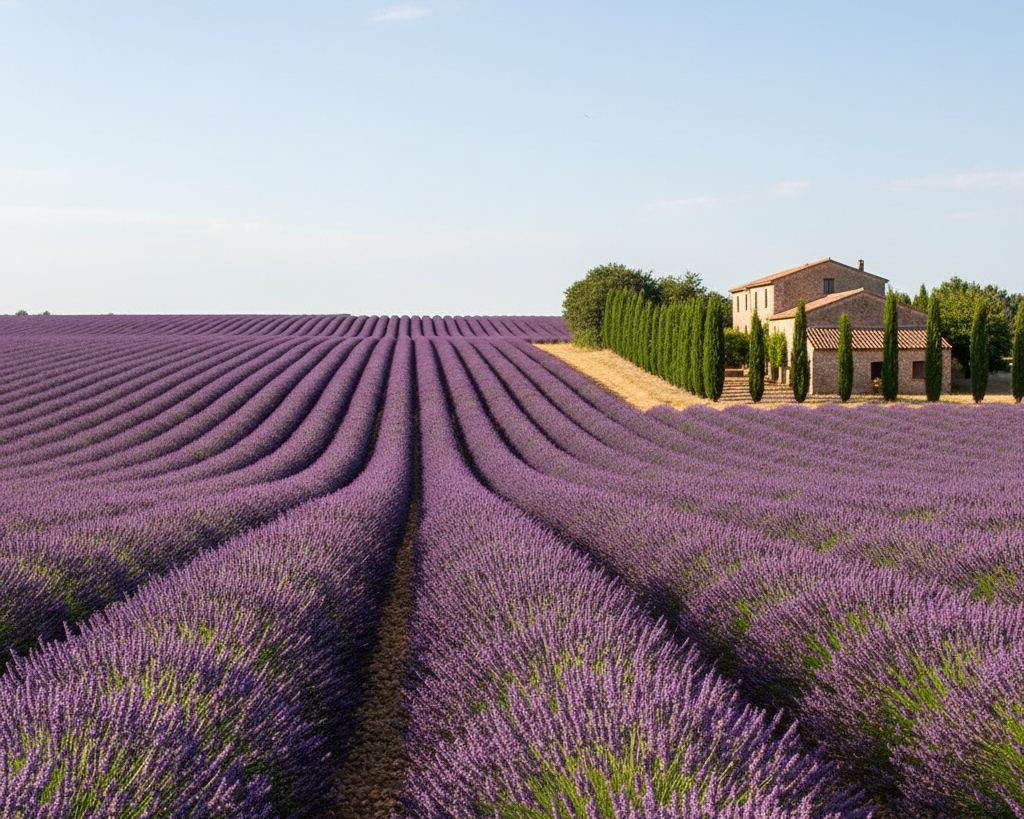
cut rows, warm oil, and the plateau at five thirty
Reserve the lavender cut on the Valensole plateau, first three weeks of July
Six nights on the Valensole plateau with every morning held in a working field, inside the first three weeks of July, from $5,364 per person on two sharing. You are there for the days the growers take the crop down, when a parcel that was solid purple at breakfast is green stubble by noon. One afternoon is spent in the still house while a load off the plateau is running.
Reserve a windowAn answer is written inside one business day by somebody at this end.
The lavandin on the Valensole plateau comes down in July, and it comes down fast. A straddle harvester taking four rows at a pass can put a ten hectare parcel flat between six in the morning and noon, so the field that was solid purple on the drive out is green stubble and a smell in the air on the way back. That is why this window exists at all. You are not booked here to look at a flower. You are booked to be standing in the rows on the days the growers decide to take them.
Six nights, based in a stone farmhouse of five rooms on the plateau road between Valensole and Riez, with two of those rooms held for this trip. The mornings are the trip. The vehicle leaves the yard at 05:20 and seats eight, and it is at a field edge before the sun is properly up, which on July 10 means 06:05. By 09:30 the heat has arrived, the smell over the rows has gone flat, and you are back at the house with the whole day ahead of you.
Which parcel on which morning is not settled until roughly four days beforehand. Cutting order follows altitude and aspect rather than any calendar. The low southern ground toward the Durance goes first, the higher parcels near 700 meters at the Riez end can run ten days behind them, and a grower who reads rain in the forecast will pull his schedule forward by two days without telling anybody outside his own family. The man who runs these mornings farms up here himself and gets the order by telephone from four families he has cut alongside for years. That arrangement is what you are reserving, and it is the reason the window is written as three weeks instead of a date.
Runs July 1 to July 21.
The window opens once the lavandin has held full color for about ten days and shuts when the last parcels are on the ground, because a cut field stays stubble for the eleven months after that.
The first machines have gone in as early as July 6 and as late as July 19 depending on how the spring ran, so the office holds your rooms across the whole three weeks rather than against a fixed date, and the operator confirms the field order about four days out.
A morning or an evening. The trip is programmed for the four hours after first light, roughly 05:30 to 09:30, which is when the oil is highest in the flower, when the machines run, and when the air over a standing row still carries the smell.
The rest of the day is heat, shuttered villages and a room with the blinds pulled to, apart from the one afternoon a load comes off the plateau and you go to the still with it.
6 nights, from $5,364 per person.
The flower is close to dependable: in most years the plateau is in full color somewhere across these three weeks, and the failure case is patchy rather than total. The cut itself is a farm decision made on the morning, so the operator can usually put you at a working parcel, though nobody underwrites which one, and a hot dry June can pull the whole harvest forward far enough that the northern ground is already down when you land.
- What this office books
- The office reserves the two farmhouse rooms, the vehicle and its driver for all six mornings, the field mornings arranged through the growers, the afternoon at the still and the road transfer at both ends, and it reserves nothing to do with your flight, your meals away from the house or any car you take for the afternoons.
- Who books it
- A person booking this wants to be standing at a headland on the morning a parcel is taken, close enough to smell the difference between a row still up and a row that went down twenty minutes ago.
- Why somebody picks another window
- If you want the plateau purple and whole, with time to sit in it and nothing mechanical anywhere in the frame, the last days of June do that better and you will not see a harvester at all.
- In the figure
- Six nights in a stone farmhouse of five rooms on the plateau road, two of them held for this trip; breakfast at 05:00, coffee and bread and apricots taken standing; the vehicle and its driver for all six mornings, seating eight; four mornings at working parcels arranged through the families who farm them; one afternoon in the still house while a load is running; one morning with a beekeeper on the plateau hives; dinner at the house on four of the six evenings; the road transfer from the coast airport in both directions, about two hours each way; local taxes and the commune tourist charge; a paper sheet of parcel locations, road numbers and the times the light is usable.
- Not in the figure
- Your own round trip flight from Orlando to the south of France, which you arrange yourself and which in July has been running about $1,150 to $2,200; the two dinners not taken at the house, about $28 to $70 a head; wine bought at the farm gate, $9 to $30 a bottle; a car for the afternoons, about $75 to $130 a day in July with fuel near $7.60 a gallon equivalent; parking on the village lavender day, $6 to $12; a session at the thermal baths down in the spa village, about $22 to $40; oil, honey and soap to carry home, $12 to $45 an item; single room supplement, $704 for the six nights; anything bought at the still, $10 to $60.
- Who this window will not suit
- You are up at 04:45 on every one of the six days and there is no version of this trip where you are not. The middle of the day runs 34 to 37 degrees on open ground, nothing is arranged in it, and the plateau has almost no shade outside the villages. If the harvest has run early you will be looking at stubble and a bin of green stalk rather than a standing purple row, and the trip costs what it costs either way. Anyone who wants a pool, a late breakfast and a town within walking distance should book a different window.
A starting figure for two people sharing one room. Pricing the exact window you pick runs two to four working days, because the company working those dates answers first. No air ticket is ever folded in.
What a cutting morning is
At 05:20 the plateau is 15 to 17 degrees and there is dew sitting on the flower, which matters, because the crop wants to be in the vat while it is still cool. Distillation is steam through a sealed still: green stalk packed in at one end, about two hours under pressure, essence coming off the top of the separator with the flower water underneath it. A hectare of lavandin yields something like 60 to 100 kilograms of essence. A hectare of true lavender, which wants ground above 800 meters and is not what most of this plateau grows, yields 15 to 25. That gap explains why the rows in front of you are a hybrid clone set 1.2 meters apart to match an axle width, rather than the wild plant of the ridges further north.
You stand at the headland while the machine works, then walk the cut rows behind it once it has gone by. It is loud, roughly as loud as standing beside a tractor, and it throws chaff that gets into your collar. Bees are the part nobody mentions in advance: hives come onto the plateau in June, and a standing field at seven in the morning is audible from thirty meters away. The work is not staged for you and it does not wait for you either. If the machine breaks a knife section, your morning becomes an hour of watching two men change a knife section in a field, and that is a fair picture of the week.
Wear closed shoes. The ground between rows is cracked and full of stones the size of a fist, the stalks are stiff enough to mark your shins through thin trousers, and after an hour in a cut parcel your hands smell of camphor for the rest of the day, along with everything else in your bag.
The three weeks and what each of them does
Color arrives across the plateau in the last third of June and holds for about three weeks before the flower browns from the tip down. The cut moves through that period rather than sitting at one end of it. What follows is what those weeks usually do, and the word usually is carrying real weight in that sentence.
- June 24 to 30
- Full color nearly everywhere, no machines out yet, and the softest light of the season at 06:00.
- July 1 to 5
- The first low parcels toward the Durance come down while everything else still stands, so both states sit side by side.
- July 6 to 10
- The main run in an ordinary year, four or five families cutting at once, stills working past midnight.
- July 11 to 15
- Middle ground goes, and the village holds its lavender day on the third Sunday with a procession through the main street.
- July 16 to 21
- The higher parcels at the Riez end and the late fields; by the close of it the plateau reads two thirds green.
- July 22 onward
- Stubble, the smell of spent stalk behind the still house, and the almonds start to matter more than the flower.
- Any week at all
- With the mistral over 60 km/h the machines stand down, because a row laid flat by wind cannot be cut clean.
The plateau between ten and eight
By ten the air is going through 30 degrees, and from two until about six it holds at 34 to 37 on open ground. Shops shut between 12:30 and 15:30, the bakery in the village has generally sold its bread by ten, and the sensible use of the middle of the day is a room with the blinds pulled to. That is not a defect in the plan. It is the reason the trip is programmed at one end of the day and says so plainly about the other.
One afternoon is different. When a load comes off the plateau you go with it and stand in the still house while it runs, which is hot, wet and close to 40 degrees at head height beside the vats. Otherwise the afternoons are yours and nothing is arranged in them. The sun sets at 21:19 on July 10 and there is usable light until nearly ten, so people who take a car for the second half of the week are often back out at a parcel edge by 20:30 on their own. The house serves dinner at eight.
The building itself is a working farm house with thick walls, tiled floors and no air conditioning in two of the five rooms, one of which is ours. Water comes off a well shared with the neighbor. Breakfast is at 05:00 and nobody sits down for it. Laundry gets done on the third day. The nearest shop is seven kilometers off and keeps the closing pattern above, so anything you want in the afternoon is bought before nine.
Arriving on the plateau
The tableland runs to roughly 800 square kilometers at 500 to 700 meters, bounded by the Durance to the west and the Verdon to the south, and the road climbs onto it from the valley in about four minutes. Valensole stands at 587 meters with something near 3,000 people in it. The parcels you will be working around are between six and twenty two kilometers from the house, which is thirty five minutes at the far end, on roads that go to single track once you are off the D6.
The nearest usable airport is about 110 kilometers southwest and the road transfer from it is included in both directions, roughly two hours each way with one stop. You arrange the long leg yourself, since no air ticket is sold from this office, and the figure above starts once you are on the ground in France. Every roof, vehicle and vat described here belongs to somebody else. The company that runs the window on the plateau bills you directly for what it operates, and no money passes through Orlando at any stage.
To reserve, send the week you are aiming at and the number sharing to bookings@rovinghours.com, or telephone +1 (407) 629-3157 and say which end of the window suits you. Naming your dates and getting them costed on paper takes two to four working days, because the rooms and the vehicle have to be confirmed against a harvest the growers have not scheduled yet. Roving Hours Bookings LLC, which does business under the name Roving Hours, works from 1350 N. Orange Avenue, Suite 221 in Orlando, FL 32789, in Orange County, Florida. If anything here reads wrong against what you find on the ground, write to corrections@rovinghours.com and it will be put right.
Start with the weeks, not the country
This form takes requests every hour of every day, and a person answers within one business day. Nothing here commits you. No figure is charged at this end.