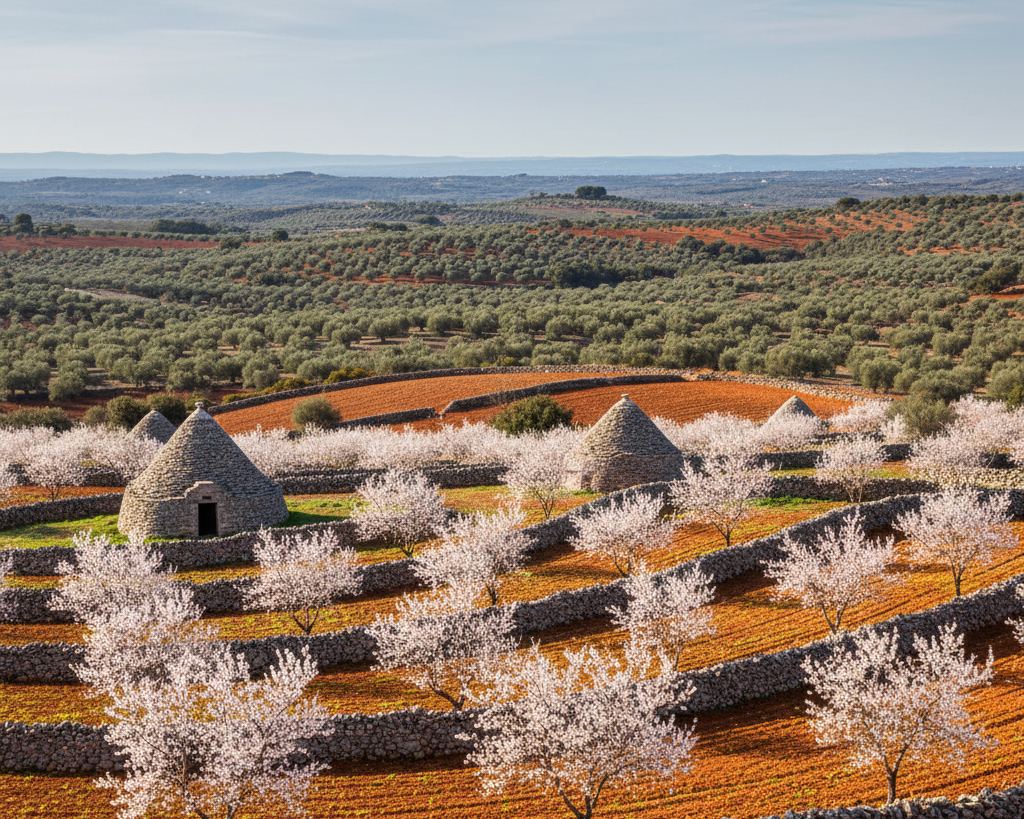
cold stone walls, white petals on red soil, bees by ten
Reserve a Puglia almond blossom trip in the Valle d'Itria for the February window
Six nights on the Murgia plateau between Locorotondo and Cisternino, held inside a fourteen day window in the second half of February, from $3,598 per person on two sharing. The almond trees on the red soil there carry flower for roughly ten days and then let it go. Six mornings are programmed and the rest of every day is open.
Reserve a windowAn answer is written inside one business day by somebody at this end.
The almond trees in the Valle d'Itria flower before anything else in Puglia does, and they hold it for about ten days. This page is the dated window Roving Hours keeps around those ten days: six nights on the plateau between Locorotondo and Cisternino, six programmed mornings in the groves, and a fourteen day frame in the second half of February inside which the flower has come and gone in every recent season. If you want to book a Puglia almond blossom trip that is pinned to the flowering rather than to a convenient week off, this is the bar on the year strip that does it.
The trees are not planted in orchards here. They stand in among the olives, four or five to a plot, on ground cut up by dry stone walls into pieces you could throw a ball across, and the soil under them is red. When the flower goes over it does not blow away tidily. It lies on that red ground for another week and then the wind clears it. A plot on the second morning after it opens looks nothing like the same plot on the eighth, and the difference is worth choosing between.
Nothing on this page is property of Roving Hours Bookings LLC. The rooms, the van, the groves and the mill all belong to other people, and the company that runs the six mornings invoices you itself, on its own paper, once the dates are agreed. The office at 1350 N. Orange Avenue, Suite 221, Orlando, FL 32789 handles no money at any stage.
Runs February 14 to March 1.
The trees break bud once the ground at root depth has held above about seven degrees for a week, and the window closes at petal fall, which one hard tramontana finishes inside two days.
The plateau has opened as early as February 6 and as late as February 24 in recent seasons, so two candidate weeks are priced and the departure is fixed in the third week of January on what the growers say the wood is doing.
A morning or an evening. The programmed hours run from about 06:15 to 10:45, covering the half hour before sunrise, the forty minutes when the light comes in sideways across the plots, and the first hour warm enough for the bees to work.
After 10:45 the day is yours, lunch runs to the middle of the afternoon, most village shops close from 13:30 to 16:30, and the light is off the groves by about 17:45.
6 nights, from $3,598 per person.
In eight seasons out of ten some part of the six mornings falls inside full flower, and in the other two you find either bare wood or the petals already down on the soil. Nothing about a tree is underwritten by anybody, and you will be told what the January reading was before you commit to a date.
- What this office books
- The office reserves the farmhouse rooms, the six programmed mornings, the driver for those hours and the access agreed with two growers; it does not reserve the flight, a hire car for the afternoons, or anything you eat.
- Who books it
- A person booking this wants to stand in a grove that is white, in the ten days it is white, with cold on their hands and nobody else in the plot.
- Why somebody picks another window
- If you want warmth, long evenings and open shutters, take the same country in May instead, when the flower is long gone but the plateau sits at 22 degrees and the villages are awake past nine.
- In the figure
- Six nights in a farmhouse of eight rooms between Locorotondo and Cisternino, two sharing; breakfast every morning, on the table from 05:45 on programmed days; six programmed mornings in the groves with a driver and an English speaking guide; access agreed with two growers who work their own trees and answer questions while they work; ground transport for the programmed hours; one morning inside a small mill finishing the last of the winter olives; one morning on foot along about 6 kilometres of wall lines, flat, no vehicle; a cold weather kit list sent as soon as the dates are fixed; the operating company's written running order for each of the six mornings; local room taxes.
- Not in the figure
- The flight, which is your own arrangement, round trip out of Orlando to the nearest airport served, roughly $780 to $1,450 in February; the road transfer from that airport up to the farmhouse, $95 to $160 each way; a hire car for the afternoons, $38 to $60 a day plus fuel; lunch and dinner, $22 to $70 a person a day; anything you drink; the visitor levy collected at the property, about $2.50 a person a night; entry to the two small museums that keep winter opening, $6 to $11 each; laundry at the farmhouse, $18 a load; a room to yourself if you are not sharing, $61 a night; tips, which nobody here asks for.
- Who this window will not suit
- This is a cold trip with a dark start to it. You are called at 05:30 six days running and you stand still in a grove at 4 degrees with wet feet, because the ground between the walls holds water in February and there is no made path across any of it. Anyone who cannot walk 6 kilometres over uneven stone, or who wants to sleep past seven, should take a different window. If a morning of bare branches would sour the whole week for you, reserve something built around a thing that is definitely there.
A starting figure for two people sharing one room. Pricing the exact window you pick runs two to four working days, because the company working those dates answers first. No air ticket is ever folded in.
Ten days of white between the stone walls
The basin sits at 400 to 430 metres and that height is the whole reason the window falls where it does. Down at Ostuni, 218 metres and twenty five minutes off the edge of the plateau, the almonds are usually out in the first week of February. Up here they run a week to ten days behind that, and the north facing plots run another two or three days behind the rest.
February on the plateau is not warm. Nights go to 3 or 4 degrees, the walls carry frost about two mornings in five, and by eleven it is 12 to 15 degrees in the sun and cold again in the shade of a wall two metres away. Weather comes in from the west in bands and clears. Reckon on one wet morning in six and pack for that one rather than for the other five.
Most of what is open in August is shut now. Village shops close from 13:30 to 16:30, a good number of the restaurants do not open at all until March, and the ones running in the second half of February are the ones the growers themselves eat in. That thins the plateau out considerably, which is part of what people are coming for.
What a programmed morning holds
Six mornings are programmed and they run roughly 06:15 to 10:45. You are called at 05:30 and you are standing in a grove before the sun is on it. The part that cannot be moved is the forty minutes after sunrise, when the light comes in sideways across the plot and every flower on the outer wood is lit from behind. Book the hour, get the trip. Book the day, get whatever the day gives you.
Two growers let the group into their own trees on those mornings, and both carry on working while you are there. You can ask them anything through the guide. The answers are about pruning cuts, frost damage on the low ground and whether the set will hold, not about scenery. One of the six mornings goes instead to a small mill finishing the last of the winter olives, which is warm inside and very loud. One goes on foot, about 6 kilometres along the wall lines, with the van left behind.
The bees are the last thing every morning. They will not fly until the air is around 12 degrees, so on a cold day they start near half past ten and on a mild one they start at nine, and you hear a grove working before you see anything move in it. On a wet morning they stay in.
- 05:30
- Called at the farmhouse, coffee out by 05:45, nothing cooked until you are back
- 06:10
- In the van, about twelve minutes to the first plot, headlights running along the walls
- 06:47
- Sunrise on February 20, then forty minutes of low light straight across the trees
- 07:30
- The grower walks his rows and takes questions through the guide while he does it
- 08:45
- Second plot, 40 metres higher, where the same variety opens two or three days later
- 10:00
- Air passes 12 degrees on a mild morning and the bees come out of the boxes
- 10:45
- Back at the farmhouse and the rest of the day belongs to you
Why the dates move, and by how much
Almond is the first tree here to come out of dormancy and it goes on soil temperature, not on the calendar. Once the ground at root depth has held above roughly 7 degrees for a week the buds swell, and about nine days after that the plot is white. A mild January pulls the whole thing forward. Across recent seasons the plateau has opened as early as February 6 and as late as February 24, a spread of eighteen days, and the coast has been ahead of it every single year.
That is why two candidate weeks are priced rather than one. Both go into the quote, both are put to the farmhouse and the growers, and the week that runs is settled in the third week of January on what the growers report the wood is doing. If you need a departure locked in October and never touched again, this is the wrong window and there is no way to make it the right one.
Petal fall ends it. The trees hold about ten days and then the first hard tramontana, the dry north wind that comes over the plateau in late February, strips them inside a day or two. There is a week of white on the ground after that, then the leaf comes and the groves go green. Two seasons in ten the six mornings simply miss, and you get bare wood or bare branches over a covered floor. You will be told plainly what the January reading was, and neither this office nor the company running the days puts any promise behind a tree.
The rest of the day on the plateau
Nothing at all is programmed after 10:45. Lunch here is the meal of the day and it is long; a table taken at 13:00 in one of the villages is yours until the middle of the afternoon if you want it. The Adriatic side is half an hour down off the rim and the water is around 14 degrees in February, which is to say the beach is yours and you will not be swimming. Sunset on February 20 falls at 17:44, and by a quarter past six the villages are dark apart from two or three bars.
Most people want a car for those afternoons. The driver is on the programmed hours only and no vehicle is held for the rest of the day, so if you intend to move around after eleven, say so when you ask and it goes into the figure.
Ask through the form below, by telephone on +1 (407) 629-3157, or in writing to bookings@rovinghours.com. Say which of the two candidate weeks suits you better and how many rooms you need. Pricing the exact window you pick takes two to four working days at this end, because the farmhouse and both growers are small operations and all three have to answer before any number is real. If anything above reads wrong to you, send it to corrections@rovinghours.com and it will be put right.
Roving Hours Bookings LLC is an independent booking agency in Orlando, Orange, Florida. It reserves and it hands the reservation on. The operating company holds the arrangements under its own licences and bills you direct. The flight out of Orlando is yours to buy, and no ticket of any kind is sold here.
Start with the weeks, not the country
This form takes requests every hour of every day, and a person answers within one business day. Nothing here commits you. No figure is charged at this end.