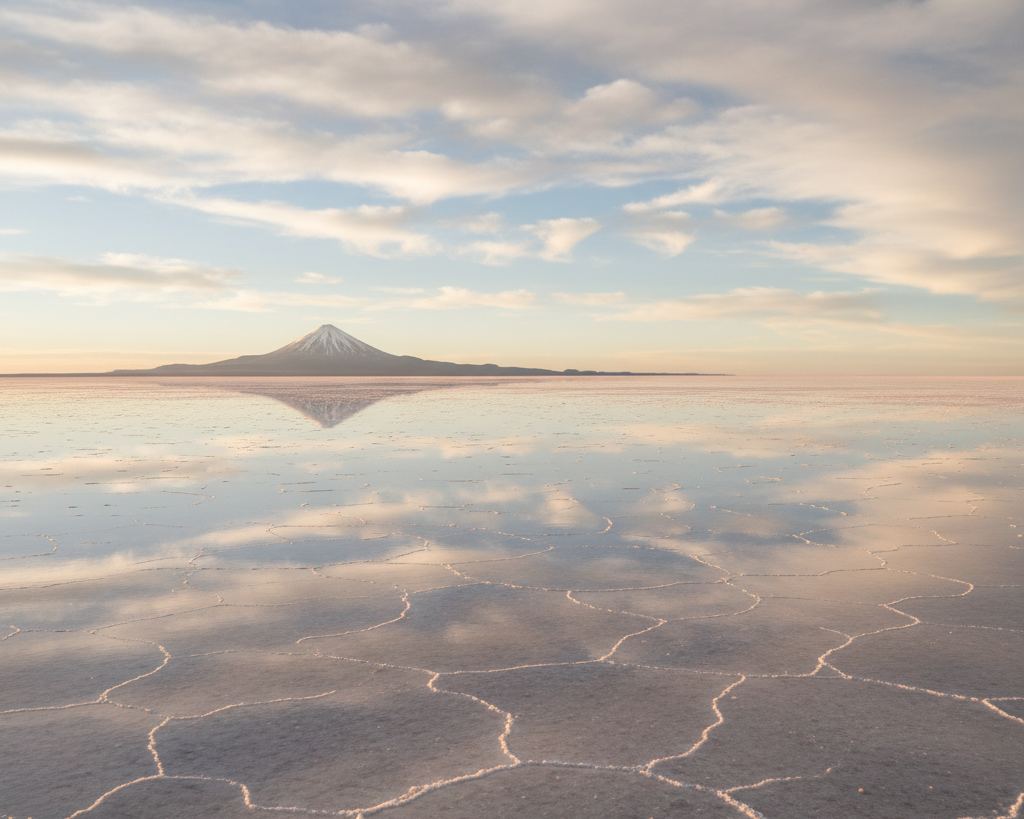
cold brine over your boots, no horizon, wind gone by seven
Reserve the Salar de Uyuni mirror, late January to early April
Roving Hours reserves six nights on the eastern shore of the salt flat with a run out onto the standing water every evening of the stay, inside the window that runs late January to early April, from $4,691 per person on two sharing. What people come for is the two hours after the wind drops, when eight centimeters of brine lying on level salt stops reading as water and starts returning the whole sky. The rest of the twenty four is quiet, and the page says so rather than filling it.
Reserve a windowAn answer is written inside one business day by somebody at this end.
The mirror is a thin film of water lying on salt, and it works here rather than in other places because the ground is level to within about a meter across ten thousand square kilometers. Rain falling between December and March has nowhere to drain to and nothing to collect in, so instead of gathering into lakes it spreads sideways. By the end of January the eastern part of the flat is holding somewhere between five and twenty centimeters of brine over a distance you cannot see across. Five centimeters of still water on a white floor with no current, no bank and no bottom worth speaking of behaves like a first surface mirror. The horizon stops being a line and becomes a seam, and the seam runs through your own boots.
An evening on the water is mostly waiting for the air to quit. Vehicles leave the shore at about 16:45, drive twenty to forty minutes out depending on where the depth reads right, and then stop, and everybody gets out and stands in it. Until roughly 17:30 the surface is still moving and the reflection is broken into scales. Then the wind falls off, the scales close up, and within ten minutes the water is holding the cloud base upside down with enough fidelity that people lose their footing looking at it. Sunset in February runs at 19:00 and the color holds until about 19:40. After dark, if there is no moon, the whole sky is doubled and the difference between up and down is a matter of which one has your shadow in it.
Roving Hours reserves six nights against that rather than one, because depth and wind are two separate variables and neither of them takes instruction.
Runs late January to early April.
The window opens when the December and January rain has finally joined into one continuous sheet across the eastern side instead of separate pans, normally in the last week of January, and it shuts when evaporation through late March pulls water off the crust faster than the closing showers put it back, so that bare salt is showing again by the second week of April.
Both edges move by two or three weeks with the rains, and because the office holds your nights against the depths the operating company is reading on the ground rather than against a fixed calendar, a season that starts late shifts your stay instead of cancelling it.
A morning or an evening. The programmed block is the evening, roughly 16:45 to 20:45 in February, with the vehicles standing on the water for the two hours before sunset at 19:00 and for about ninety minutes after it.
The rest of the day belongs to you, because wind is up from mid morning until late afternoon and a rippled sheet gives back nothing, so the operating company schedules nothing between breakfast and the afternoon departure except the one morning at the salt gathering ground.
6 nights, from $4,691 per person.
The sheet forms across these weeks in most years and the office sells the window on that record rather than on any promise, but a flat reflection also needs still air and a sky with something in it, and across six evenings a stay usually gets three or four that go properly glassy, one chopped up by wind and one under rain. Two things can remove it outright: a January that stays dry leaves the crust bare, and a very wet February can put water above forty centimeters, at which point the operating company will not drive out on it. Weather is underwritten by nobody, not by that company and not by this office, which is the plain reason the stay carries six evenings rather than one.
- What this office books
- The office books the six nights of lodging, the road transfers between the town and the shore, the six evening runs with a driver and the one morning inland, and it books no flight, no seat down from La Paz, no car hire and no meal beyond those set out below.
- Who books it
- A person booking this wants the two hours when the surface goes still enough to hold the whole sky at once, and wants somebody who was out there yesterday to decide which stretch of shore is carrying the right depth today.
- Why somebody picks another window
- Somebody whose picture is the ridged hexagons of dry crust, the island of old cactus eighty kilometers out and the long drive south to the colored lagoons should take a dry month instead, because the water that makes this window closes all three of those.
- In the figure
- Two nights in a family run guesthouse in the town and four nights in a lodge built from cut salt blocks on the eastern shore, two sharing; breakfast every morning; four evening meals at the lodge, served after the vehicles come back in; road transfer between town and shore lodge in both directions; six evening runs onto the standing water in a vehicle taking six, with the launch point chosen that afternoon from the day's depth reading; a driver who works this flat through the season and takes the depth himself at three points before anyone steps out; rubber boots to the knee and a loan tripod for each person; the community entry fee at the eastern shore, collected by the village and paid on your behalf by the operating company; one morning at the salt gathering ground and the old rail sidings outside the town; a printed sheet of the week's depths, sunset times and moon times; drinking water carried in the vehicle; all local taxes and the operating company's booking administration.
- Not in the figure
- Round trip flight from Orlando, usually $840 to $1,520 depending on the week; the connection down from La Paz, which stays your own arrangement, $30 to $75 each way on the overnight road service and more by other means; lunches in the town, $6 to $14 a day; the two evening meals not listed above, $9 to $22 each; drinks; a vehicle held for the two of you instead of shared, $310 for the stay; laundry, $4 to $9 a load; single occupancy of the salt block room, $540 across the six nights; camera gear, filters and spare batteries; gratuities to the driver, entirely your own call; anything you add once you are there, billed by the operating company on its own paper.
- Who this window will not suit
- The ground here is at 3,656 meters and nothing in the arrangement changes that, so if thin air at that height is something you already know you dislike, this is the wrong purchase. You will stand in cold brine in rubber boots for two hours at a stretch, six evenings running, get back after 20:30 and eat late. The middle of every day is empty on purpose because wind ruins the surface, and the town is small, dusty and short on things to do when it rains. And there is a real chance of an evening or two, possibly more, when cloud or chop leaves you standing on water that gives back nothing at all.
A starting figure for two people sharing one room. Pricing the exact window you pick runs two to four working days, because the company working those dates answers first. No air ticket is ever folded in.
Why the water arrives in late January and goes in April
Rain starts on the altiplano in December, but early in the season it comes down in bands and the flat takes it in patches. You get a wet pan here, dry crust two kilometers on, and no continuous surface. What changes in the last week of January is not the amount of rain but the joining up: enough has fallen that the low eastern side carries one sheet, and one sheet is what a reflection needs. That is the front edge, and it is the reason the office does not sell this in early January even though it rains then.
The back edge is evaporation. Rain thins out through the second half of March, sunshine hours climb, and the sheet begins retreating toward the low ground faster than the last showers can top it up. Through the first week of April there is usually still water on the eastern side and the runs still go, but the crust starts showing through in pale islands and the doubled sky becomes a doubled sky with holes in it. By about the tenth of April there is no point pretending, so the window closes there.
Both edges wander. A weak start to the rains can hold the opening back into the second week of February; a heavy December can bring it forward to about the eighteenth of January. The operating company sets its dated list in November and then corrects it against what its drivers actually see. Pricing a specific set of dates takes this office two to four working days for exactly that reason, since the answer depends on depths measured in the field rather than on a printed season.
The evening block, and the empty middle of the day
Two of the four quarters of the day are programmed and the other two are not, and it is worth being clear about which. Departure from the shore lodge is 16:45. You are on the water from roughly 17:20. Sunset is 19:00 in mid February and 18:24 in the first week of April. The vehicles start back between 20:15 and 20:45, later on moonless nights when people want the stars in the water, and dinner is at the lodge afterwards.
Mornings are yours and there is a mechanical reason for it. The air is calm at first light, which would make dawn a second candidate, but the sheet at that hour is often skinned with a cold haze and the drive out has to happen in the dark, so the operating company runs the evening as its standing block and keeps one dawn slot in reserve for the week if a driver thinks a particular morning is worth it. Between about 10:30 and 16:00 the wind is up, the surface is corrugated, and going out would show you a gray chop with nothing in it. Nobody schedules that. One morning of the six goes inland to the salt gathering ground and the old rail sidings, and the rest of the daylight is books, the town, or the doorway of a salt block room with the flat in front of it.
- Last week of January
- separate pans join into one sheet, first evenings run
- Early February
- deepest water of the season, launch points move inland
- Mid February
- sunset 19:00, most reliable stillness after 17:30
- Late February
- wettest fortnight, occasional days when depth stops the runs
- Early March
- rain thinning, sheet steady, longest run of usable evenings
- Late March
- evaporation gaining, drivers working further along the shore
- First week of April
- crust showing through in patches, window closing
- Any evening
- one quarter of the day is programmed, the rest is not
Salt, and what is underneath the water
Under the film is a crust that runs several meters thick in the center and thins toward the margins, and under the crust is brine held in layers of sediment. Where the sun gets at the surface it dries into ridged polygons about a meter wide, which is the picture most people have of this place, and which the wet season removes entirely. In these weeks the flat has no texture at all. It is the reason the water reads as a mirror rather than as a flooded field: there is nothing under it to interrupt the reflection and no shore near enough to break it.
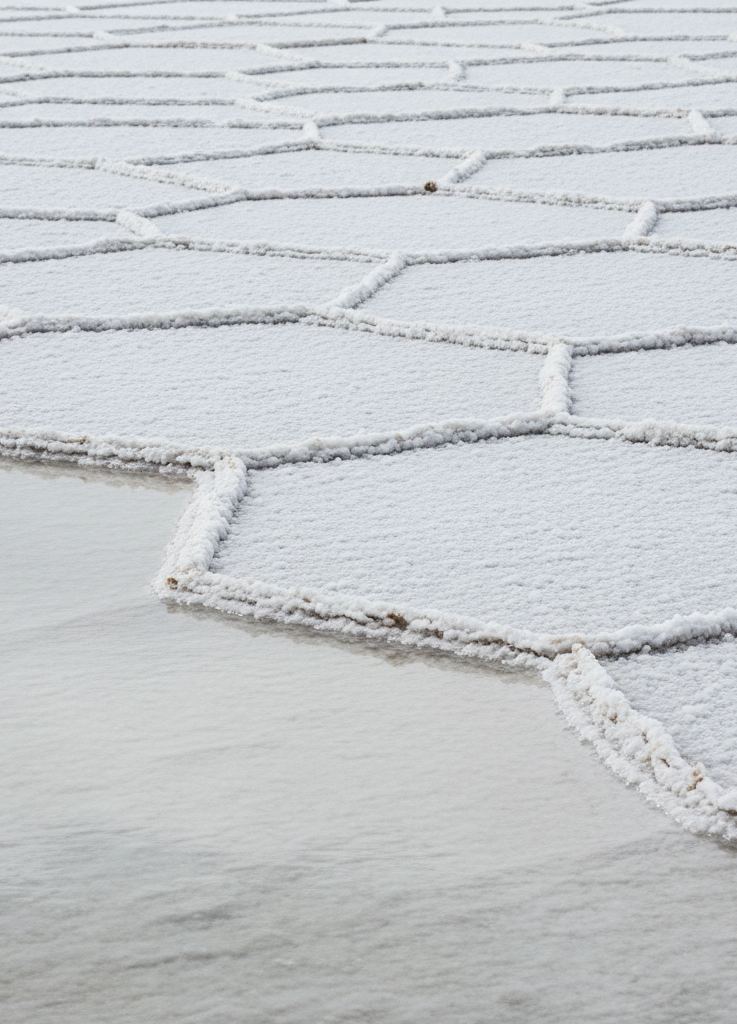
The brine is hard on machinery. Vehicles get hosed underneath at the village every time they come off, and the driver watches depth carefully, because past about thirty centimeters the salt water starts finding places you cannot rinse. That is the practical limit on how far out a run goes, and it is why the launch point changes through the week rather than staying put. The village at the shore is a working salt place for most of the year, with the cones and the block cutting, and in these months that work is stopped and the ground it happens on is under water.
Two things people expect from photographs are not available in this window. The island of old cactus, eighty kilometers out, is normally cut off by standing water for the whole of it. The long track south toward the colored lagoons and the geyser field is a three day drive on ground that the same rain turns to mud. If either is what you actually want, a dry month is the honest answer and this office will say so before quoting.
What a reflection actually depends on
Three conditions have to arrive together: water thin enough that wind cannot corrugate it, air still enough that nothing does, and a sky carrying something worth returning. A flat gray overcast reflects perfectly and gives you a gray floor. Broken cloud at sunset is what people remember. Across six evenings the usual split is three or four that work properly, one lost to wind, and one to rain sitting on the whole basin. Moon phase matters too, and the office sends your week's moon times with the confirmation, because a full moon puts light on the water and takes the stars out of it, while a new moon does the opposite.
Nothing named on this page belongs to this office. The rooms, the vehicles, the boots and the tripods are somebody else's property, and whichever company is working the dates you choose is the company that sends you the invoice, directly and on its own paper. Nothing with wings appears in the figure above, and getting yourself as far as South America stays your own piece of work; the office begins where the road down from La Paz ends. Where the trip depends on a community fee at the shore, the operating company obtains and pays that as part of running the day.
To begin, send the weeks is in view and how many people are going, and say whether anyone in the party would rather have the dawn slot than the evening. Roving Hours Bookings LLC answers from Orlando, Orange, Florida. You can call +1 (407) 629-3157 or write to bookings@rovinghours.com, and anything that needs correcting on a quote already sent goes to corrections@rovinghours.com. The office address is 1350 N. Orange Avenue, Suite 221, Orlando, FL 32789.
Start with the weeks, not the country
This form takes requests every hour of every day, and a person answers within one business day. Nothing here commits you. No figure is charged at this end.