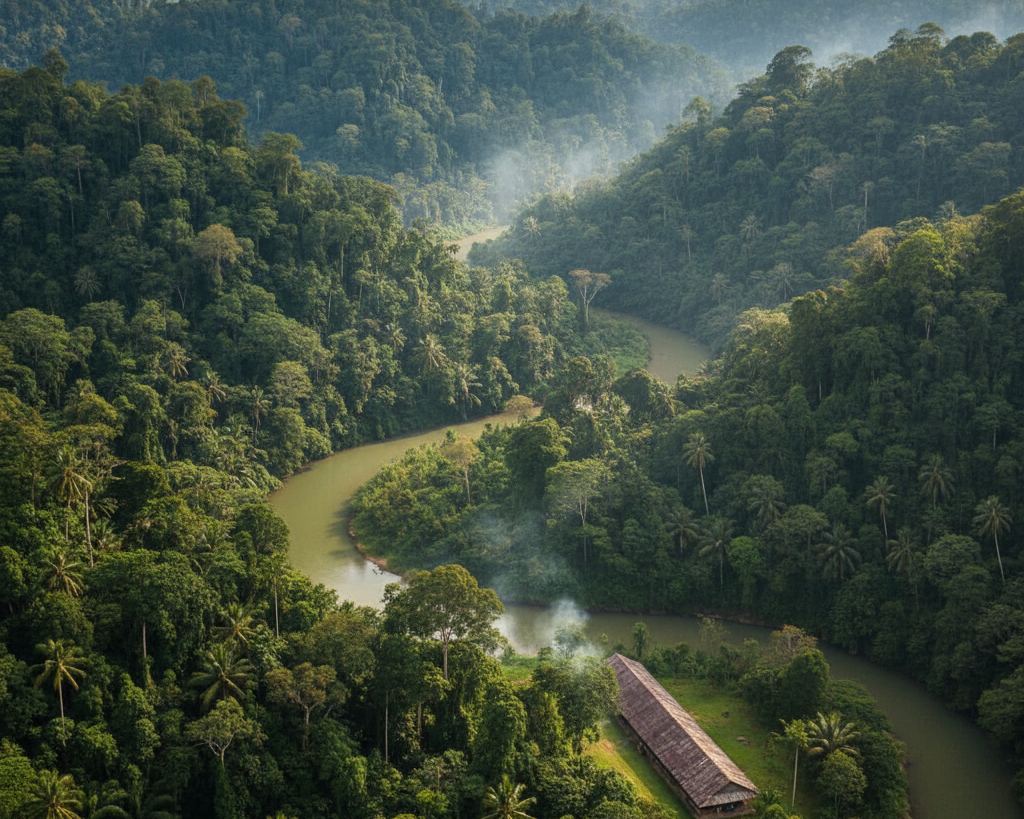
bamboo floor, tuned bronze, and the rain coming on at four
Reserve a Sarawak highlands music trip for the three days in June
Ten nights, seven of them on a plateau at 1,020 metres in the interior of Sarawak, set around the three days of playing that fall in the third week of June, from $3,061 per person with two of you sharing a room. Players come in from the other rivers, some of them two days on foot over the ridge with an instrument wrapped in a rice sack, and for three afternoons a platform built into a corner of a rice terrace carries four string lutes, bamboo zithers and a rack of bronze gongs. On the Monday morning they go home and the settlement is back in the paddy pulling weeds.
Reserve a windowAn answer is written inside one business day by somebody at this end.
The playing lasts three days. It starts on a Friday at half past ten in the morning on a platform of hardwood and bamboo built out into a drained corner of a rice terrace at 1,020 metres, and it ends on the Sunday when the light goes at 18:31, because there is no power up there to carry it past that. You can reserve a Sarawak highlands music trip with Roving Hours for the ten nights built around those three days, seven of them on the plateau itself, from $3,061 per person with two of you sharing a room.
What the dates buy is not only the platform. The players start arriving on the Wednesday, some up the same logging track you will come by, some on foot over the ridge from the next valley, which is two days of walking. They sleep behind the doors of the gallery, they eat at the same fires, and the tuning goes on in the corridor for most of Thursday. By Monday morning the boats are loaded, the visitors are gone downriver, and the settlement is weeding the terraces again. That is the whole of the window, and it is why this trip has one shape rather than several.
Most of the daylight is programmed and none of the dark is. The generator that carries the amplification runs from 10:30 until 18:15 on each of the three days, so the sound finishes with the light, and after that the gallery has two bulbs on the micro hydro and whatever anybody feels like playing without a wire.
Runs June 13 to June 26.
It opens once the plateau's rice is transplanted and the logging track has had a dry stretch long enough to carry a loaded vehicle, and it shuts on the Sunday night the third day of playing ends, because the visiting players go down the river on Monday and the doors turn back to the ordinary work of June.
The three days are fixed by the settlements themselves once the planting is finished, usually eight to ten weeks ahead, so in a given year they can sit anywhere between June 15 and June 23; we hold your nights against the likely Friday and shift the whole ten around them the day the date is settled.
Most of the daylight. The programmed hours are most of the daylight, roughly 07:30 to 18:15, because the generator that carries the amplification starts at half past ten and the sound stops when the light does.
The rest of the day is the dark, and at this latitude that is eleven and a half hours of it: eating at the doors, two bulbs on the micro hydro, whatever anybody feels like playing without a wire, and most of the settlement asleep by ten because the fields start at first light.
10 nights, from $3,061 per person.
The three days have gone ahead every June that anyone up there can account for, and the settlements put them on whether four hundred visitors come or forty, but the platform stands in an open field and June afternoons build cloud on the eastern range from about half past three, so reckon on rain interrupting one afternoon in three and on a wet enough year, perhaps one in five, to push most of two afternoons under the gallery roof. Nothing here is underwritten by anybody, not the weather, not the river gauge, not the gibbons that call across the valley on about half the mornings, and if the rain takes an afternoon the trip has still run and the figure stands as it is.
- What this office books
- This office books the ten nights of rooms, every meal, the 4WD and driver for both road days, the highland guide, the seven plateau days and your place on the platform for all three days of playing; it books nothing that flies, the river passage belongs to the licensed boat company and is billed by them, and no money passes through us at any point.
- Who books it
- A person booking this wants to be inside the gallery on the nights the visiting players are sleeping in it, rather than in a seat in front of a stage, and wants the two days either side when the same people are cooking, retuning and arguing about the running order.
- Why somebody picks another window
- If what you want is the plateau quiet, the terraces green and the walking done in an empty valley, take a week in late August instead and accept that there will be no playing in it at all.
- In the figure
- Ten nights of rooms on two sharing, seven behind the gallery on a floor mattress under a net, two in a river town guesthouse and one on the coast; every meal from dinner on the first night to breakfast on the last, cooked at the doors on the plateau and eaten there; the 4WD and driver for both road days, 148 kilometres each way including the two river crossings; a highland guide for the seven plateau days who plays the tube zither himself and knows which door each visiting player is sleeping behind; your place on the platform for all three days and on the gallery mats for the afternoon workshops; the walk out to the salt spring, 4.6 kilometres on the bunds, with the boiling shed working; the transfer between the river landing and the guesthouse at both ends of the river leg; drinking water boiled and cooled and refilled twice a day, which matters more up there than it sounds; a mosquito net, a mattress, a pillow and one blanket for every plateau night; one spare day held on the river town side of the track in case rain puts the clay out of use.
- Not in the figure
- Your flight, which is in no part of this and stays your own arrangement from the first leg to the last: Orlando to the Borneo coast and back, with two or three connections either way, has run $1,590 to $2,780; the river passage itself, which the boat company holds under its own licence and bills to you directly, $26 to $44 each way; getting to and from Orlando, and a room by that airport the night before if you want one, $110 to $185; drinks past the boiled water and the coffee that come with meals, $2 to $7; a jar of rice wine bought at a door rather than passed to you, $4 to $12; tips for the guide and the driver together, which run $10 to $18 per traveller per day; salt in a bark cylinder from the spring, $6 to $15, and plaited mats or beadwork from the door of whoever made them, $15 to $130; a four string lute if you decide you want one made for you, $230 to $900 and several months of waiting; laundry at the river town, $5 to $12 a bag; time on the settlement's shared connection above the school, $3 to $8 an hour when it is working; any night beyond the ten if the track holds you up longer than the spare day covers, $40 to $95.
- Who this window will not suit
- Do not book this if the road day is going to defeat you: 148 kilometres of red logging track, nine hours in the dry and closer to twelve when it is not, windows shut against the dust or open to the rain, timber lorries with the right of way on every bend, and two crossings where everybody gets out and walks over. Seven nights are spent on a mattress on a hardwood floor behind a gallery with twenty five other doors in it, one washroom between several families, cold water off the stream, and a settlement that is up and moving at twenty past six. For three afternoons the sound is amplified and you will be inside thirty metres of it whether you want to be or not, with the open ground at 28 degrees between eleven and three and the air not moving at all. And on the forest sections after rain the leeches come up through the leaf litter in numbers that people find genuinely unpleasant, which is a thing to know before you agree to the walking rather than after.
A starting figure for two people sharing one room. Pricing the exact window you pick runs two to four working days, because the company working those dates answers first. No air ticket is ever folded in.
What the three days are made of
Count on sixty to ninety players. The instrument you will hear most is a four string lute cut from a single piece of soft wood in the shape of a boat, fretted with beeswax that gets moved along the neck when the tuning changes, played sitting cross legged with the body of it laid on the thigh. Behind that there are bamboo tube zithers whose strings are lifted out of the skin of the tube itself, a nose flute that carries about as far as a whisper and needs the whole gallery to go quiet for it, a jaw harp of bamboo no longer than a finger, and a rack of eight small bronze gongs worked by two people at once with the sticks crossing over each other.
None of it is a performance in the sense you would get at home. Sets run twenty minutes or ninety depending on who is in the mood, the running order is settled in the morning and rearranged at four, and half of what happens on the boards is two players from different rivers finding out what the other one does with the same six notes. The afternoon workshops on the gallery mats are six or eight people to a teacher, and the instrument will be in your hands inside ten minutes.
Between sets everyone goes back to their door and eats. Highland rice, small grained and sticky enough to take in the fingers, ferns cooked hard with garlic, chicken done inside a length of green bamboo over the fire for an hour and a half, and spring salt on all of it. If a jar of rice wine comes out at your door it gets passed until it is empty. Refusing it once is fine and refusing it three times is noticed.
A day on the plateau, first light to lamps
The light is the frame for all of it, and this close to the equator the light does not move: twelve hours and a few minutes, every day of the year, sunrise within a quarter of an hour of 06:22 and sunset within a quarter of an hour of 18:31.
- 06:22
- first light, fires in the gallery, yesterday's rice warmed through with salt and fern
- 07:40
- out along the bunds while the air is still under 22 degrees, buffalo standing in the terraces
- 10:30
- generator on, the first players up on the boards, and the first forty minutes of it is tuning
- 12:15
- open ground at 28 degrees and largely empty, the playing moved under the gallery roof
- 14:00
- workshops on the mats, tube zither, jaw harp and lute, six or eight to a teacher
- 15:40
- cloud stacking on the eastern range, which is when the running order starts changing
- 17:20
- the gong rack carried out, the long sets, the boards going under a couple of hundred pairs of feet
- 18:31
- the last set finishing in the last of the light, generator off
- 20:00
- lamps, unamplified playing at three or four doors, and the settlement asleep by ten
The road up, and the river below it
You reach the coast under your own arrangements and we start from there. The first day is short: east along the coast road to the landing, then two hours and forty minutes upriver in a covered longboat that seats about twenty. The company running that boat holds its own licence for the water and sends you its own bill for the passage; we put you on the right one at the right hour, and there our part in it stops. You sleep that night in a river town of one street and a market that opens at five in the morning.
The second day is the track: 148 kilometres of logging road from the last tarmac up onto the plateau, nine hours when the clay is dry and closer to twelve when it is not. Lorries have the right of way on every bend, so the 4WD reverses to a passing place several times a day, and there are two crossings where everybody gets out and walks over while the driver takes the vehicle through. The high point is around 1,300 metres on the ridge, and the drop onto the plateau is the last hour of it. The district permit for that road is applied for on their own paperwork by the company running your week, well before you get there.
Heavy rain closes the track. It is not common in the third week of June, which is the driest stretch the plateau gets in any ordinary year, but one wet night can put the clay out of use until the middle of the afternoon. There is a spare day built into the ten on the river town side for exactly that, which is also why we would rather have you on the plateau by Wednesday than Thursday.
What the plateau is when nobody is playing
Terraced wet rice, which is the thing that separates this place from the rest of the interior, worked with water buffalo and irrigated off the stream. Stone monuments out in the fields, some of them slabs stood on end, some of them ditches cut clean through a spur, marking deaths that nobody now living can put a date to. A school, a church, twenty six doors in the gallery of the main longhouse and four or five smaller houses behind it. No road out except the one you came in on. Nothing sold anywhere in the settlement except salt, plaited mats and beadwork, and those from the door of whoever made them.
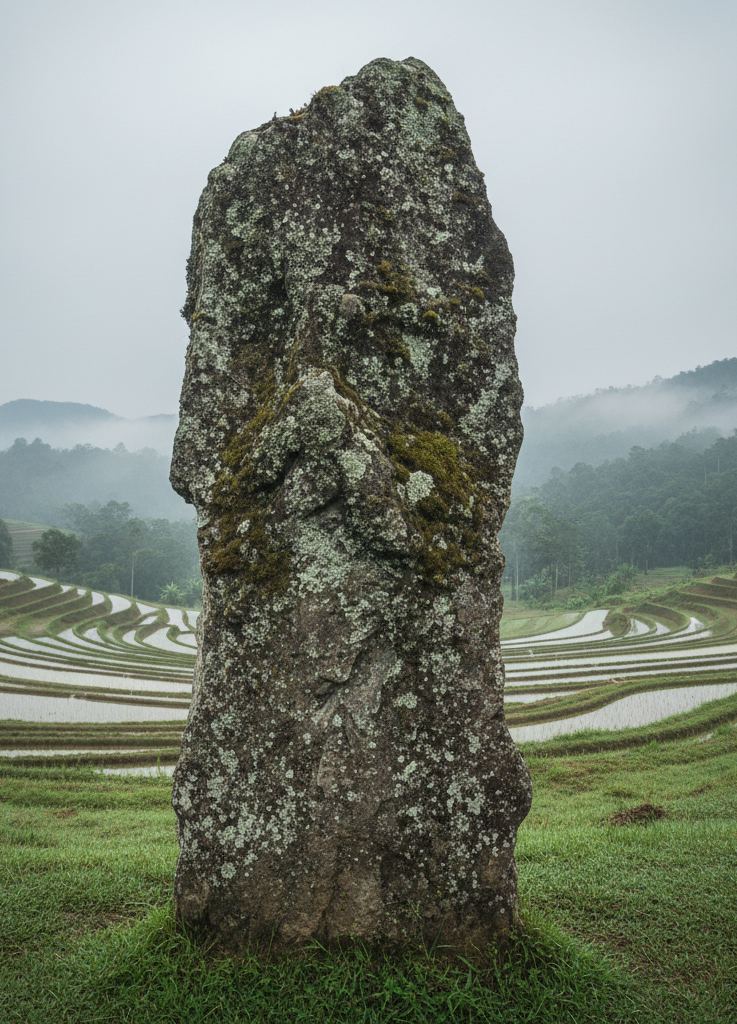
The walking is on the bunds and on trails through secondary forest at the edge of the paddy, and gaiters earn their place on the forest sections. The salt spring is 4.6 kilometres out and the boiling shed works most days of the week: brine into iron pans over a wood fire, fourteen hours down to salt, packed into bark cylinders and traded down the river. The forest across the valley has gibbons in it, and on about half the mornings you will hear them from ten past six, which is before there is enough light to see the far side.
Ask us for a figure and give us a week. It comes back to you in writing inside two to four working days, and the reason it takes that long is that the plateau rooms for those dates are settled between the settlements and the company that works them months in advance, the vehicle and driver have to be held for two entire days of road, and the boat answers to a river gauge rather than a timetable.
None of what is on this page belongs to Roving Hours Bookings LLC. Not a door in that gallery, not the 4WD, not the boat, not the lute somebody will put in your hands on the second afternoon. What sits at 1350 N. Orange Avenue, Suite 221 in Orlando, Orange, Florida 32789 is an office that assembles the ten nights and then stands out of the way. Whichever company is working those dates on the plateau is the one that sends you a bill and sets its own conditions on it, and Roving Hours takes nothing from you at any stage, holds no card, and has nothing on this website to pay.
And there is no air travel inside the figure. Getting yourself to Borneo and home again stays your own arrangement from the first leg to the last, and our ten nights begin at the coast and end there. Call +1 (407) 629-3157 with the dates you can travel, or put them in writing to bookings@rovinghours.com, and if something we have already sent you needs correcting, corrections@rovinghours.com is the address for that.
Start with the weeks, not the country
This form takes requests every hour of every day, and a person answers within one business day. Nothing here commits you. No figure is charged at this end.