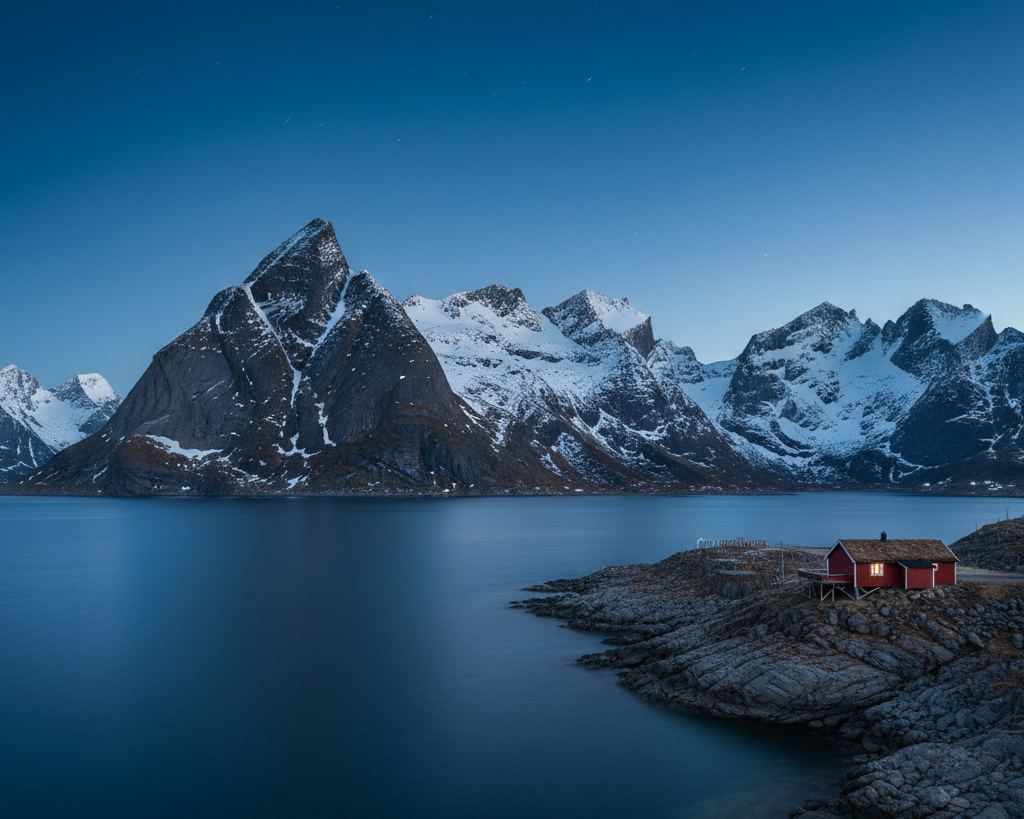
two blue hours at noon, then the road home in darkness
Reserve a polar night trip to Senja, late November to mid January
Six nights in a fishing village on the outer coast of Senja, on dates you pick between November 27 and January 14, from $4,381 per person on two sharing. For that stretch the sun stays under the sea and a long blue twilight does the work of a day, peaking for about an hour either side of local noon. Roving Hours holds the rooms, the vehicle and the guide against your dates and puts the request to the company that runs the trip.
Reserve a windowAn answer is written inside one business day by somebody at this end.
Senja sits at 69 degrees north off the coast of Arctic Norway, and for a little under seven weeks each winter the sun does not get above the sea from any point on the island. That stretch is the polar night, and it is not a long dusk. The sun tracks along beneath the horizon, near enough at midday to throw a great deal of light up into the sky and never near enough to appear in it. On December 21 it climbs to within about three degrees of the rim and goes back down.
What arrives in place of a day is a lift in the southeast starting around half past nine, two hours of deepening color, a peak somewhere between 10:50 and 12:40, and then the same sequence in reverse until it is fully dark by ten past two. Snow takes that color and holds it. White ground under a sky that is blue all the way down to the waterline, with no sun anywhere in it, does not resemble photographs of the same thing, and that is the entire reason this window is on the calendar.
A polar night trip to Senja is six nights in one of the fishing villages on the outer coast, with a vehicle, a driver, a guide and one programmed hour a day. You choose your own dates inside the window. Roving Hours puts the request to the company that runs the trip and comes back with a costed answer against those dates, ordinarily inside two to four working days.
Runs November 27 to January 14.
It opens on the first morning the sun fails to clear the horizon at 69 degrees north and closes on the last morning before it climbs back over the sea, a little under seven weeks later.
The two dates hold to within twenty four hours from one season to the next, so the office keeps the same seven weeks every year and shifts only the first and last departure when the calendar asks for it.
One hour. The trip is programmed for the hour bracketing solar noon, which falls at 11:38 in the last days of November, 11:48 on the solstice and 11:59 by the middle of January.
The rest of the day is dark or close to it, and goes on the coast road, on long meals indoors, and on sleep taken at odd times.
6 nights, from $4,381 per person.
The blue hour is arithmetic and it turns up whether or not anyone is watching; what is unsettled is the sky above it, and on this coast cloud covers the horizon on roughly two days in three, so six nights ordinarily yield two or three clean middays. Aurora is a separate question, common enough here in a dark clear hour and underwritten by nobody, and no one on this trip will tell you it is coming.
- What this office books
- Roving Hours reserves the six nights, the road transfers from the mainland, the vehicle, the guide and the programmed hour on each of the six days; it does not reserve, sell or handle your airfare, your time on the water, or anything you buy in the village.
- Who books it
- Somebody reserving this wants to stand outdoors at midday inside a light that contains no sun and watch what it does to snow.
- Why somebody picks another window
- If what you want is to walk ridges and look down on the island, take a February window instead, when the same snow is on the ground and six hours of usable daylight are there to spend on it.
- In the figure
- Six nights in a family run guest house of four to six rooms above a working harbor, twin or double with private bath; breakfast every morning, laid out late because nothing moves before it; a hot evening meal on five of the six nights, fish on four of them; road transfer from the mainland airport at Bardufoss and back, about two hours twenty each way in winter conditions; a vehicle, a driver and a guide for the whole stay; the programmed hour on all six days, at a different position each day; hand and body warmers, a tripod, and an outer shell and boots in your size if you would rather not fly with your own; a printed sheet giving solar noon and the start and end of twilight for each date of your stay; a drying room for wet clothing and a washing machine you are free to use.
- Not in the figure
- Airfare from Orlando, $920 to $1,640 round trip across this window, which is your own arrangement and is not handled here; an hour on the water in a small local boat, which the company running it holds under its own license and bills you for directly, $95 to $140 per person; lunch on all six days, $14 to $28 a head at the store or the one place in the village that cooks; wine or beer with dinner, $9 to $16 a glass; a room to yourself instead of sharing, $560 for the stay; a second guide if your party wants to split at midday, $310 a day; snowshoe or ski hire, $22 to $35 a day; an extra night on the mainland when your return leaves early, $130 to $190; wool from the two workshops that stay open through the winter, $40 to $260.
- Who this window will not suit
- Do not reserve this if you need daylight to feel like yourself, because there is none for the whole stay and the fourth day is when most people notice. Anyone unwilling to stand still outdoors at 25 °F for ninety minutes, with wet snow coming off the ridge sideways, should pick a different window. It is not a walking trip: the ground is frozen, the tracks are under snow, and the programmed hour is spent standing in one place or moving slowly between two. And if the horizon stays gray for all six days, which happens here, you will have reserved six blue hours and seen the color of dishwater in four of them.
A starting figure for two people sharing one room. Pricing the exact window you pick runs two to four working days, because the company working those dates answers first. No air ticket is ever folded in.
The one hour, and the twenty three around it
The hour is fixed and everything else bends around it. Solar noon on the outer coast falls at 11:38 in the last days of November, 11:48 on the solstice and 11:59 by the middle of January, and the programmed hour runs from thirty minutes before it to thirty minutes after. The guide chooses the position the evening before, on wind direction and cloud base rather than on the view: the beach at Ersfjord when the swell is small enough to walk the sand, the causeway out to Husøy when the wind is off the land, the head of a fjord under a ridge when it is blowing hard from the west and you want a wall between you and it. You are driven, you stand, you are driven back. Three of the six positions are inside 200 meters of the vehicle, because ninety minutes on open ground at 25 °F is as much as most people want on any given day.
The other twenty three hours are not programmed and should not be read as spare. Two of them go on the road, because the villages are strung along a single coastal route and the one you sleep in is rarely the one you stand in. Breakfast is late and it takes a long time. There is a stove, a table, a drying room and a store of firewood, and by the third afternoon most people have stopped looking at the clock and started sleeping in the middle of the day, which is the ordinary way to live here in December rather than a failure of planning.
What holds the window open
Nothing about the window is anybody's decision. It opens on the first morning the sun fails to clear the horizon at this latitude and closes on the last morning before it climbs back over the sea, and those two mornings land on the same pair of dates to within a day, season after season. The office keeps November 27 to January 14 every year and moves the first and last departure only when the calendar moves them.
The mountains stretch that period locally, which matters when you choose which village to sleep in. A house standing under a 600 meter ridge to its south loses the sun for two or three weeks longer than the open water does, so in some settlements the light does not reach the walls until the first week of February, even though the sun is back over the sea in the middle of January. It also means the two ends of the window are not the same trip. Late November still carries a band of yellow low in the south at noon and enough contrast to read a map by. The first fortnight of January is the same astronomy running the other way, the color returning a few minutes a day, with pink showing on the ridge tops before anything lower changes at all.
- November 27 to December 5
- a yellow band still sits low in the south at noon, twilight runs close to five hours, the road is often bare
- December 6 to December 14
- the color goes fully blue, midday light down to four and a half hours, sea off the outer coast about 6 °C
- December 15 to December 23
- the floor of the window, solar noon at 11:48 on the 21st, sky lifting at 09:30 and gone by 14:10
- December 24 to December 26
- the village closes for three days, no store and no fuel, all three dinners eaten in the house
- December 27 to January 3
- the darkest weather rather than the darkest sky, west wind and swell, more of the hour spent inside the fjords
- January 4 to January 10
- light climbing back a few minutes a day, pink on the ridge tops before noon, five hours of twilight again
- January 11 to January 14
- the sun clears the sea horizon on the 15th, so the last departures of the season leave the island a day or two before it does
The village, the road and what closes
You sleep in a house of four to six rooms above a working harbor, with a family living in the other half of it. Dinner is at one table each night, fish on four of the six, and the food comes out when it is ready. The village store opens for a few hours in the middle of the day and not at all on Sunday, and the nearest fuel pump is 30 kilometers back along the fjord. Over December 24, 25 and 26 the whole settlement shuts, and if your dates fall across those days you eat in the house, because nothing else is available anywhere within reach.
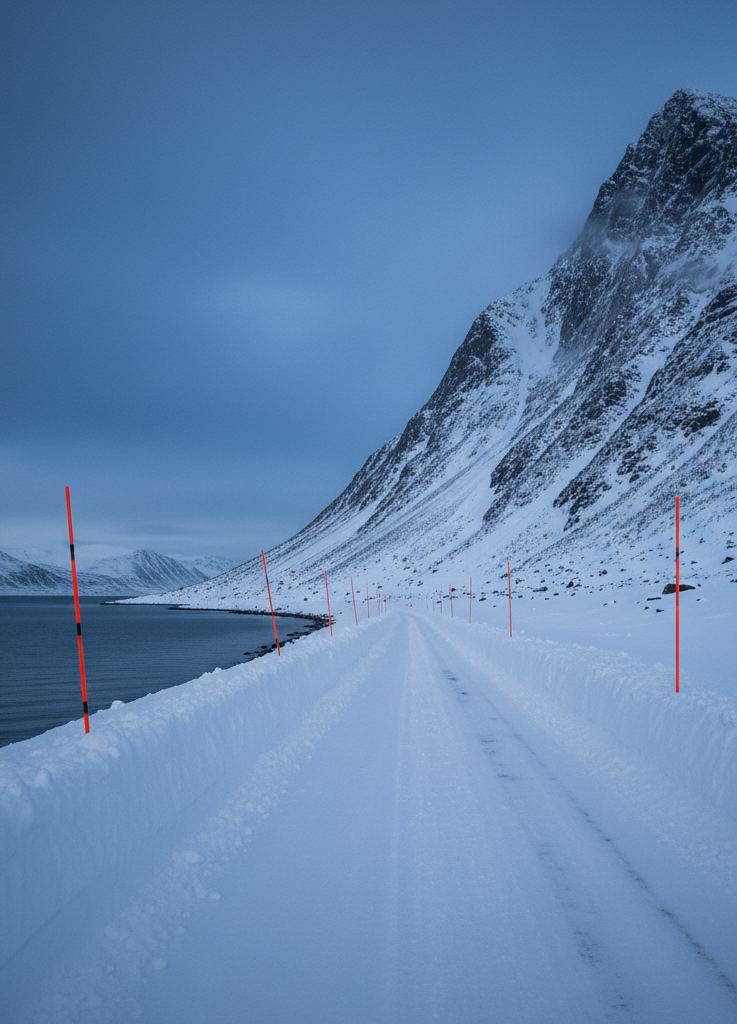
The coast road narrows to one lane in places and runs through unlit tunnels cut straight into rock, with passing bays hollowed out of the wall. After a heavy fall it is closed while the crews clear it, usually for two to five hours, and the day's hour then happens wherever the vehicle can actually get to rather than where the guide had wanted it. The water offshore holds around 6 °C through December, which is why the coast is milder than the latitude suggests: air between 23 and 30 °F on most days, wet snow rather than dry cold, and a wind off the west that settles what the temperature feels like far more than the number does.
What this office does and what it does not
Roving Hours Bookings LLC operates under the name Roving Hours and works from 1350 N. Orange Avenue, Suite 221, Orlando, Orange, FL 32789. It is an independent booking agency, not an operator. It owns nothing that carries a traveler and nothing that shelters one: not the house above the harbor, not the vehicle on the coast road, not the boat in the bay. What it does is hold your dates, put the request to the company on the ground, argue over the detail on your behalf, and hand you a written answer you can read before you commit to any of it.
Your bill is written by the firm on the ground, under the terms that firm sets, and it reaches you directly from them. This office takes no money at any stage of the arrangement. Reaching Norway is your own arrangement and airfare is not handled here; the road transfer from the mainland airport at Bardufoss is handled here, and it sits inside the figure quoted above.
If you want an hour on the water while you are there, say so and it will be set up, but the company that runs that boat holds the passage under its own license and writes its own bill for it. Call +1 (407) 629-3157 to talk through dates before you commit to anything, write to bookings@rovinghours.com to open a request, and send corrections or paperwork to corrections@rovinghours.com. Requests are answered within one business day, and a costed quote against your chosen dates follows two to four working days after that. The agency's own agreement with you is governed by the law of Florida.
Start with the weeks, not the country
This form takes requests every hour of every day, and a person answers within one business day. Nothing here commits you. No figure is charged at this end.