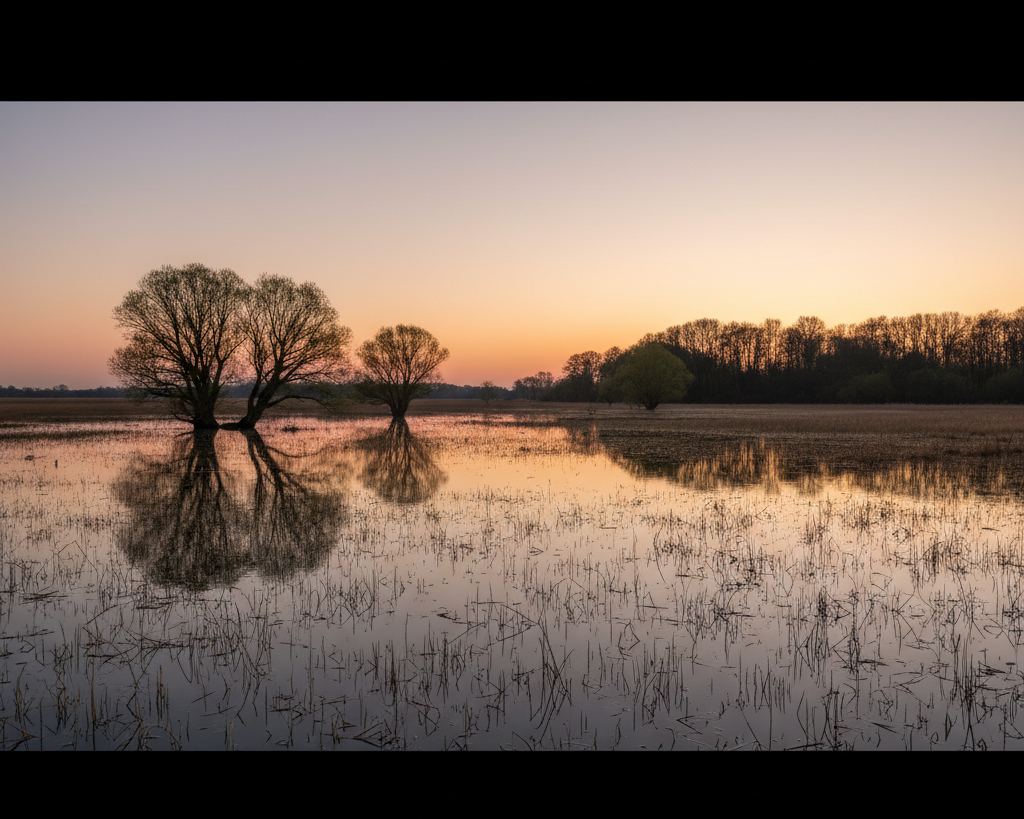
wet reed, cold hands, forty minutes of noise overhead
Reserve the Somerset Levels starling roost, late November to mid January
Roving Hours reserves five nights on the moors south of Glastonbury with an evening watch over the reed beds every day of the stay, inside the window that runs late November to mid January, from $3,357 per person on two sharing. What brings people is the forty minutes before the birds drop into the reeds, when a flock that has spent the day scattered across the Levels pulls into one moving body low over the water.
Reserve a windowAn answer is written inside one business day by somebody at this end.
The starlings come to the Somerset Levels because the reed beds sit on old peat workings that were cut, flooded and left, and reed took them. A bird that has fed all day on grubs and grain across forty square miles of drained moor wants to sleep somewhere a fox cannot walk and a barn owl will not bother it, and standing water under two meters of reed stem is exactly that. So the birds spend the daylight scattered and the dusk converging, and the converging is the whole reason this window exists.
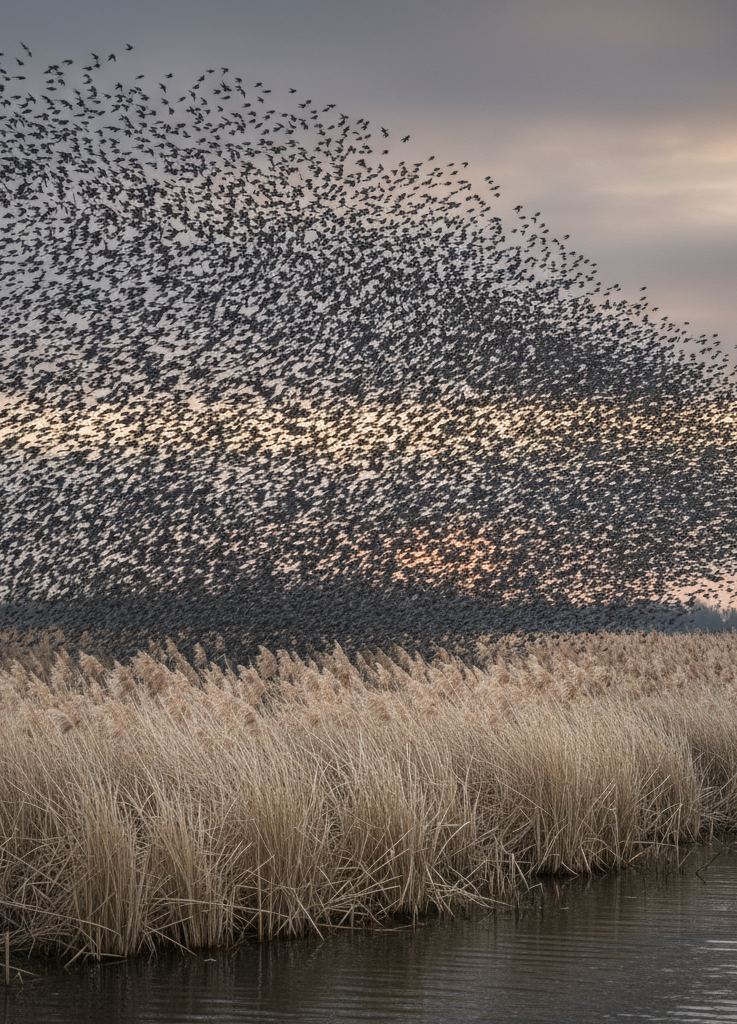
What you actually watch is the last stage of that convergence. From about half an hour before sunset, groups arrive from every quarter, a few hundred at a time, and instead of dropping straight in they join what is already circling. The mass builds. At some point it is dense enough that the individual birds stop reading as birds and the flock reads as one surface, folding through itself, thinning to a smear and thickening again. Then it goes down, usually in under ninety seconds, in a column that pours into the reed like water finding a drain. After that there is noise from inside the bed for ten minutes and then it stops.
Roving Hours reserves five nights against this, not one, because the display is a matter of conditions rather than schedule and one evening is a coin toss.
Runs late November to mid January.
The window opens when the wintering flock has built up enough birds over the moors to hold together as one body at dusk, usually the last week of November, and it shuts in the second week of January when birds begin peeling off westward and the flock breaks into smaller groups that scatter to separate reed beds.
The opening date moves by up to a fortnight either way depending on how cold the autumn ran in northern Europe, and the office holds your nights against the operator's own dated list rather than a fixed calendar, so an early or late season shifts your stay rather than cancelling it.
One hour. The trip is programmed for the last hour of light, roughly 15:40 to 16:30 in December, when the flock gathers over the reed beds and goes down.
The rest of the day is unstructured and yours, with the operator running one optional morning walk on the droves and otherwise leaving you to the villages, the church towers and the peat moor lanes.
5 nights, from $3,357 per person.
The flock is present on the Levels every winter and goes to roost every evening it is there, so the birds themselves are close to reliable, but the tight rolling display that people come for depends on wind, rain and whether a peregrine is working the reed bed, and perhaps one evening in three across a five night stay produces the long shape shifting kind. Nobody underwrites the behavior of wild birds, the operator does not, and this office does not either, which is why the stay carries five evenings rather than one.
- What this office books
- The office books the five nights of lodging, the evening transfers to the reed beds, the warden led watches and the two moor walks, and it books no flight, no rail ticket, no car hire and no meal outside the ones named below.
- Who books it
- A person booking this wants to stand in the cold and watch two hundred thousand birds behave as one thing for forty minutes, and wants somebody else to know which of the reed beds they are using this week.
- Why somebody picks another window
- Somebody who wants the birds in daylight, with warmth and long hours outside, should take a spring or autumn window somewhere else, because here you get four flat grey hours of usable light and one good one.
- In the figure
- Five nights in a farmhouse room with four rooms let in total, two sharing; breakfast each morning; three evening meals at the farmhouse on the nights the flock is furthest out; return road transfer to the reed bed each evening of the stay, with the choice of bed made that afternoon; a warden led watch on all five evenings with a scope set up on the bank; two guided morning walks on the droves and rhynes, three to five miles each, flat; entry to both reed bed reserves for the length of the stay; a loan pair of binoculars per person if you would rather not carry your own; a printed sheet of the week's roost movements and where the flock sat each night; all local taxes and the operator's booking administration.
- Not in the figure
- Round trip flight from Orlando, typically $780 to $1,340 depending on the week; rail or road connection from the airport to Somerset, $95 to $185 per person each way; lunches, $14 to $26 a day; the two evening meals not listed above, $32 to $58 each; drinks; waterproof over trousers and boots if you do not bring your own, $70 to $150 to buy locally; a second scope or camera support hired from the operator, $45 for the stay; gratuities to the wardens and driver, entirely at your discretion; anything you add after arrival, billed by the operator on its own paper.
- Who this window will not suit
- This is standing still in the wet cold and near dark for forty minutes at a time, five evenings running, and the walking is flat but the ground is soft and you will be muddy to the knee. If you dislike short days, you will get eight hours of light in December and much of it flat grey under cloud. There is no warm indoor viewing, no seating on the bank and no shelter beyond a hedge. And you may drive out five evenings and see a modest gathering that goes down in six minutes rather than the long rolling one, which is the honest shape of the thing and not a fault in the arrangement.
A starting figure for two people sharing one room. Pricing the exact window you pick runs two to four working days, because the company working those dates answers first. No air ticket is ever folded in.
Why the window is late November to mid January
Birds are on the Levels from October, but the numbers early in autumn are local and the gatherings are small and businesslike. The flock only reaches the size that produces the long display when the continental wintering birds have arrived, which is normally complete by the last days of November. That is the front edge.
The back edge is less tidy. Through the first week of January the flock is still whole. In the second week it begins to come apart, not by leaving the country but by splitting: birds move to smaller beds westward and northward, the single roost becomes three or four, and each one is a fraction of the size. By the third week of January you can still see starlings go to roost, and it is a pleasant thing, but it is not what this page is about, so the office stops selling the stay before it becomes a disappointment.
Both edges move. A cold December in northern Europe pushes birds across earlier and can bring the opening forward by ten days; a mild one delays it. The operator sets its dated list in late October each year, and pricing the exact window you pick runs two to four working days at this end, because the office has to check your nights against a list that is not yet a year old.
The shape of one day here
The trip is programmed for one hour and the office says so plainly rather than dressing the rest of the day as itinerary. In the second week of December sunrise is 08:03 and sunset 16:07. The vehicle leaves for the reed bed at 15:10, the watch runs from roughly 15:40, the flock goes down between 16:05 and 16:25 depending on cloud, and you are back indoors by 17:15. Everything else in the twenty four is yours.
That is not a shortfall, it is the arrangement. The moor in the middle of the day is quiet, wide and largely empty of people, and two guided walks on the droves are included for those who want them. The rest of the time people go to the villages, the abbey ruins, the tower on the hill, or sit somewhere warm with a book. Nobody should book this expecting a full program.
- Late November
- flock reaches full winter size, first evenings sold
- Early December
- shortest useful light, sunset 16:07, coldest still air
- Mid December
- highest counts of the season on both beds
- Late December
- villages close down, moor at its emptiest
- Early January
- flock still whole, weather more often wet than cold
- Second week January
- roost begins splitting, window closes
- Any evening
- one hour of the day is programmed, the rest is not
The two beds, and why nobody promises which one
There are two reed bed reserves within nine miles of one another, both on the same drained peat workings, both wardened. The flock uses one, then sometimes moves to the other with no warning anybody can read in advance. Wardens count each evening and the operator calls them at about 14:00, which is why the destination for your watch is decided on the afternoon of the watch and not printed in advance.
This matters practically. The two beds have different approaches: one has a boarded walkway of about 900 meters from the parking, the other a soft track of half that with a stile. Both are flat. Neither has any shelter. If you have limited mobility, say so when you ask for the quote, because one of the two suits it much better and the operator will weight the week accordingly.
What is honest to expect
Some evenings the birds arrive, circle twice and drop. That takes six minutes and it is worth seeing, but it is not the thing on the photographs. The long version, where the mass holds together for twenty minutes and keeps changing shape, needs a certain amount of wind, not too much rain, and often a bird of prey working the edges to keep the flock tight. Across five evenings a stay will usually produce one or two of those and three quieter ones. It can produce none. Nature is not underwritten by anybody and this office will not pretend otherwise, which is exactly why the trip is sold as five evenings rather than as an event.
The operating company runs the vehicles, holds the farmhouse rooms and arranges the warden watches on its own account, and the operator running those days sends the invoice on its own paper. No vessel, no vehicle, no bed and no aircraft on this page is company property, and this office takes no money at any point. The flight out is yours to buy and no ticket is sold at this counter; when you tell us your dates we work backward from the roost calendar to the nights that fit them.
To start, send which window is in view and how many people are going. Roving Hours Bookings LLC answers from Orlando, Orange, Florida, and you can reach the office at +1 (407) 629-3157 or write to bookings@rovinghours.com; anything that needs correcting on a quote already sent goes to corrections@rovinghours.com. The office is at 1350 N. Orange Avenue, Suite 221, Orlando, FL 32789.
Start with the weeks, not the country
This form takes requests every hour of every day, and a person answers within one business day. Nothing here commits you. No figure is charged at this end.