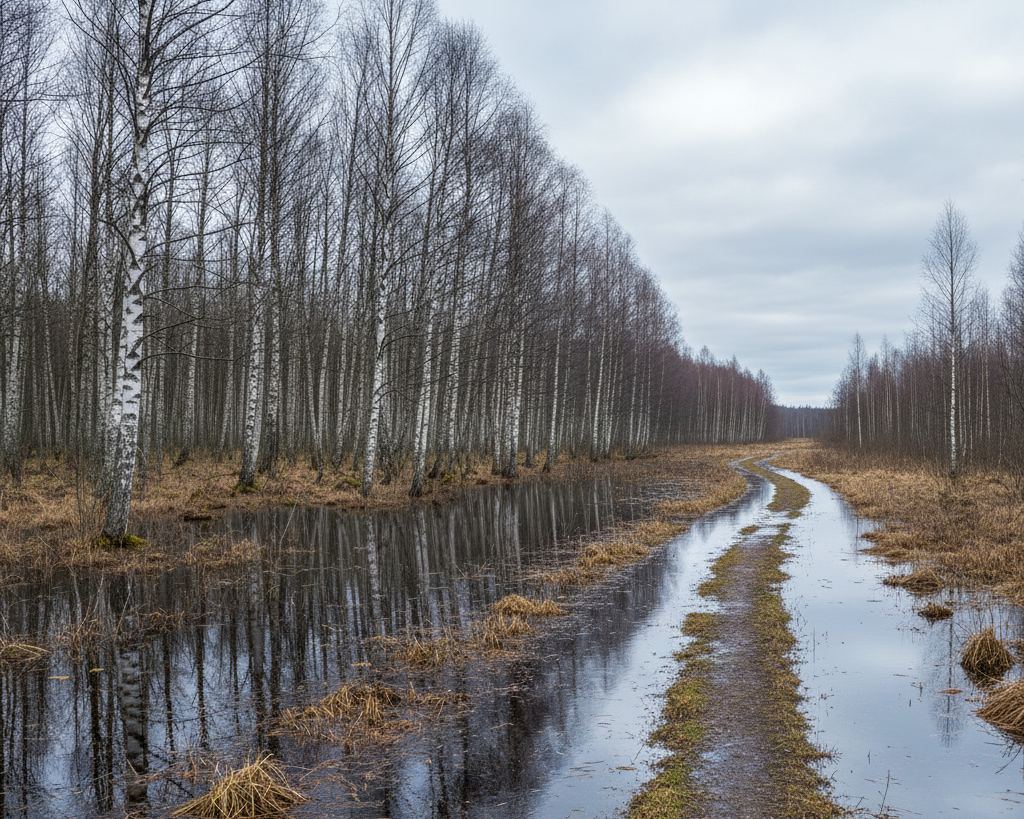
paddling between bare alders above a road that is under water
Reserve a Soomaa fifth season trip in Estonia for the late March to April flood
Six nights on the Halliste floodplain in southwestern Estonia, five of them at a farmhouse with four guest rooms standing inside the flooded ground and the last one on the airport road at Tallinn, with three programmed days in open canoes and a half day in a log dugout, from $3,268 per person on two sharing between March 20 and April 30. The water is the product. For a few weeks the melt sits a yard or two deep over hay meadow and floodplain forest, and a boat goes along lines that are a road, a field edge and a footpath for the other eleven months.
Reserve a windowAn answer is written inside one business day by somebody at this end.
Estonia counts a fifth season the way it counts the other four, and the country has one place where the phrase is literal enough to build a week around. In the second half of March the snow in the Soomaa basin melts into soil that is still frozen a foot down, so almost none of it soaks away. The five rivers take what they can hold and the rest goes sideways into the forest and the hay meadows. Roads go under. People who reserve a Soomaa fifth season trip in Estonia are reserving six nights placed inside that stretch of water, three of the days spent crossing ground that is normally walked on.
The reason it happens here and not in the next parish is the flatness. The land falls about a foot in a mile across this basin, and the Navesti, the Halliste, the Raudna, the Lemmjõgi and the Kõpu all arrive within a few miles of one another near Riisa before leaving as one river toward the coast. There is no gorge, no fall and nothing to move the water along faster than it wants to go. A normal spring lifts the rivers five to eight feet above their summer level and puts water over tens of square miles of meadow and floodplain forest. A heavy one goes past ten feet and covers something closer to sixty square miles, and the highest mark measured in the last hundred years stands at around eighteen feet.
Five of the six nights go to a farmhouse of four rooms on the Tõramaa side, built on a rise of a meter and a half above the meadow, which in an ordinary high water leaves the house dry and the track to it under a couple of feet. That is deliberate. Being on the wet side of the water is the entire point of the base, and the last night is spent near the airport road at Tallinn, ninety miles north, so that the morning you fly is a short one.
Runs March 20 to April 30.
The melt comes off ground that is still frozen underneath faster than five slow rivers can carry it away, and the level holds until the soil thaws enough to take water again and the channels pull the rest back inside their banks.
The peak has arrived as early as the second week of February and as late as the first days of May, so the office holds your nights, your guide and your boats against the dates you can actually travel and reorders the days inside them rather than shifting the whole week.
Most of the daylight. The programmed part of the day runs from roughly 08:30 to 18:15, because a flooded forest can only be read in daylight and the paddling, the bog walk and the dugout all sit inside that.
Evenings belong to you and there is not much in them: dark by eight in late March and closer to nine by the end of April, no lit path anywhere near the house, so it is the sauna, wet clothes over the stove and an early bed.
6 nights, from $3,268 per person.
In most springs the water comes over the low section of the Riisa road at some point between the last week of March and the middle of April and stays over it for ten days to three weeks, which is the local test of whether the fifth season has arrived. Nobody promises a flood and nothing of the kind is promised from here; the figure holds six nights, a guide, a house and a set of boats, and the level is settled by how much snow fell in January and how fast it goes.
What you are inside for those five nights is not a lake. It is a forest with water in it, standing between black alder and ash that will not carry a leaf until the middle of May, so you can see two hundred yards through trees in a way that is impossible for the rest of the year. Underneath the hull are cart tracks, ditch lines, a hayfield boundary and, in one place on the second day, the road surface itself.
- What this office books
- The office books the six nights, the guide, both road transfers, the bog walk and your places on the three canoe days and the dugout half day; it books no airfare, and the boats and your passage in them are held and billed by the Estonian firm that owns the hulls and carries people in them under its own license.
- Who books it
- A person booking this wants to paddle over a road, a hayfield and a forest floor during the short run of weeks when that is the honest way to cross them.
- Why somebody picks another window
- If you want the same country dry, with leaves on the alders and every bog trail walkable end to end, take the second half of June instead and accept that the rivers will be back inside their banks and the boats will be following channels.
- In the figure
- Six nights two sharing, five at a farmhouse with four guest rooms on the Tõramaa side of the water and the last on the airport road at Tallinn; breakfast every morning and dinner cooked in the farmhouse on five evenings; a hot lunch carried in a dry bag on each of the three water days; a guide who grew up on these rivers and has worked several floods; three programmed days in open canoes with paddles, buoyancy vests and dry bags in the hire; a half day in a log dugout on still water with the man who cuts them; rubber boots in your size, waterproof over trousers and a bag that will keep a camera dry; a guided walk over the bog on bog shoes when the surface will carry a group; both road transfers between Tallinn and the farmhouse, about ninety miles each way; a wood fired sauna every evening and a warm room for drying clothes; and a day by day sheet giving the level read that morning and what each day becomes if the number is wrong for the plan.
- Not in the figure
- The flight, which you arrange yourself, Orlando to Tallinn through a European hub, about $860 to $1,740 round trip in the flood weeks; the two meals in Tallinn at either end of the week, $14 to $40 a person; food and drink on the one free evening away from the house, $16 to $45; a dry suit hire if you would rather have one than layers, $30 to $55 a day; a single room supplement, $410 for the six nights; a second half day in the dugout if the first one takes, $45 to $95; an extra night at the farmhouse if the level holds and you want more of it, $95 to $140 a room; beer or wine in the house, $4 to $9 a glass; laundry, $8 to $18 a load; and gratuities, which are not looked for in rural Estonia and are not inside the figure.
- Who this window will not suit
- This is a cold, wet week with long stretches of sitting still in it. You will be in a boat for five or six hours on three of the days, in air that can be 38F with rain crossing it and water at 36F under the hull, and once you are in the middle of a flooded forest the way out is to keep paddling to the far side of it. Anyone who needs firm ground underfoot, a dry seat or a phone signal should read that twice, and anyone who cannot take a plan being rewritten at breakfast should leave this one alone, because the level is read at seven and the level decides the day. It is also wrong for somebody who wants to be shown a thing on demand: in a winter with little snow the meadows stay green and dry, the week turns into river paddling and bog walking, and none of the figure comes back for that.
A starting figure for two people sharing one room. Pricing the exact window you pick runs two to four working days, because the company working those dates answers first. No air ticket is ever folded in.
What the level does across the window
The gauge starts to move in the third week of March in most years. Water comes up quickly, three or four days from the first rise to something near the top, then holds and falls slowly over the following ten days to three weeks. The local test is the low section of the Riisa road: when it goes under, the fifth season is in, and the households on the far side of it move to boats for their groceries and their school run, which they have always done and do without any commentary.
Somewhere between March 25 and April 15 sits the fortnight that most often has both the water and the light. Before that you can get a big level with the days still short and the nights still hard frozen. After the middle of April the level drops away and the ground begins to take water again, and by the last week of the month you are usually looking at a high, brown, fast river inside its banks with wet grass on either side, which is a different week entirely and is sold as one.
Not every winter delivers. A January that gives fifteen inches of snow and a wet, warm second half of March will put water over the roads for a fortnight. A winter of rain and no snow will not, and in those springs the rivers run high and hard and stay where they belong. The office states this before it takes a date rather than after, because it is the one thing on the page that nobody controls and nobody should pretend to.
The three days on the water
The programmed part of the day runs from about 08:30 to 18:15, and it uses most of the light on purpose. The distances are eight to fourteen miles, mostly with the current and across it, in open canoes with two paddlers and a guide alongside. Launching is often from a road surface with a foot of water on it, which takes some getting used to. The water is 34F to 40F for the whole window; the air behind it sits between 38F and 50F by day, with frost most nights in March, so the layering matters more than the paddling technique does.
Half a day goes to a different boat. A haabjas is a dugout cut from a single aspen trunk, five to six meters long, the sides softened with water and heat and spread outward until the hull will take two people and their boots. It sits low. There are two or three inches of freeboard, no keel worth the name, and it turns on a thought, which is why that half day happens on still flooded meadow rather than in the current. The building of these has come down to a small number of people in this parish, and the one who takes you out is one of them.
- 07:00
- the level is read off the post at the landing
- 07:45
- breakfast, and the day is set from that number
- 08:30
- the vehicle goes as far as dry road allows
- 09:15
- boats in, more often than not from a road
- 12:30
- lunch eaten standing on a bog island or afloat
- 15:00
- the wind gets up across the open meadow
- 18:15
- out, boots off, the programmed part is finished
- 20:00
- dark in March, closer to 20:40 by late April
What the flood pushes to the surface
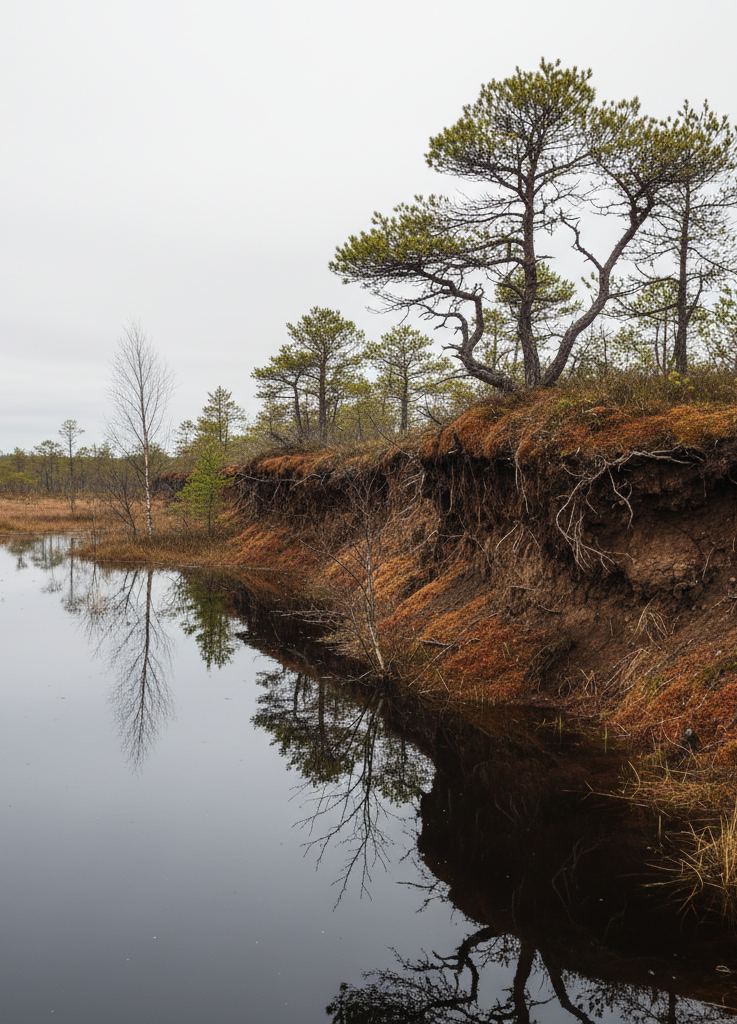
The bogs do not flood. Kuresoo and the three others stand five to seven meters above the mineral ground around them, dry and springy while everything below is under, and their northern edge drops about eight meters in a hundred, which is abrupt for a bog and worth the walk. One day of the week goes there on bog shoes when the surface will carry a group, which is a question of frost and rain rather than of the calendar.
Everything alive moves at the same time. Cranes are back over the flooded meadows from the third week of March and are loud about it. Whooper swans and geese use the sheet water for a few weeks as a staging ground, in numbers that fall away as soon as it drains. Pike leave the channels and spawn in flooded grass sometimes only a foot deep, and you see their backs out of the water from a boat. In the middle of April, for three or four days, the male moor frogs in the shallow pools turn pale blue, which is short, local and easy to miss if the week falls wrong. Elk and boar concentrate on whatever ground is above the line, which in a big flood means the roadsides and the bog margins.
Coming a fortnight to either side
Two weeks before this window opens, in the first half of March, you get the same country under old snow and ice. The rivers are frozen at the edges, the tracks are drivable, the light is short and the bogs walk well on hard frost. That is a real week, but it is not this one, and the office will say so rather than take the booking and hope.
Two weeks after it closes, in the first half of May, the leaf comes onto the alder and the whole floodplain shuts down to about thirty yards of visibility. The water is inside the banks, the boats follow the rivers, the days are long and warm and the mosquitoes have started. If the flood is what you want, that fortnight is not a compromise, it is a different product.
Send the weeks you could travel and a costed answer on paper takes two to four working days, because every night, every boat and the guide have to be confirmed with the people holding them before a figure goes anywhere. Not one roof, hull or wheel described here belongs to Roving Hours Bookings LLC, known as Roving Hours, which works from 1350 N. Orange Avenue, Suite 221 in Orlando, Orange, Florida 32789. The farmhouse, the canoes, the dugout and the vehicle are Estonian and stay that way, their invoice is written by them on their own terms and reaches you directly, and no money is taken at this end at any stage. Getting yourself as far as Tallinn is your own arrangement, since no air ticket is sold from this office. Questions on +1 (407) 629-3157 or by mail to bookings@rovinghours.com; if a date, a distance or a number anywhere on this page is wrong, write to corrections@rovinghours.com and it will be put right.
Start with the weeks, not the country
This form takes requests every hour of every day, and a person answers within one business day. Nothing here commits you. No figure is charged at this end.