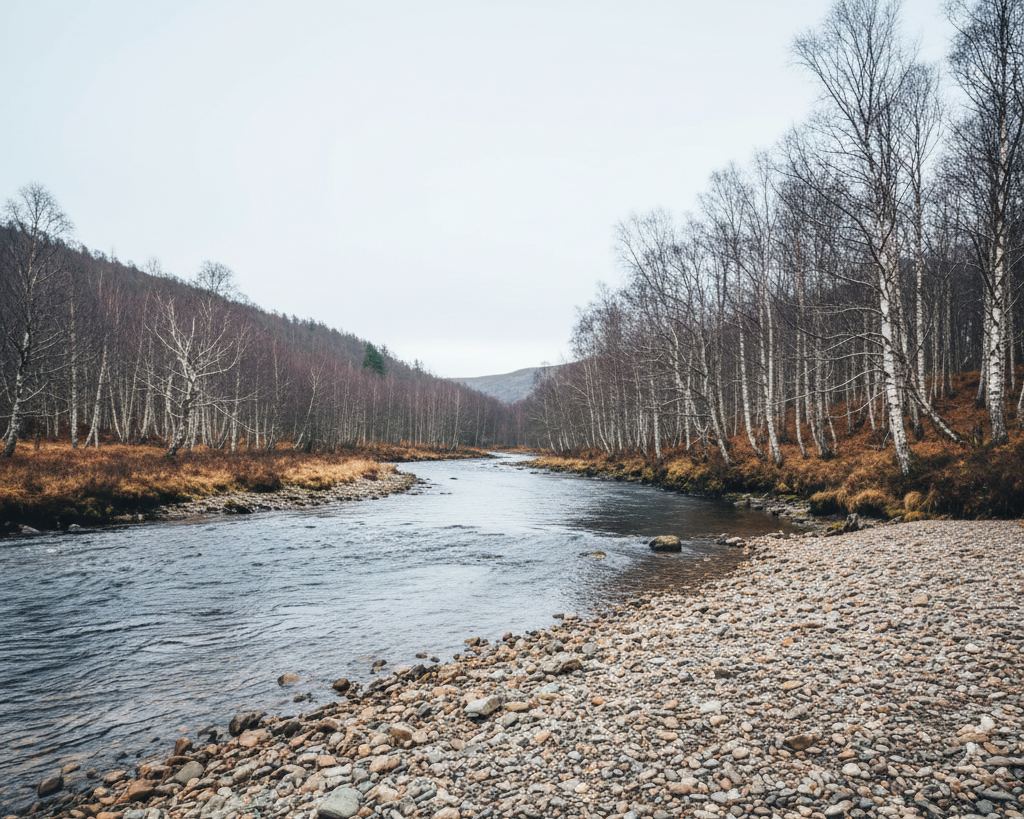
ice in the rod rings, a dram poured into the water
Reserve a Speyside salmon fishing week, February 11 to March 31
Roving Hours reserves six nights in the middle strath with five days of let water on the Spey, inside the window that runs February 11 to March 31, from $5,660 per person on two sharing. What people come for is the opening itself, which happens on a fixed date with a ceremony on the bank, and the six weeks behind it, when the river is cold, high and almost empty of people.
Reserve a windowAn answer is written inside one business day by somebody at this end.
The salmon season on the Spey opens on February 11, and the eleventh is the eleventh whatever the river happens to be doing. It is one of the few dates in a fishing year that nobody shifts: the order that governs the district sets it, every beat on the river works to it, and the water is let from that morning onward. The opening is marked on the bank. A piper, a few words said over the river, a quaich of whisky poured into the water, and the first cast of the season made in front of a few hundred people standing about in the cold with their hands in their pockets. The whole of it takes forty minutes. By late morning the crowd has gone and the strath is quiet again for six weeks.
What the eleventh gives you after that is cold water and an empty river. February on the Spey is snowmelt off the Monadhliath and the Cairngorms, running at one to four degrees Celsius, and ice makes in the rod rings on a still morning so that you break it out with a thumb every dozen casts. Nothing is in leaf. You can read the whole beat from the bank, every seam and every stone in it, and you can fish half a mile of it without seeing another person.
Roving Hours reserves six nights in the middle strath against five days of let water, and puts your arrival on a Sunday, because Sunday is not a fishing day for salmon anywhere in Scotland and there is nothing lost by spending it on the road.
Runs February 11 to March 31.
The window opens because the Spey season opens on February 11 under the order that governs the district, a date that is marked on the bank that morning, and it shuts at the end of March because the water has warmed to between 5 and 7 degrees, the clocks have gone forward, and the spring arrangement that people book this week for has become a different kind of fishing.
The front edge does not move at all, which is unusual on this site; what moves is the weekday it lands on, and in a year when the eleventh falls on a Sunday the rods go out on the twelfth, so the office builds your nights around the ceremony rather than around a fixed arrival day.
A morning or an evening. The trip is programmed for the morning and the first part of the afternoon, from 09:15 on the water until about 14:00, which in cold water is when fish move if they are going to.
The rest of the day carries no itinerary at all, and people spend it in the drying room, on the flat gravelled path along the old railway, in the villages, or making up flies for the next morning.
6 nights, from $5,660 per person.
Spring salmon are few on any Scottish river and this window sits at the thin end of the year, so a five day week can pass with neither rod touching anything, and that is an ordinary February result rather than a failure of the beat or the arrangement. Nothing underwrites a wild fish, not the ghillie, not the company that runs your week and not this office, which is why the week is sold as five days of let water and not as a catch.
- What this office books
- The office books the six nights, the five rod days and the beat permits that go with them, the ghillie on each of those days and the road transfer to the water every morning, and it books no flight, no rail seat, no car hire and no evening meal beyond the four listed below.
- Who books it
- A person booking this wants the first cast of a season that starts on a date rather than a mood, and wants the cold quiet fortnight behind it, when a fish that has spent three years at sea comes up a river with nobody else on it.
- Why somebody picks another window
- Somebody who wants warm water, long light and something on the end of the line most days should take a summer or autumn week somewhere else, because February here gives you nine and a half hours of light, wet hands and a river that can be empty of moving fish for days together.
- In the figure
- Six nights in a stone lodge of six rooms in a village in the middle strath, two sharing; breakfast every morning and a packed lunch carried to the water on the five fishing days; four evening meals at the lodge; five days of let water on named beats between Grantown on Spey and Fochabers, with the beat permit held throughout by the company running the week; a ghillie on the beat on every fishing day; road transfer from the lodge to the water and back each morning; the loan of a two handed rod, reel and line for the week if you would rather not carry your own; flies made up at the hut for the height and temperature you are actually fishing; a drying room with a stove kept going for waders and jackets; the ghillie's handwritten sheet of what came off each beat that week and at what gauge height; all local taxes and the booking work at both ends.
- Not in the figure
- Round trip flight from Orlando, generally $760 to $1,420 depending on the week; road or rail connection from the arrival airport into the strath, $105 to $200 per person each way; chest waders, boots and a wading staff if you do not bring your own, $65 for the week to hire or $120 to $340 to buy locally; the two evening meals not listed above, $28 to $56 each; drinks; a sixth rod day added where the beat has room for it, $170 to $330; distillery visits in the afternoons, which you arrange for yourself, $16 to $90 a head; a rod section broken in the current, $40 to $200 to replace; what you hand the ghillie at the end of the week, which is yours to decide and is not collected here; anything added after arrival, invoiced by the company running the week.
- Who this window will not suit
- This is five mornings standing in moving water at three or four degrees with wet hands, and the cold comes through neoprene at about the forty minute mark whatever you are wearing over it. The light is short at the front of the window, nine and a half hours of it, much of that under low cloud, and the bottom you are wading on is round cobble the size of a fist that shifts under your boots. You may fish the entire week and touch nothing at all, and people do. If you want to be busy, or warm, or sure of a result, this is the wrong week and nothing in the arrangement will change that for you.
A starting figure for two people sharing one room. Pricing the exact window you pick runs two to four working days, because the company working those dates answers first. No air ticket is ever folded in.
Why the front edge is fixed and the back edge is a judgment
Most of the windows sold from this office wander with the weather by a week either way. This one does not, at the front. February 11 has not moved and will not move for the convenience of anybody's calendar, which makes it the simplest date on the whole site to hold a week against. What changes from year to year is the weekday it lands on. When the eleventh falls on a Sunday the ceremony still happens that morning and the rods go out on the twelfth, and the week is built that way rather than selling you a morning that cannot be fished.
The back edge is our own line and we draw it at March 31 for three reasons. The water climbs from around 2 degrees in the middle of February to between 5 and 7 by the last week of March, so fish move more freely and the fishing stops being the slow cold business people booked it for. The clocks go forward on the last Sunday of the month, and overnight the useful part of the day slides toward the evening, which changes the shape of everything on this page. And every fish touched before the first of April goes straight back into the river, without argument and without being lifted out for a photograph if the ghillie says not; that is the rule on this water in spring and it is part of what this particular week is. Rather than sell an April week under a February heading, the office stops here.
The half of the day that is programmed
The rod goes into the water in the morning and comes out in the early afternoon. The vehicle leaves the lodge at 08:40, the ghillie has the beat and the tackle sorted by 09:15, and you fish through to about 14:00 with twenty minutes at the hut in the middle of it. That is the entire programme, five days out of six.
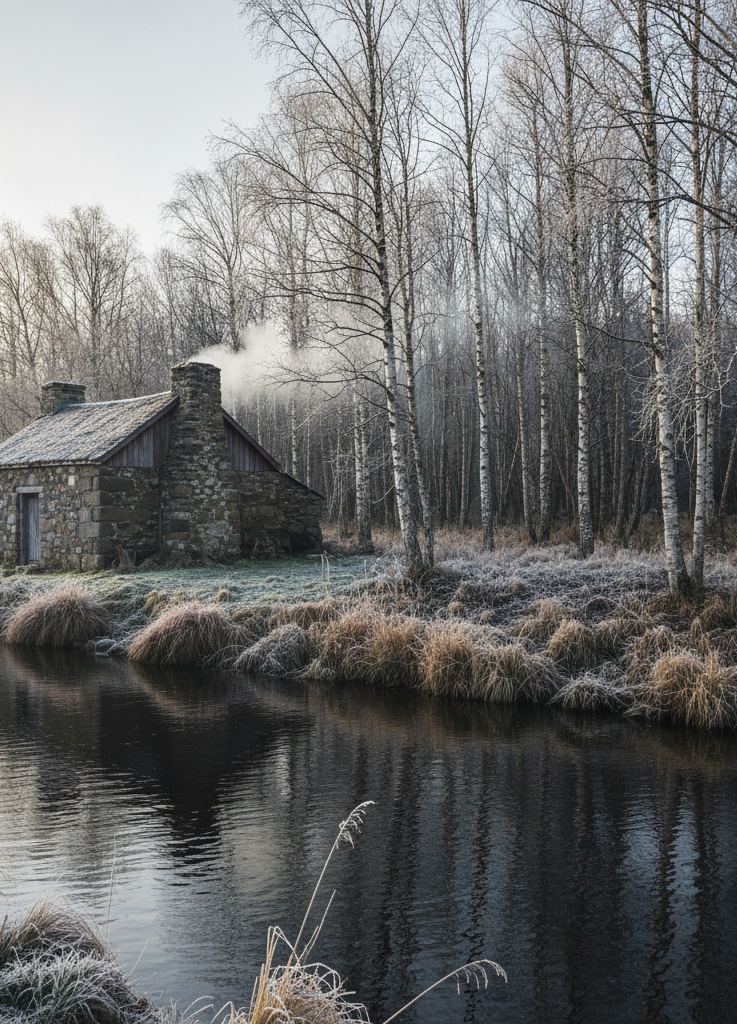
The reason it ends there is not the light. In the second week of February the sun is up at 07:45 and down at 17:10, so you come off the water with an hour and a half still in hand. It ends there because a fly worked properly through five cold hours has covered the beat, and because in water this cold the fish that are going to move tend to do it between about eleven and two, when the river has taken up whatever heat the day is offering. Five careful hours in the right part of the day is what is being sold here. Nine tired ones are not.
The rest of the day is yours and carries no itinerary. There is a drying room with a stove and most people spend the first hour back inside it. The old railway runs the length of the strath as a flat gravelled path and you can walk as much of it as you like. The glen is malt whisky country and several working distilleries take visitors in the afternoon, which you arrange for yourself. The village shop shuts at 17:00, the hotels stop serving food at about 20:30, and after that the strath goes dark in a way that surprises people who have not wintered this far north.
- February 11
- the river opens, the ceremony on the bank, the first cast
- Rest of February
- coldest water of the window, 1 to 4 degrees, fewest fish moving
- First week of March
- light lengthening at both ends, hill snow still holding
- Second week of March
- often the highest gauge of the window as the snow comes off
- Third week of March
- water usually 5 to 7 degrees, more fish in the system
- Last Sunday of March
- clocks forward, the evening gains an hour overnight
- March 31
- the office stops selling this window
- Any Sunday
- not a fishing day for salmon anywhere in the country
The river, the beats and standing in it
The Spey drops about 300 meters over its 98 miles, from a loch in the hills above Laggan to the firth at Spey Bay, and that fall is the reason it runs off and clears within a day of a spate while flatter rivers stay coloured for a week. The beats held for this week sit between Grantown on Spey and Fochabers. A beat is a named stretch of a mile or two with its own hut, its own ghillie and its own letting by the rod, so the number on the water is settled well in advance; the permit for it belongs to the company running your week, and neither you nor this office holds it.
None of these beats is fished from a boat. All of it is wading. The bottom is round cobble about the size of a fist and it shifts under your boots, so everybody carries a staff, and water at three degrees works through neoprene in about forty minutes, which is why the stove in the hut is lit from eight in the morning and why the ghillie calls you in at eleven whether you think you want tea or not.
The two handed cast that everybody uses on this water was worked out here, on banks exactly like these, where alder standing close behind you leaves nowhere to throw a line backward. If you have never made one, say so when you ask for a price. The ghillie will give the first morning to teaching it properly rather than watching you fight the river for five days.
What is honest to expect about the fish
Spring salmon are few, and the counts on this river in February are small in any year you care to look at. A beat with four rods on it can go three days with nobody touching anything and then see two fish inside an hour on the fourth. Across five days, two rods sharing water might account for one. They might account for none, and a blank February week is an ordinary result rather than bad luck or a fault in the beat. Nothing here underwrites a wild fish: not the ghillie, not the company that runs your week, and not this office. What the week actually holds is the opening, five days of let water, a hut with a fire in it, and somebody on the bank who knows where fish lie at the height the river happens to be that morning.
Every roof, hut, vehicle and rod day named on this page is somebody else's property, and this office owns none of it. The company that runs your week invoices you itself and is paid directly, so no money moves through here at any stage. The long leg is your own arrangement, since no air ticket of any kind is sold from this office, and if you tell us the days you can genuinely get away we will work the week backward from them. Putting a written figure against a specific week takes two to four working days, because the season's letting sheet has to be read beat by beat before anybody quotes you anything.
Tell us the week you are looking at and how many rods you are. Roving Hours Bookings LLC answers from Orlando, Orange, Florida; you can call +1 (407) 629-3157 or write to bookings@rovinghours.com, and a change to a price already sent goes to corrections@rovinghours.com. Paper reaches us at 1350 N. Orange Avenue, Suite 221, Orlando, FL 32789.
Start with the weeks, not the country
This form takes requests every hour of every day, and a person answers within one business day. Nothing here commits you. No figure is charged at this end.