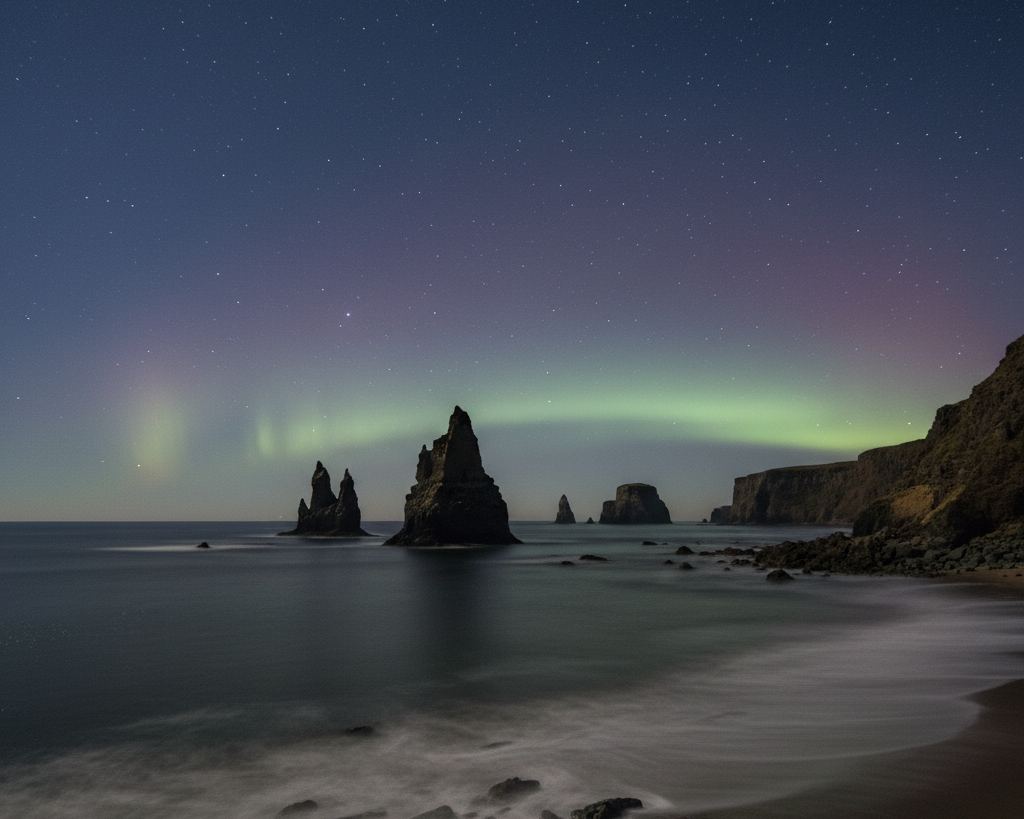
a pale grey band low in the south, sand at four degrees
Reserve an aurora australis watch in southern Tasmania, April to September
Roving Hours holds eight nights on the coast below Hobart, on a departure set to a new moon between April 12 and September 28, from $4,127 per person on two sharing. What those nights are held for is one hour after full dark on a south facing beach, with open water and then the ice behind whatever the sky is doing. The rest of each day is yours and nothing is programmed into it.
Reserve a windowAn answer is written inside one business day by somebody at this end.
The aurora australis is seen from southern Tasmania more often than from anywhere else in Australia with a sealed road to it and a bed at the end of the road. This is an eight night stay on the coast below Hobart built around one watched hour a night, and you can reserve an aurora australis watch in southern Tasmania on any of the eight departures held between April and September. Everything else about it is ordinary: a farmhouse with four rooms, a vehicle, a driver who reads the numbers, and daylight you spend as you please.
What the figure holds is exposure, which in this case means nights. Eight of them in a place where the geomagnetic latitude, the black southern horizon and the absence of any town between you and the ice all line up at once. Whether the sky does anything across those nights is not a term of the reservation and it cannot be made into one. What is a term of the reservation is that somebody reads the solar wind speed and the cloud model at 21:30 every night, and drives on the nights that justify driving.
One hour of the day is programmed and the other twenty three are not. It is the hour around local magnetic midnight, close to 23:10 in April and nearer 22:50 by the end of September. That is when the auroral oval is overhead if it is going to be overhead at all, and it is when the group is on sand, facing south, with every light off.
Runs April 12 to September 28.
It opens once daylight saving has ended and full dark arrives before 19:00, and it shuts at the end of September, by which point sunset has moved back past 18:00 and the usable dark either side of the watch hour has thinned to a couple of hours.
The two end dates hold within a day or so each year, but the eight departures inside them are set on new moons and therefore slide by up to eleven days from one year to the next, so the office costs your month against the moon calendar for your year rather than against a date carried over from last time.
One hour. One hour a night is programmed, the hour around local magnetic midnight, which in southern Tasmania sits close to 23:10 in April and moves to about 22:50 by late September.
The rest of the day is unstructured: you sleep off the night, the daylight is yours to spend on the Channel or in the Huon, and the only fixed point before the watch is the 21:30 call in the kitchen that says whether the group drives or stands down.
8 nights, from $4,127 per person.
Nobody underwrites this and nobody can. Across eight nights in southern Tasmania you can reasonably expect three or four clear enough to watch, and on a clear night in the equinox months something visible is likelier than not, while in midwinter it is closer to even; if the sky gives you nothing at all across the whole stay, you have had eight nights on the coast, the figure does not change, and that is the arrangement you are agreeing to.
The eight departures sit on new moons. A gibbous moon low in the north washes a faint arc out of the sky about as effectively as cloud does, and there is no point buying dark and then standing under a lit sky. Eight nights is the length because the arithmetic needs the room: at this latitude in winter three or four nights in eight are clear enough to be worth the drive, and a single usable night is not a trip.
- What this office books
- The office books the eight nights of lodging, the vehicle and the driver who makes the nightly call, the two evening meals on watch nights and the daytime drives; it does not book your flight, and it does not hold the Bruny Island vehicle crossing, which the company operating the trip carries under its own licence and bills to you itself.
- Who books it
- A person booking this wants to stand on a beach with a black southern horizon and see with their own eyes, rather than in somebody else's photograph, a thing that is only occasionally there.
- Why somebody picks another window
- Anyone who wants the subject of a trip to be sitting there waiting for them should take a window whose subject is on the ground and cannot leave, because this one can run its full eight nights and hand you a faint horizon glow you would otherwise have walked past.
- In the figure
- eight nights in a four room farmhouse above the Channel, two people to a room; breakfast every morning, taken whenever you come down; two evening meals cooked at the farmhouse on watch nights; a vehicle and a driver for every night the watch is called; ground transport to the watch sites, between 25 and 95 minutes each way; the 21:30 geomagnetic and cloud call, made out loud by the person who will be driving; a tripod and a remote release for each pair, with exposure settings written out on paper; gloves, a windproof outer layer and sleeping bag liners held at the farmhouse in adult sizes; four daytime drives across the Huon and the Channel on the days you want them; a printed sheet of moon phases, twilight times and fallback sites for each of the eight nights.
- Not in the figure
- round trip flights from Orlando to Hobart, which are your own arrangement, $1,650 to $2,900 depending on month and routing; the leg within Australia if it is ticketed separately, $190 to $420; the Bruny Island vehicle crossing, carried and billed by the company operating the trip under its own licence, about $28 per car return; lunches and any meal not on the two watch nights, $14 to $45 a head; alcohol, $8 to $16 a glass; a camera body able to hold a 13 second exposure, hired in Hobart for $45 to $80 a day if you bring none; laundry at the farmhouse, $12 a load; the extra night in Hobart most people take at the front end, $140 to $260; anything bought at the Saturday market in Hobart, $0 to as much as you like; travel between your home and the airport in Orlando, $30 to $90 each way.
- Who this window will not suit
- This is a night trip and it will take your sleep apart: the call comes at 21:30 and you can be standing still on sand at midnight in two degrees with wind coming straight up the Channel. If an hour outside in the cold makes you angry, or if being woken to be told the night is off will ruin the following morning, take a daylight window instead. The beach tracks are unlit and muddy from May onward and you walk them in the dark with a red torch. And the plain one: you can do all eight nights properly, do everything right, and see a grey smear or nothing at all, and there is no version of this in which somebody owes you a sky.
A starting figure for two people sharing one room. Pricing the exact window you pick runs two to four working days, because the company working those dates answers first. No air ticket is ever folded in.
The hour, and the other twenty three
Nothing is asked of you before half past nine at night. People sleep until nine in the morning, eat in the farmhouse kitchen whenever they appear, and spend the short day on the Channel or up the Huon, which is where the four daytime drives go if you want them that day. Sunset in Hobart on 21 June is 16:44 and the sun is back at 07:42, so midwinter gives you nine hours of daylight, rather less useful than nine hours sounds once low cloud settles onto the water and stays there.
At 21:30 the driver makes the call out loud in the kitchen so that everybody hears the same reasoning. Three things decide it: the speed of the solar wind, the direction of the interplanetary magnetic field, and where the cloud is going to be over the three south facing beaches within reach. If it is a go, everyone is in the vehicle by 22:10 and standing on sand between 22:35 and 23:00, which puts the programmed hour where it belongs. If it is a stand down, it is a stand down and you go to bed. Nobody drives 70 kilometers to look at overcast, and nobody is asked to.
Dress for the beach and not for the vehicle. Air temperature on the sand at midnight in July runs 2 to 6 degrees Celsius, and the southerly that sharpens a display is the same southerly coming up the water at you. Gloves, a windproof outer layer and sleeping bag liners are kept at the farmhouse in adult sizes, because people underestimate this and then leave after twenty minutes.
What the eye sees and what the camera records
This is the part most pages about the southern lights leave out. To the naked eye at 43 degrees south, a moderate display is a pale grey band low in the south, sometimes with a green tint at the base, sometimes with vertical structure that moves slowly enough that people argue about whether it moved. The color everybody knows from photographs is real, but most of it sits below the threshold of human night vision, and a 13 second exposure at f/2.8 and ISO 3200 records red and green in a stretch of sky that looked grey to the eye standing beside the tripod.
A strong display is a different thing altogether and there is no mistaking it: beams past the zenith, changing on a timescale of seconds, bright enough to light the sand. Those arrive a handful of times a year and nobody puts one in a calendar. Between the two, and far more common than either, is a horizon glow that a person who did not know what they were looking at would drive straight past.
The sun is on the declining side of its eleven year cycle at the moment, which sounds like bad news and is only partly. The peak years produce the large storms. The declining years produce recurrent streams of fast solar wind off coronal holes, which come round again with the sun on a 27 day rhythm and give steady moderate activity. Neither pattern is a promise about your particular week. Read the odds line on the facts sheet above and take it at face value.
- April
- dark by 19:00, equinox activity still raised, mild nights near 8 degrees on the sand
- May
- first reliably long nights, cloud increasing, three or four clear nights in eight
- June
- longest dark of the window, coldest sand, frost inland in the Huon on clear nights
- July
- as June but with more frontal cloud off the Southern Ocean and mud on the tracks
- August
- dark still long, first settled spells of high pressure, 2 to 7 degrees at midnight
- September
- equinox activity lifts again, nights shortening fast, sunset back past 18:00
The coast you stand on
The three watch sites face south over open water with nothing between them and the Antarctic coast about 2,500 kilometers away, so the sky behind a display is genuinely black instead of the dull orange you get within reach of a city. They are 25, 55 and 95 minutes from the farmhouse, and which one gets used on a given night depends entirely on where the cloud is not.
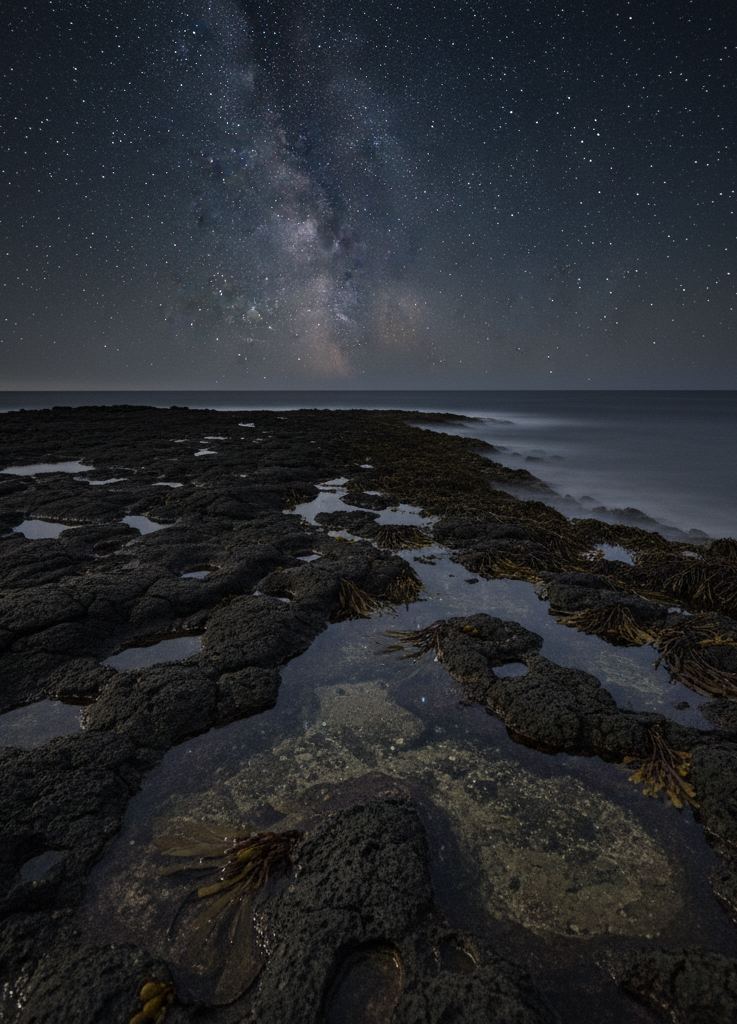
The furthest is at Cockle Creek, 43 degrees 33 minutes south, the last point in Australia a car can reach. It is two hours and twenty minutes from Hobart with the final 19 kilometers on gravel, so it gets used on the nights when the forecast pays for the drive and left alone on the nights when it does not. One night of the eight normally involves a vehicle crossing to Bruny Island for the Cloudy Bay horizon. That crossing is carried by the company operating the trip, under its own licence, and it appears on that company's invoice rather than anywhere on this page.
A practical detail that catches people out: most kitchens outside Hobart stop serving at 20:00 in winter, and some stop at 19:30. That is why the meal on watch nights is cooked where you are sleeping, and why the daytime drives are timed to return before dark rather than at the end of the afternoon.
Holding eight nights in your month
Name the month you have in mind and the office costs it on paper against that year's moon calendar. Allow two to four working days for the figure, because neither the farmhouse nor the driver confirms an eight night hold in an afternoon, and a number that has not been confirmed by both of them is not worth sending you.
Nothing described here belongs to this agency. The farmhouse, the vehicle, the tripods and the person making the 21:30 call are all somebody else's, and the reservation is lodged with the company that owns them. Their invoice goes to you directly, and no part of it passes through Roving Hours in either direction.
The long haul is yours to arrange, since no air travel is sold or ticketed here. Most travelers come into Hobart with one change inside Australia and take an extra night at the front end, which is worth doing in this window: an arrival delayed by a day can cost you one of the three or four clear nights the stay was built around.
Roving Hours Bookings LLC keeps an office at 1350 N. Orange Avenue, Suite 221, Orlando, FL 32789, in Orange County, Florida, and the agents here place reservations and do nothing else. Send your month and the number of people to bookings@rovinghours.com, call +1 (407) 629-3157 if you would rather say it out loud, and use corrections@rovinghours.com if something on a reservation already made needs correcting. Written requests are answered within one working day.
Start with the weeks, not the country
This form takes requests every hour of every day, and a person answers within one business day. Nothing here commits you. No figure is charged at this end.